
English spelling can be confusing, especially when two words look almost identical. One common example is shakey versus shaky. Many people see both spellings online and wonder whether they mean different things or if one of them is simply incorrect.
The good news is that the answer is straightforward. Understanding the difference between shakey and shaky can help you write more accurately, avoid common spelling mistakes, and communicate more professionally in both casual and formal situations.
Shakey or Shaky The Straight Answer
The correct standard English spelling is shaky.
While shakey occasionally appears online, in personal writing, or as part of business and product names, dictionaries and style guides generally recognize shaky as the accepted spelling.
| Word | Standard English? | Typical Usage |
| Shaky | Yes | General writing and speech |
| Shakey | Usually No | Names, brands, or informal variations |
If you’re writing for school, work, publishing, or professional communication, use shaky.
What Does Shaky Mean?
The adjective shaky describes something that is unstable, trembling, uncertain, weak, or unreliable.
Depending on the context, shaky can refer to:
- Physical movement
- Emotional states
- Financial situations
- Logical arguments
- Relationships
- Performance quality
Examples:
- My hands felt shaky after the workout.
- The company faces shaky economic conditions.
- His explanation sounded shaky.
The exact meaning depends on the situation.
The Adjective Meaning of Shaky in Different Contexts
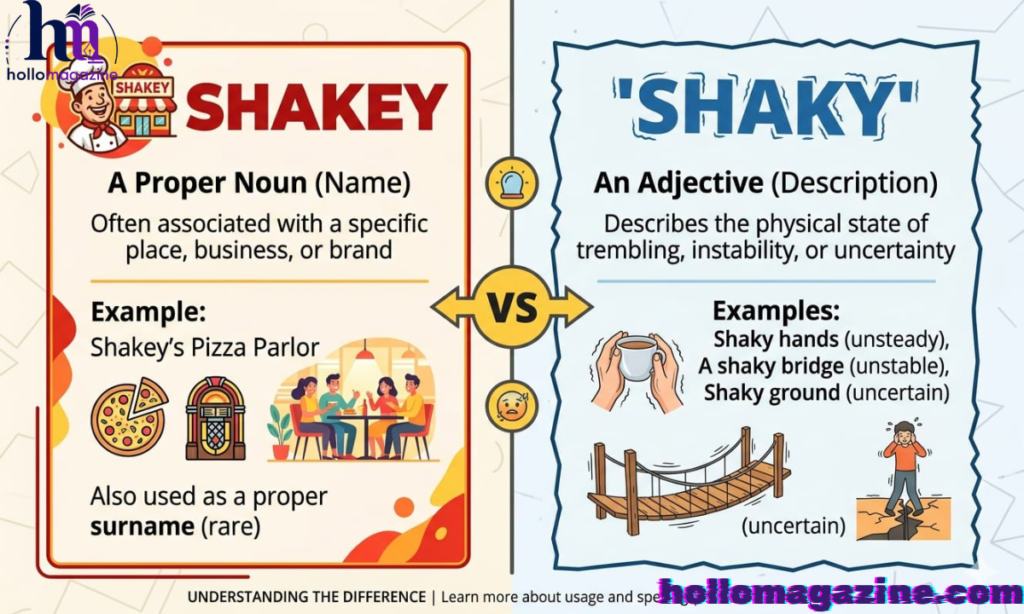
Physical Instability
The most literal meaning of shaky relates to physical movement or lack of stability.
Examples:
- The table feels shaky.
- Her legs were shaky after running.
- The ladder looked shaky.
Common related words include:
- Wobbly
- Unsteady
- Trembling
- Unstable
Emotional or Nervous States
Shaky can also describe emotions, especially nervousness or anxiety.
Examples:
- She gave a shaky speech.
- His voice sounded shaky during the interview.
- I felt shaky before the exam.
In these cases, the word suggests uncertainty or stress.
Financial and Economic Contexts
Business writers frequently use shaky to describe unstable financial situations.
Examples:
- The market remains shaky.
- Investors worry about shaky growth forecasts.
- The economy entered a shaky period.
This meaning is common in financial reporting and economic analysis.
Logical or Intellectual Weakness
Shaky can also describe ideas, arguments, or reasoning that lack strong support.
Examples:
- The evidence was shaky.
- Their conclusion rests on shaky assumptions.
- The theory has a shaky foundation.
Here, the word implies weakness or unreliability.
Why People Get Confused About Shakey vs Shaky
Several factors contribute to the confusion.
Common reasons include:
- Similar pronunciation
- Informal internet spelling
- Brand names using Shakey
- Typographical mistakes
- Lack of familiarity with spelling patterns
Since both versions sound identical when spoken, many writers assume either spelling works.
However, standard English favors shaky.
Read This: Realist vs Realest How Are These Different? When To Use
Shake Plus Y The Real Spelling Rule
The spelling of shaky follows a common English pattern.
The base word is:
Shake
When adding the adjective-forming suffix -y, the final silent e is dropped.
Examples:
| Base Word | Adjective Form |
| Shake | Shaky |
| Ice | Icy |
| Spice | Spicy |
| Shine | Shiny |
This rule explains why shaky—not shakey—is considered correct.
Is Shakey Correct English?
In most situations, no.
Major dictionaries and grammar references recognize shaky as the standard spelling.
However, shakey may appear in:
- Brand names
- Usernames
- Nicknames
- Creative writing
- Personal preferences
Examples:
- A restaurant named Shakey’s
- A social media username
- A character nickname
These special cases do not change the standard spelling.
Shaky in Formal Writing
Professional writing generally requires the accepted dictionary spelling.
Examples:
✔ The company faces shaky market conditions.
✔ The witness gave a shaky account.
✔ The proposal rests on shaky assumptions.
Avoid using shakey in:
- Academic papers
- Business reports
- Professional emails
- Journalism
- Published content
Consistency improves credibility.
Everyday Examples of Shaky

Here are common everyday uses:
- My hands felt shaky after drinking too much coffee.
- The bridge looked shaky during the storm.
- Her confidence seemed shaky before the presentation.
- The startup’s finances remain shaky.
- Their relationship is on shaky ground.
Notice how the word works in both literal and figurative situations.
Shaky Hands After Exercise A Practical Example
Imagine someone completing an intense workout.
They might say:
“My arms feel shaky.”
This happens because muscles experience fatigue after heavy exertion.
Possible causes include:
- Muscle exhaustion
- Adrenaline release
- Dehydration
- Low blood sugar
- Physical stress
In this context, shaky refers to physical trembling.
Shaky Market Conditions A Business Case
Business publications frequently use shaky to describe uncertainty.
Example scenario:
A company experiences:
- Falling sales
- Rising costs
- Economic uncertainty
An analyst might write:
“The company operates in a shaky market environment.”
The word highlights instability without implying complete failure.
Shaky Ground The Metaphor
One of the most common figurative expressions is shaky ground.
Meaning:
- Weak position
- Uncertain situation
- Lack of strong support
Examples:
- Their argument stands on shaky ground.
- The negotiations remain on shaky ground.
- The evidence leaves the case on shaky ground.
The metaphor compares uncertainty to standing on unstable terrain.
Common Mistakes with Shaky Spelling
Writing Shakey in Formal Content
One of the most common errors is using shakey in professional writing.
Incorrect:
❌ The report contains shakey conclusions.
Correct:
✔ The report contains shaky conclusions.
Mixing Spellings
Some writers alternate between the two forms.
Example:
❌ The market is shaky. Investors remain shakey.
Consistency matters.
Always use shaky in standard writing.
Avoiding the Word Entirely
Some writers avoid shaky because they are unsure of the spelling.
Instead, confidently use the correct form whenever appropriate.
The word is clear, useful, and widely understood.
Shakey in Brand Names
Although shaky is the standard spelling, shakey sometimes appears in names and branding.
Examples may include:
- Restaurants
- Nicknames
- Online accounts
- Entertainment titles
Businesses occasionally choose alternative spellings because they:
- Stand out visually
- Create memorable branding
- Establish a unique identity
Brand usage does not determine dictionary correctness.
Quick Comparison Shakey vs Shaky
| Feature | Shaky | Shakey |
| Dictionary Approved | Yes | Usually No |
| Formal Writing | Recommended | Not Recommended |
| Academic Use | Yes | No |
| Business Writing | Yes | No |
| Brand Names | Sometimes | Sometimes |
| Reader Expectations | High | Lower |
Synonyms That Share the Meaning
Depending on context, alternatives include:
Physical Context
- Unsteady
- Trembling
- Wobbly
- Unstable
Emotional Context
- Nervous
- Uneasy
- Anxious
- Uncertain
Business Context
- Fragile
- Unpredictable
- Weak
- Volatile
Logical Context
- Flawed
- Weak
- Questionable
- Unsupported
These alternatives can add variety to your writing.
How to Remember the Correct Spelling of Shaky

A simple memory trick can help.
Think about these words:
- Spice → Spicy
- Shine → Shiny
- Ice → Icy
- Shake → Shaky
The final silent e disappears before adding y.
Easy Rule
Shake + y = Shaky
Not shakey.
This rule works in nearly every situation.
Reference Cambridge Dictionary Definitions
Cambridge Dictionary defines shaky as not firm, strong, or steady. The word can describe physical instability, uncertain situations, weak arguments, nervous behavior, or unreliable conditions.
The dictionary-recognized spelling is shaky, making it the preferred form for standard English communication, professional writing, and academic use.
Conclusion
The distinction between shakey and shaky is simpler than many people expect. Shaky is the accepted standard spelling found in dictionaries, style guides, professional writing, and everyday English. It can describe physical instability, emotional nervousness, financial uncertainty, or weak reasoning.
Although shakey occasionally appears in brand names, nicknames, and informal contexts, it is generally not considered the standard spelling. When accuracy matters, choosing shaky will ensure your writing looks polished, professional, and grammatically correct.
Frequently Asked Questions
Is shaky or shakey correct?
Shaky is the standard and dictionary-approved spelling.
What does shaky mean?
Shaky means unstable, trembling, uncertain, weak, or unreliable.
Is shakey a real word?
Shakey occasionally appears in names and informal usage, but shaky is the standard spelling.
Why is shaky spelled without an e?
English spelling rules typically drop the silent e before adding the suffix y.
Can shaky describe emotions?
Yes. It often describes nervousness, anxiety, or lack of confidence.
What does shaky ground mean?
It refers to an uncertain or weak position.
Is shaky formal English?
Yes. It is appropriate for formal and professional writing.
What is a synonym for shaky?
Depending on context, synonyms include unstable, unsteady, nervous, fragile, and uncertain.

Rimsha creates simple grammar guides, English writing tips, and word meaning content for readers at Hollo Magazine.