
English learners often struggle with become and became because both words come from the same verb but are used in different tenses. The confusion grows when forms like becomes, has become, and have become enter the picture. A single wrong choice can make an otherwise correct sentence sound unnatural.
The good news is that the difference is based on a simple timeline rule. Once you understand where each verb form belongs, you’ll be able to use them confidently in conversations, academic writing, business communication, and exams.
Understanding the Basics of Become vs Became
The verb become means:
- To start being something
- To change into a different state
- To develop into something over time
Examples:
- She became a doctor.
- He has become more confident.
- They want to become entrepreneurs.
The key difference lies in tense.
| Verb Form | Function |
| Become | Base form |
| Becomes | Simple present |
| Became | Simple past |
| Become | Past participle |
| Has become | Present perfect |
| Have become | Present perfect |
Understanding these forms is essential for correct grammar.
The Base Form “Become”: What It Really Means
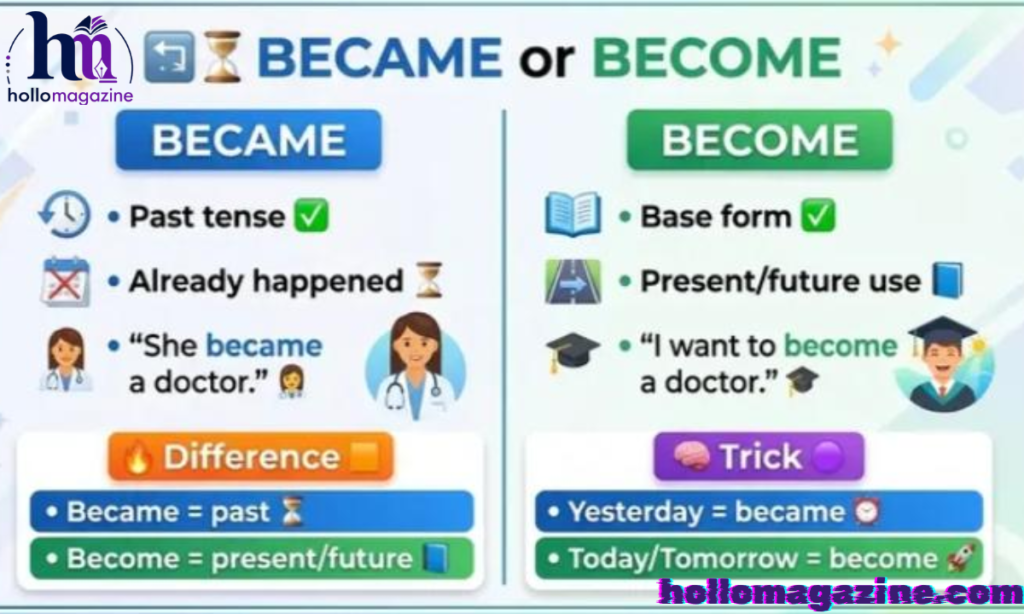
The word become is the base form of the verb.
It appears after:
- To
- Modal verbs
- Future constructions
- Certain auxiliary verbs
When to Use “Become”
Use become when:
- Writing infinitives
- Using modal verbs
- Talking about future possibilities
- Forming perfect tenses
Common structures:
- To become
- Will become
- Can become
- May become
- Should become
Examples of “Become” in Present Tense
Examples:
- I want to become a teacher.
- They hope to become successful.
- You can become anything you choose.
- We may become partners.
- She will become the team leader.
Notice that the base form remains unchanged after these helping verbs.
Quick Tip
If the word follows to, can, will, may, should, or another modal verb, use become, not became.
The Simple Past Form “Became”: Understanding Its Purpose
Became is the simple past tense of become.
It describes a completed change that happened in the past.
When to Use “Became”
Use became when:
- The action happened before now.
- The time period is finished.
- You’re describing a completed transformation.
Signal words often include:
- Yesterday
- Last year
- In 2020
- Suddenly
- Eventually
Correct Examples of “Became”
Examples:
- She became a nurse in 2018.
- The weather became colder overnight.
- He became famous after the movie.
- The company became profitable last year.
- They became close friends during college.
In every example, the change already happened.
Pro Tip
If you can add a finished past time reference, became is often the correct choice.
Become vs Becomes: The Simple Present Tense Difference
Many learners confuse become and becomes.
The rule is straightforward:
| Subject | Correct Form |
| I | Become |
| You | Become |
| We | Become |
| They | Become |
| He | Becomes |
| She | Becomes |
| It | Becomes |
Examples:
- I become nervous before presentations.
- They become excited before vacations.
- He becomes impatient when waiting.
- She becomes motivated by challenges.
- It becomes difficult after sunset.
Remember the simple present rule:
Third-person singular subjects require “becomes.”
Read This: “More Friendly” vs “Friendlier”: The Complete Guide to Choosing the Right Form
Present Perfect Tense: “Has Become” and “Have Become”
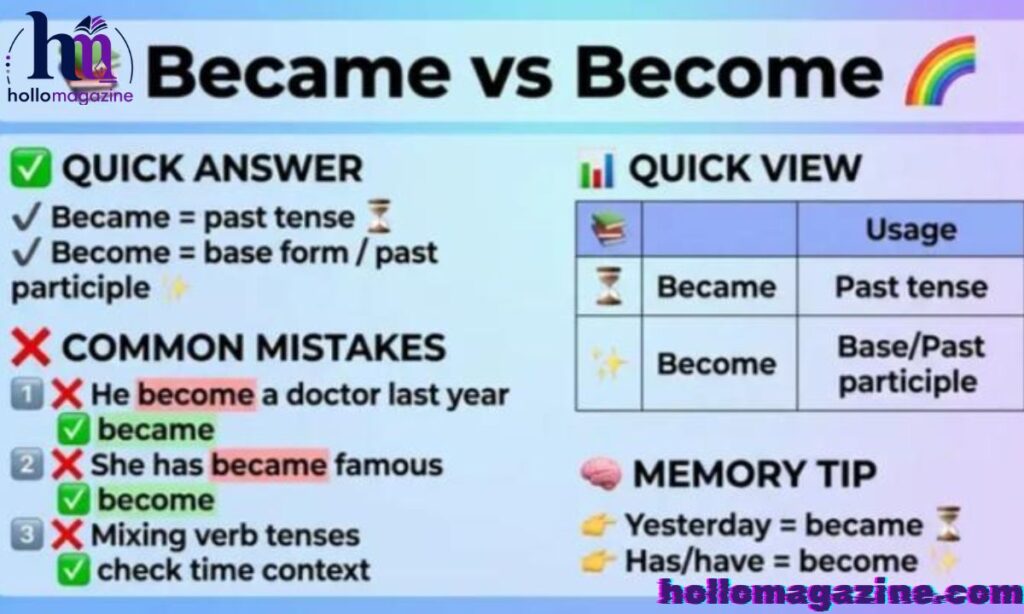
Present perfect describes a change connected to the present.
Has Become
Use has become with singular subjects.
Subjects include:
- He
- She
- It
- Someone
- Everyone
Examples:
- She has become a skilled manager.
- He has become more confident.
- The company has become successful.
- It has become increasingly popular.
Have Become
Use have become with plural subjects and certain pronouns.
Subjects include:
- I
- You
- We
- They
Examples:
- We have become better communicators.
- They have become industry leaders.
- You have become more patient.
- I have become more disciplined.
Why “Has Became” Is Always Incorrect
One of the most common grammar mistakes is:
❌ Has became
This is incorrect because has requires a past participle.
Correct:
- Has become ✅
- Have become ✅
Incorrect:
- Has became ❌
- Have became ❌
Remember:
| Auxiliary | Correct Form |
| Has | Become |
| Have | Become |
| Had | Become |
Never pair has, have, or had with became.
The Subtleties of “Would Become”
Would become describes:
- Future situations viewed from the past
- Hypothetical outcomes
- Conditional situations
Examples
- She knew she would become successful.
- Without practice, he would become rusty.
- They believed the project would become profitable.
- The city would become a major tourist destination.
- I never imagined I would become a writer.
Because would is a modal verb, the base form become is required.
Comparison Table: Become vs Became vs Becomes vs Has Become vs Have Become
| Form | Tense | Example |
| Become | Base form | I want to become a doctor. |
| Becomes | Present simple | She becomes nervous easily. |
| Became | Past simple | He became famous last year. |
| Has become | Present perfect | She has become more confident. |
| Have become | Present perfect | They have become experts. |
This table summarizes the most important distinctions.
Memory Tricks to Never Confuse Become vs Became Again
1. The Timeline Trick
Think of a timeline:
- Future/Possibility → Become
- Past Event → Became
- Present Result → Has become / Have become
2. The “S” Rule
If the subject is:
- He
- She
- It
Use:
- Becomes
Example:
- She becomes motivated.
3. The “Has Became” Red Flag
Whenever you see:
- Has became
- Have became
- Had became
Assume it’s wrong.
Replace became with become.
4. The Sound Test
Read the sentence aloud.
Incorrect:
- She has became successful.
Correct:
- She has become successful.
Most native speakers immediately hear the difference.
5. The Color Change Analogy
Imagine a wall changing color.
Present possibility:
- The wall may become blue.
Past change:
- The wall became blue.
Present result:
- The wall has become blue.
This visual example helps many learners remember the tense differences.
Mini Case Study: How Grammar Changes Meaning
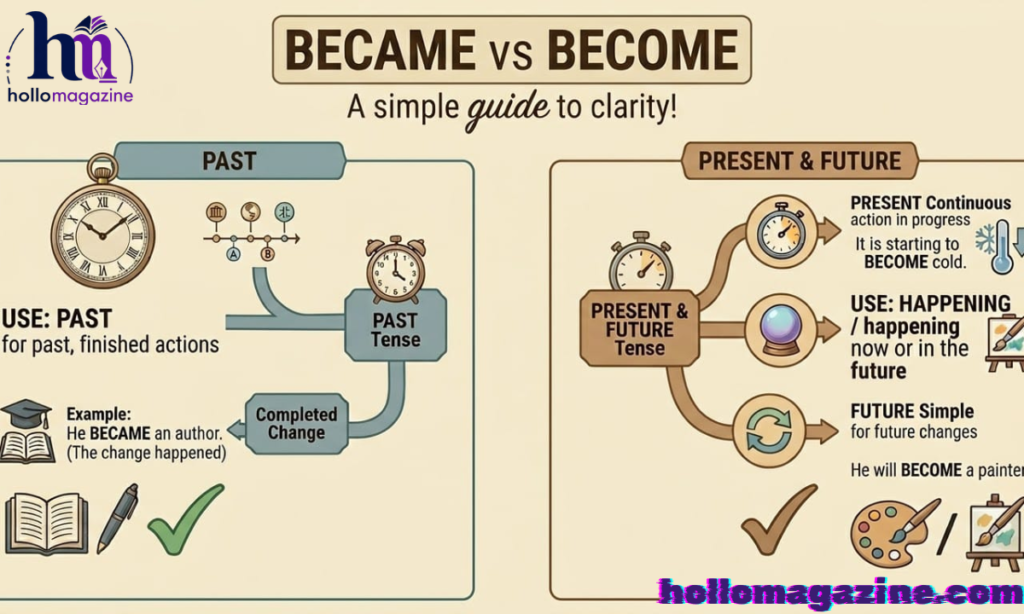
Small verb changes can completely alter meaning.
Case Study 1: Career Transformation
Present goal:
- She wants to become a lawyer.
Completed past event:
- She became a lawyer in 2022.
Current result:
- She has become a respected lawyer.
Each sentence represents a different stage of the same journey.
Case Study 2: Habits
Present tendency:
- He becomes distracted easily.
Past event:
- He became distracted during class.
Current condition:
- He has become more focused recently.
The tense changes the time perspective.
Case Study 3: Long-Term Change
Future possibility:
- The town may become a technology hub.
Past transformation:
- The town became a technology hub.
Present outcome:
- The town has become a technology hub.
Grammar determines whether the change is expected, completed, or currently relevant.
Expert Insights
Language experts consistently emphasize that verb forms must match their grammatical context.
A reliable rule is:
- Base form after modals → become
- Simple past events → became
- Present perfect → has become / have become
- Third-person present → becomes
Mastering these patterns improves clarity, professionalism, and accuracy in both spoken and written English.
Conclusion
The difference between become and became is primarily about time. Become is the base form used with infinitives, modal verbs, and perfect tenses, while became is reserved for completed actions in the simple past.
By remembering a few key rules—especially avoiding has became and recognizing when to use becomes, has become, and have become—you can eliminate one of the most common English grammar mistakes and communicate with greater confidence.
Frequently Asked Questions
Is “became” the past tense of become?
Yes. Became is the simple past tense form of the verb become.
Which is correct: has become or has became?
Has become is correct because present perfect requires the past participle.
Can I say “have became”?
No. The correct form is have become.
When should I use becomes?
Use becomes with third-person singular subjects such as he, she, and it.
What is the past participle of become?
The past participle is become.
Is “would become” correct?
Yes. Modal verbs like would are followed by the base form become.

Rimsha creates simple grammar guides, English writing tips, and word meaning content for readers at Hollo Magazine.