
The phrase “day well spent” is widely used in English to describe a satisfying, productive, enjoyable, or meaningful day. You’ll often see it in social media captions, personal reflections, travel posts, motivational quotes, and everyday conversations. Despite its popularity, many people wonder whether the phrase is grammatically correct or if a different version such as “a day well spent” should be used instead.
Understanding how and when to use this expression can help you communicate more naturally in both spoken and written English. In this guide, we’ll explore the meaning of “day well spent,” examine its grammar, compare common variations, provide real-life examples, and share useful alternatives you can use in different situations.
What Does “Day Well Spent” Actually Mean?
The phrase “day well spent” refers to a day that was used in a meaningful, productive, enjoyable, or worthwhile way.
When someone says a day was well spent, they usually mean that their time was used effectively and left them feeling satisfied, fulfilled, or happy.
Simple Definition
Day well spent = a day used wisely or enjoyed fully.
Examples:
- Spending quality time with family.
- Completing important goals.
- Traveling to a new place.
- Learning a new skill.
- Helping others.
- Enjoying a memorable experience.
Common Contexts
People often use the phrase when talking about:
- Personal achievements
- Family gatherings
- Vacations and travel
- Productive workdays
- Volunteer activities
- Relaxing weekends
- Educational experiences
Example:
“After hiking through the mountains and watching the sunset, it truly felt like a day well spent.”
The phrase carries a positive emotional tone and often expresses gratitude or satisfaction.
Is It Correct to Say “Day Well Spent”? (Grammar Explained)
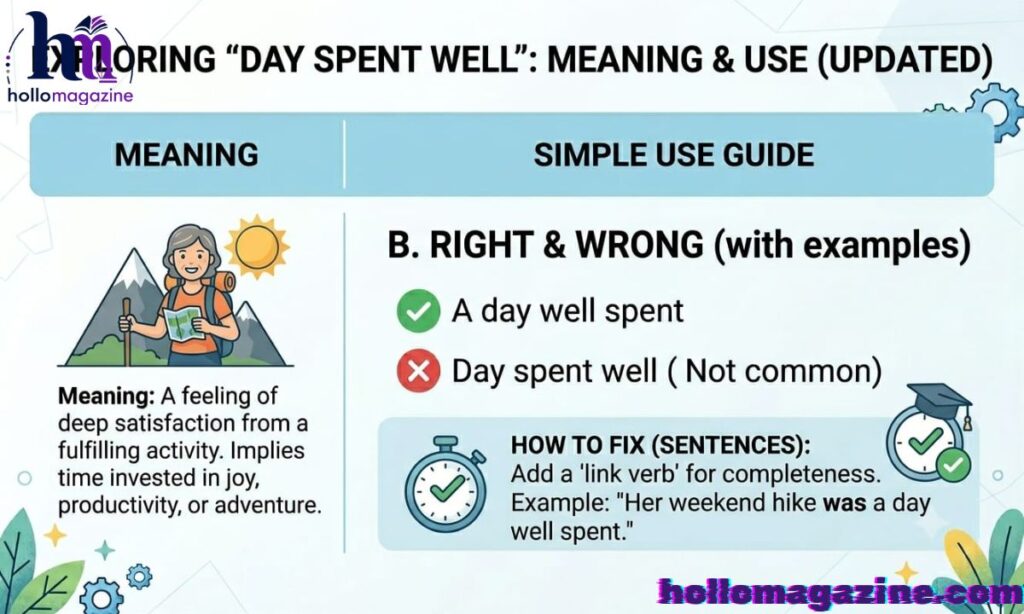
Yes, “day well spent” is grammatically correct in certain contexts.
The expression is a shortened form of the phrase:
“A day that was well spent.”
English frequently omits words when the meaning remains clear. This creates a concise expression that sounds natural and idiomatic.
Why It Works Grammatically
In the phrase:
Day well spent
- Day = noun
- Well = adverb
- Spent = past participle adjective
Together, they describe a day that was used effectively or meaningfully.
Examples:
- What a day well spent!
- Looking back, it was a day well spent.
- Another day well spent with friends.
Although grammatically acceptable, the phrase often sounds more natural when used with an article.
More Natural Version
Many grammar experts and native speakers prefer:
A day well spent
because it functions as a complete noun phrase.
Example:
- It was a day well spent.
This version is generally considered the safest choice in formal writing.
Day Well Spent vs A Day Well Spent
Many English learners wonder whether they should write “day well spent” or “a day well spent.”
Both are correct, but they are used differently.
| Phrase | Usage | Example |
| Day well spent | Informal expression, captions, titles | Day well spent at the beach |
| A day well spent | Complete grammatical phrase | It was a day well spent |
| The day was well spent | Full sentence | The day was well spent helping others |
When to Use “Day Well Spent”
Common in:
- Instagram captions
- Social media posts
- Photo descriptions
- Headlines
- Informal writing
Examples:
- Day well spent with family.
- Day well spent exploring nature.
- Day well spent making memories.
When to Use “A Day Well Spent”
Better for:
- Formal writing
- Essays
- Professional communication
- Complete sentences
Examples:
- It was a day well spent learning new skills.
- The conference was a day well spent for all attendees.
Quick Comparison
| Situation | Best Choice |
| Social media caption | Day well spent |
| Blog post | A day well spent |
| Essay | A day well spent |
| Professional writing | A day well spent |
| Personal reflection | Either works |
When and Where to Use “Day Well Spent” Correctly
The phrase is versatile and can fit many everyday situations.
1. After Completing a Goal
When you accomplish something important, the phrase emphasizes satisfaction.
Examples:
- Finishing a major project made it a day well spent.
- Completing all my tasks felt like a day well spent.
2. During Travel Experiences
Travelers often use this phrase after enjoyable adventures.
Examples:
- Day well spent exploring historical landmarks.
- Day well spent discovering hidden beaches.
3. Spending Time with Loved Ones
Family and friendships are common themes associated with this expression.
Examples:
- Day well spent with grandparents.
- Day well spent catching up with old friends.
4. Learning Something New
Educational activities often create a sense of accomplishment.
Examples:
- Day well spent attending a photography workshop.
- Day well spent improving language skills.
5. Relaxation and Self-Care
A productive day doesn’t always mean hard work.
Examples:
- Day well spent reading a good book.
- Day well spent relaxing by the lake.
Best Situations for Using the Phrase
- Family gatherings
- Road trips
- Vacations
- Study sessions
- Volunteer work
- Fitness activities
- Creative projects
- Personal growth experiences
Read This: Become vs Became: The Ultimate Guide to Using These Verb Forms Correctly
Day Well Spent Sentence Examples (Real-Life Usage)
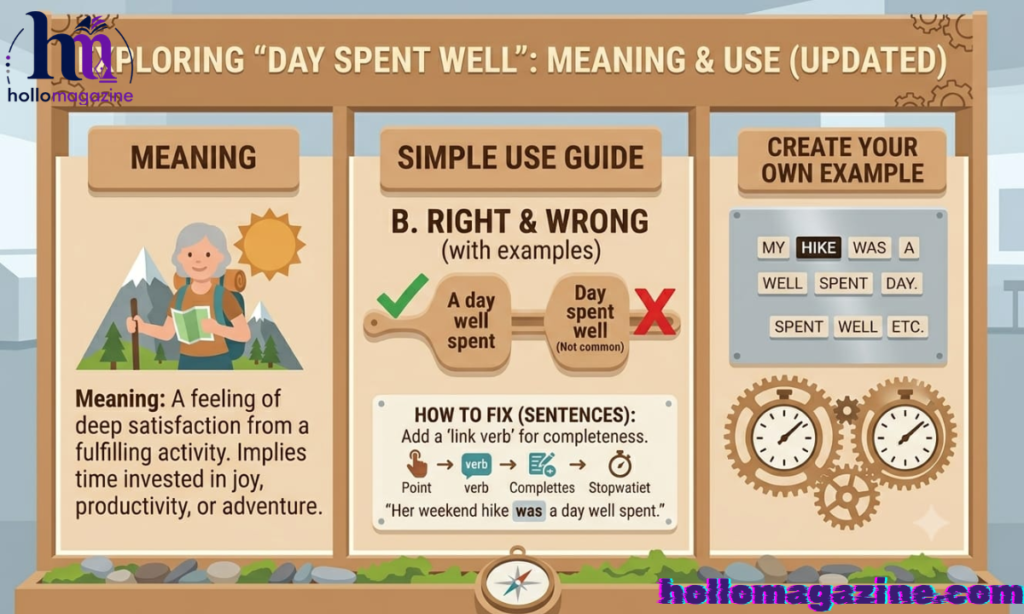
Below are examples showing how native speakers commonly use the phrase.
Everyday Conversations
- Today was a day well spent.
- It felt like a day well spent from start to finish.
- That was definitely a day well spent.
Family and Friends
- A day well spent with loved ones is always memorable.
- Day well spent celebrating with friends.
- It was a day well spent making family memories.
Travel and Adventure
- Day well spent exploring the countryside.
- We enjoyed a day well spent visiting local attractions.
- A day well spent outdoors is never wasted.
Work and Productivity
- Finishing the presentation made it a day well spent.
- It was a day well spent improving my skills.
- Every productive day becomes a day well spent.
Social Media Captions
- Day well spent. 😊
- Sunshine, laughter, and a day well spent.
- Memories made, lessons learned, day well spent.
- Another beautiful day well spent.
Synonyms and Alternatives for “Day Well Spent”
Using alternatives can make your writing more varied and engaging.
Common Alternatives
- Productive day
- Meaningful day
- Rewarding day
- Fulfilling day
- Memorable day
- Enjoyable day
- Worthwhile day
- Successful day
- Valuable day
- Satisfying day
Example Comparison
| Original Phrase | Alternative |
| Day well spent with family | Memorable day with family |
| Day well spent learning | Productive day learning |
| Day well spent traveling | Rewarding day traveling |
| Day well spent helping others | Meaningful day helping others |
More Expressive Alternatives
- Time well spent
- Every moment was worth it
- A rewarding experience
- A meaningful way to spend the day
- An unforgettable day
- A productive use of time
- A fulfilling experience
Best Alternative by Context
| Context | Alternative |
| Work | Productive day |
| Education | Valuable day |
| Travel | Memorable day |
| Family | Meaningful day |
| Personal growth | Fulfilling day |
| Volunteer work | Rewarding day |
Using these alternatives helps avoid repetition while preserving the same positive message.
Conclusion
The phrase “day well spent” is a widely accepted English expression used to describe a day that was meaningful, productive, enjoyable, or rewarding. Although it often appears in captions and informal writing, it remains a natural and effective way to express satisfaction with how time was used.
For more formal situations, “a day well spent” is generally the preferred option because it forms a complete grammatical phrase. Whether you’re reflecting on a successful project, a family gathering, a travel adventure, or a relaxing weekend, this expression remains a simple yet powerful way to celebrate a worthwhile day.
Frequently Asked Questions
Is “day well spent” grammatically correct?
Yes, it is grammatically correct and commonly used in informal English, especially in captions and personal reflections.
Which is better: “day well spent” or “a day well spent”?
“A day well spent” is generally better in complete sentences, while “day well spent” is popular in captions and informal contexts.
What does “day well spent” mean?
It means a day that was used productively, meaningfully, or enjoyably.
Can I use “day well spent” on social media?
Yes, it is one of the most common phrases used in social media captions.
Is “day well spent” formal English?
It is more informal. In formal writing, “a day well spent” is usually preferred.
What is another way to say “day well spent”?
You can say productive day, rewarding day, fulfilling day, worthwhile day, or meaningful day.
Is “time well spent” the same as “day well spent”?
They are similar, but “time well spent” is broader and can refer to any period of time, not just one day.

Rimsha creates simple grammar guides, English writing tips, and word meaning content for readers at Hollo Magazine.