
When scheduling meetings, booking appointments, planning events, or managing calendars, you’ve probably seen both time slot and timeslot used online. This often leads to a common question: Which spelling is correct? Are they interchangeable, or does one form have a grammatical advantage over the other?
The short answer is that time slot is the standard and widely accepted spelling in modern English, while timeslot appears as a less common closed compound form in certain industries, software platforms, and informal writing. Understanding when and where each form is used can help you write more professionally and avoid confusion.
Quick Reference Guide
| Term | Status | Common Usage |
| Time Slot | Standard English | Formal writing, business communication, scheduling |
| Timeslot | Alternative Variant | Software, technical systems, informal usage |
| Recommended Form | Time Slot | Most style guides and dictionaries prefer it |
What’s the Difference Between Time Slot and Timeslot?
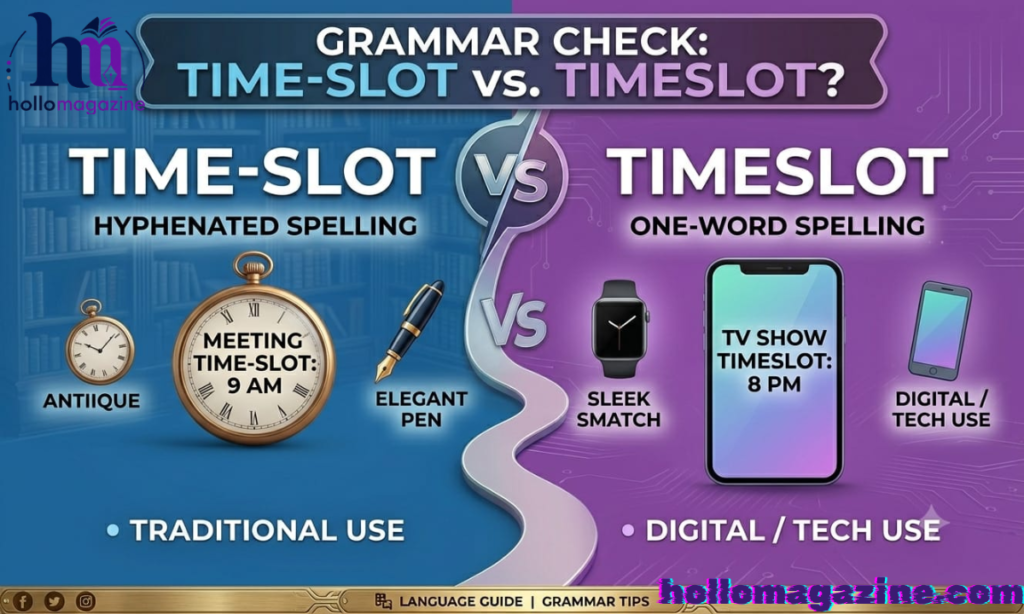
The difference between time slot and timeslot is mainly a matter of spelling rather than meaning.
Both terms refer to:
- A specific period of time allocated for an activity
- A scheduled appointment window
- A reserved section of a timetable
- A designated interval for meetings, events, or broadcasts
For example:
- Please select a time slot for your appointment.
- The software automatically assigns a timeslot for each booking.
Although both examples communicate the same idea, the two-word version remains the preferred choice in most professional contexts.
Quick Comparison
| Feature | Time Slot | Timeslot |
| Meaning | Specific scheduled period | Same meaning |
| Dictionary Preference | More common | Less common |
| Business Writing | Preferred | Occasionally used |
| Academic Writing | Preferred | Rare |
| Scheduling Systems | Common | Common |
| SEO and Readability | Stronger | Less common |
The Standard Two-Word Form
The term time slot is considered the standard spelling in contemporary English.
Most style guides, business publications, educational resources, and scheduling platforms use the two-word version because it follows traditional English compound noun rules.
Why Time Slot Is Preferred
Several factors explain why the two-word form dominates:
- Greater readability
- Widely recognized by readers
- Common in professional documents
- Frequently used in calendars and booking systems
- Preferred in business communication
Examples of Correct Usage
- Choose a time slot that works best for you.
- Each speaker has a dedicated time slot.
- The interview time slots filled quickly.
- Students can reserve a time slot online.
Common Industries Using Time Slot
The phrase appears regularly in:
- Healthcare scheduling
- Online booking systems
- Education
- Broadcasting
- Event management
- Customer support scheduling
- Transportation services
Because the phrase is universally understood, it remains the safest choice for formal writing.
When One Word Appears
Despite the popularity of the two-word version, timeslot does appear in certain contexts.
As language evolves, many compound nouns gradually move from two words to one word. Examples include:
- Web site → Website
- Data base → Database
- Note book → Notebook
Some organizations and software developers have adopted timeslot as a closed compound noun, particularly in technical documentation and digital scheduling tools.
Why Timeslot Exists
The one-word spelling often appears because:
- Software interfaces favor shorter labels.
- Technical systems simplify terminology.
- Internal company style guides may adopt it.
- Industry-specific usage evolves over time.
Examples of Timeslot Usage
- The application automatically creates a timeslot.
- Users may edit their assigned timeslot.
- Each timeslot supports one reservation.
These examples are understandable, but many editors would still revise them to the two-word version in formal publications.
Should You Use Timeslot?
For most writers, the answer is simple:
✅ Use time slot in articles, business writing, emails, reports, and academic content.
⚠️ Use timeslot only if a company, software platform, or style guide specifically requires it.
Read This: Propose vs Purpose – Which Is Correct? 2026
How to Use Time Slot Correctly in Different Contexts
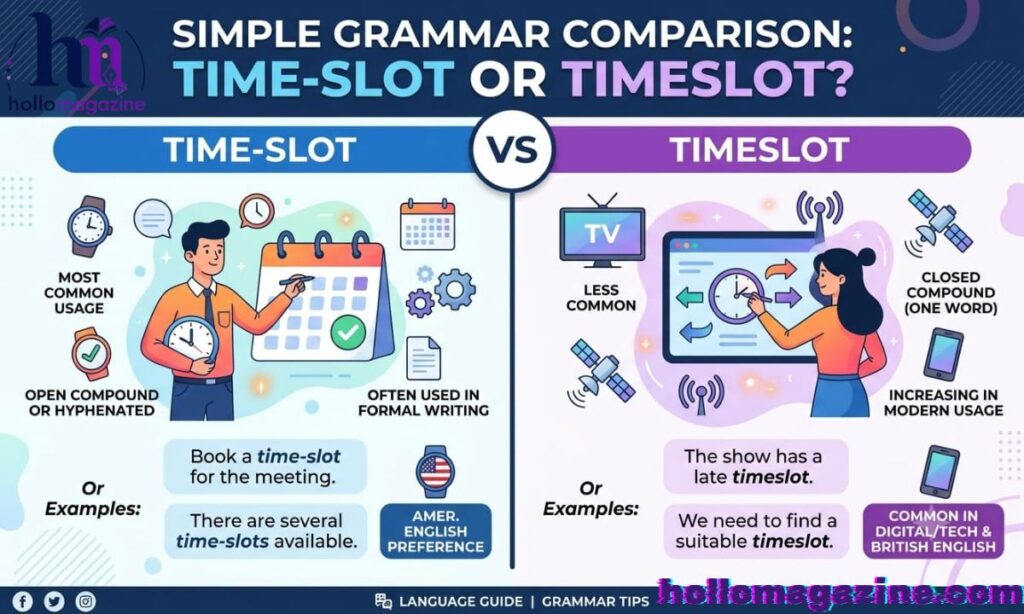
Using time slot correctly depends on the situation. Fortunately, the phrase works similarly across many industries.
Time Slot Usage Across Contexts
| Context | Example |
| Business Meetings | Reserve a time slot for the presentation. |
| Healthcare | Patients can choose a preferred time slot. |
| Education | Students book a time slot for advising sessions. |
| Broadcasting | The program occupies a prime time slot. |
| Events | Each speaker receives a 20-minute time slot. |
| Customer Service | Select a delivery time slot online. |
| Transportation | Travelers can book a departure time slot. |
Business Context
In professional communication, a time slot typically refers to a scheduled period allocated for meetings or presentations.
Examples:
- We have an available time slot on Tuesday morning.
- Please confirm your preferred time slot.
Healthcare Context
Hospitals and clinics frequently use the phrase when managing appointments.
Examples:
- The earliest available time slot is at 10:00 AM.
- Patients may reschedule their time slot online.
Broadcasting Context
Television and radio networks use the term for scheduled programming periods.
Examples:
- The show received a prime evening time slot.
- The network moved the program to a later time slot.
Event Planning Context
Conference organizers often divide schedules into specific time slots.
Examples:
- Each workshop has its own time slot.
- Participants can register for multiple time slots.
Tips for Correct Usage
- Use “time slot” as two words in formal writing.
- Keep the spelling consistent throughout a document.
- Match your terminology to your audience.
- Follow organizational style guidelines when necessary.
Time Slot Synonyms and Related Term
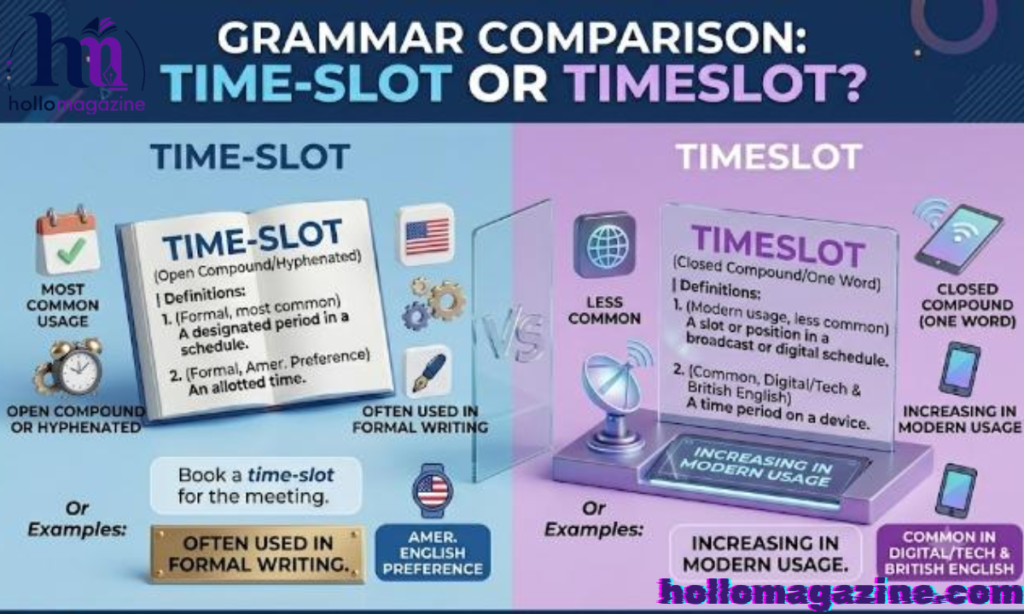
Depending on the context, several alternatives can replace time slot.
Common Synonyms
- Appointment
- Schedule window
- Booking period
- Session
- Time period
- Allocation
- Scheduled interval
- Reservation window
- Meeting period
- Availability window
Related Terms
| Term | Meaning |
| Appointment | Scheduled meeting time |
| Schedule | Organized timetable |
| Calendar Slot | Open calendar availability |
| Booking Window | Time available for reservations |
| Session | Designated activity period |
| Time Frame | General period of time |
| Availability | Open scheduling opportunity |
Choosing the Right Alternative
The best synonym depends on context:
- Healthcare → Appointment
- Meetings → Schedule window
- Events → Session
- Reservations → Booking window
- Broadcasting → Programming slot
Using the most precise term improves clarity and professionalism.
Conclusion
The debate between time slot and timeslot is largely a spelling issue rather than a difference in meaning. Both forms refer to a designated period reserved for a particular activity, appointment, meeting, or event. However, time slot remains the standard and most widely accepted version in modern English.
For business communication, academic writing, professional content, and SEO-focused articles, the two-word form is usually the best choice. While timeslot may appear in software systems and industry-specific documentation, using time slot ensures clarity, consistency, and broader reader acceptance.
Frequently Asked Questions
Is time slot or timeslot correct?
Both exist, but time slot is the standard and more widely accepted spelling.
Why do some websites use timeslot?
Some software platforms and technical industries prefer the closed compound form for simplicity and branding purposes.
Is timeslot one word in dictionaries?
Some dictionaries recognize it as a variant, but time slot remains the more common form.
Which spelling should I use in professional writing?
Use time slot because it is the preferred form in business and formal communication.
Do time slot and timeslot mean the same thing?
Yes, both refer to a specific scheduled period reserved for an activity or appointment.
Can I use time slot in academic writing?
Yes. The two-word version is generally preferred in academic and professional contexts.
What is another word for time slot?
Depending on context, alternatives include appointment, session, booking window, scheduled interval, or availability window.

Rimsha creates simple grammar guides, English writing tips, and word meaning content for readers at Hollo Magazine.