
In business writing, internal communications, HR documents, and corporate announcements, you’ll often encounter both company-wide and companywide. While they appear nearly identical, many writers wonder whether the hyphen is necessary or if the closed compound form is now acceptable.
The answer isn’t always straightforward because both versions appear in modern English. However, style guides, dictionaries, and professional writing standards generally favor one form depending on context. Understanding the difference can help you write more clearly and maintain consistency across business documents.
Whether you’re drafting an email, creating a company policy, writing an employee handbook, or publishing corporate content, knowing when to use company-wide versus companywide is an important grammar and style decision.
Hyphenation Rule– Company-Wide vs. Companywide
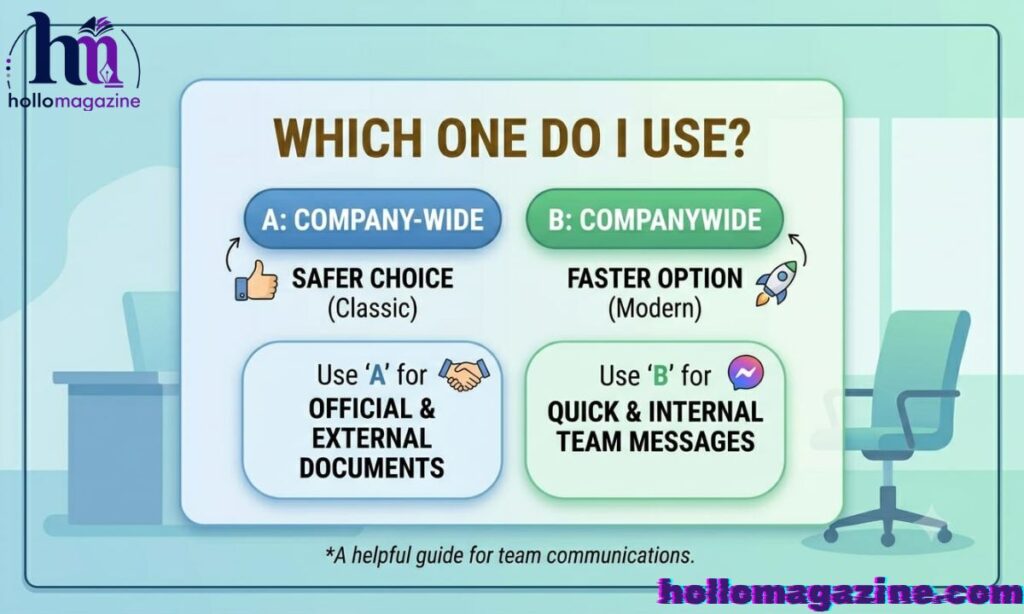
The primary difference between company-wide and companywide involves hyphenation.
Both forms describe something that affects, involves, or applies to an entire company. The meaning remains the same regardless of spelling.
Quick Comparison Table
| Term | Meaning | Common Usage |
| Company-Wide | Across the entire company | Traditional and widely preferred |
| Companywide | Across the entire company | Accepted by some dictionaries and organizations |
| Recommended for Formal Writing | Company-Wide | Most style-conscious writing |
The debate is not about meaning but about style and readability.
When to Use the Hyphen in Company-Wide
Traditionally, compound modifiers that appear before a noun are hyphenated.
Examples:
- A company-wide policy
- A company-wide initiative
- A company-wide announcement
- A company-wide training program
The hyphen helps readers immediately understand that the two words function together as a single modifier.
Why Many Editors Prefer the Hyphen
Professional editors often favor company-wide because:
- It improves readability.
- It follows traditional compound adjective rules.
- It reduces ambiguity.
- It aligns with many business style preferences.
- It looks more polished in formal documents.
Examples
Correct:
- The company-wide meeting begins at 9 a.m.
- Management announced a company-wide restructuring plan.
- Employees participated in a company-wide survey.
These examples clearly show the compound modifier working before a noun.
The Case for Writing Companywide as One Word
English constantly evolves, and many hyphenated compounds eventually become closed compounds.
Examples include:
- E-mail → Email
- Web site → Website
- On-line → Online
As a result, some dictionaries and organizations now recognize companywide as an acceptable alternative.
Why Some Businesses Prefer Companywide
Organizations sometimes use the closed form because:
- It appears modern.
- Internal style guides allow it.
- Digital writing favors simpler formatting.
- Branding guidelines may require consistency.
Examples
- The companywide initiative improved efficiency.
- Employees received a companywide update.
- Management approved a companywide policy.
Although these examples are understandable and accepted in some workplaces, many editors still prefer the hyphenated version for formal writing.
What Do Major Style Guides Say About Company-Wide?
Style guides influence how businesses, publishers, and professionals use language.
General Trend Among Style Authorities
Most traditional style approaches favor company-wide, especially when it functions as a compound adjective before a noun.
Examples:
- Company-wide changes
- Company-wide communications
- Company-wide objectives
The hyphen makes the relationship between the words immediately clear.
Modern Usage Trends
Recent business writing has shown increased acceptance of companywide, particularly in:
- Corporate websites
- Internal communications
- Human resources documents
- Digital content
However, consistency matters more than choosing one version over the other.
Best Practice
For formal and professional writing:
✅ Company-wide
For organizations whose style guide permits it:
✅ Companywide
Consistency Rule
Once you choose a form, use it consistently throughout the document.
Avoid:
- Company-wide meeting
- Companywide policy
- Company-wide survey
- Companywide initiative
within the same piece of writing.
Consistency improves professionalism and readability.
How to Use Company-Wide Correctly in Sentences
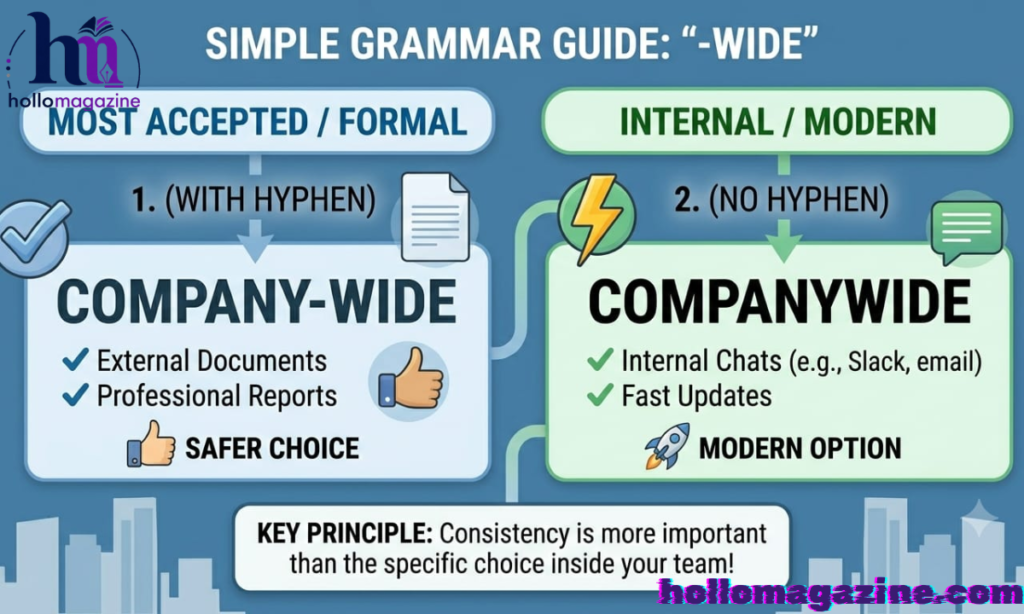
The phrase commonly appears in corporate communication, management documents, employee updates, and organizational planning.
Business Writing Examples
Internal Communication
- The CEO announced a company-wide strategy update.
- Employees attended a company-wide town hall meeting.
- Management distributed a company-wide memo.
Human Resources
- The company-wide training program starts next month.
- HR launched a company-wide wellness initiative.
- A company-wide benefits review is currently underway.
Corporate Operations
- The company-wide software upgrade improved efficiency.
- Teams participated in a company-wide compliance program.
- Leadership approved a company-wide restructuring effort.
Marketing and Branding
- The company-wide branding campaign strengthened customer recognition.
- Managers implemented a company-wide communication strategy.
- The company-wide launch generated strong results.
Sentence Placement Tips
Company-wide typically works best:
- Before a noun
- As a compound adjective
- In business-related contexts
Examples:
- Company-wide survey
- Company-wide policy
- Company-wide announcement
- Company-wide event
Read This: Thats vs That’s – Which Is Correct? 2026
Company-Wide vs Companywide Usage
Both forms appear in modern English, but their frequency and acceptance differ.
Usage Comparison
| Feature | Company-Wide | Companywide |
| Traditional Style | Yes | No |
| Modern Acceptance | Yes | Yes |
| Business Documents | Very Common | Common |
| Formal Reports | Preferred | Less Common |
| Internal Communications | Common | Common |
| Readability | High | High |
| Editor Preference | Often Preferred | Sometimes Accepted |
Which Should You Choose?
For most professional writers, the safest choice is:
Company-wide
Reasons:
- More widely recognized
- Preferred by many editors
- Easier to read
- Common in formal documents
If your organization’s style guide specifically uses companywide, follow that standard instead.
Quick Rule
Use company-wide when writing for a broad audience unless you have a specific reason to use companywide.
Common Mistakes

Although the phrase is simple, writers frequently make a few avoidable mistakes.
Incorrect Usage
Mistake #1: Mixing Both Forms
Incorrect:
- The company-wide policy supports the companywide initiative.
Better:
- The company-wide policy supports the company-wide initiative.
or
- The companywide policy supports the companywide initiative.
Choose one style and remain consistent.
Mistake #2: Using Unnecessary Variations
Incorrect:
- Company wide meeting
- Company wide policy
- Company wide training
Preferred:
- Company-wide meeting
- Company-wide policy
- Company-wide training
Without the hyphen, the phrase may appear incomplete or less polished.
Mistake #3: Ignoring Style Guide Requirements
Different organizations have different editorial standards.
Always:
- Check internal guidelines.
- Follow brand style requirements.
- Maintain consistency throughout documents.
Proofreading Checklist
Before publishing content, verify:
- Hyphenation is consistent.
- The phrase matches organizational style.
- Compound modifiers are clear.
- Formatting remains uniform throughout the document.
Conclusion
The debate between company-wide and companywide is largely a matter of style rather than meaning. Both forms communicate that something affects or involves the entire organization. However, company-wide remains the more traditional and widely preferred option in formal business writing.
For reports, employee handbooks, corporate communications, and professional documents, the hyphenated version is usually the safest choice. While companywide continues to gain acceptance in modern business language, consistency should always be your top priority. Choosing one form and applying it throughout your content will ensure clarity, professionalism, and strong readability.
Frequently Asked Questions
Is company-wide or companywide correct?
Both are acceptable, but company-wide is generally preferred in formal and professional writing.
Why is company-wide often hyphenated?
The hyphen helps show that the words work together as a compound modifier before a noun.
Is companywide one word in modern English?
Yes. Some dictionaries and organizations recognize companywide as an accepted variant.
Which form do businesses use most often?
Many businesses still prefer company-wide, especially in formal communications and reports.
Should I use companywide in professional writing?
You can if your organization’s style guide allows it, but company-wide remains the safer choice.
Can I use both forms in the same document?
It’s best not to. Consistent usage improves readability and professionalism.
What does company-wide mean?
It describes something that applies to, affects, or involves the entire company.

Rimsha creates simple grammar guides, English writing tips, and word meaning content for readers at Hollo Magazine.