
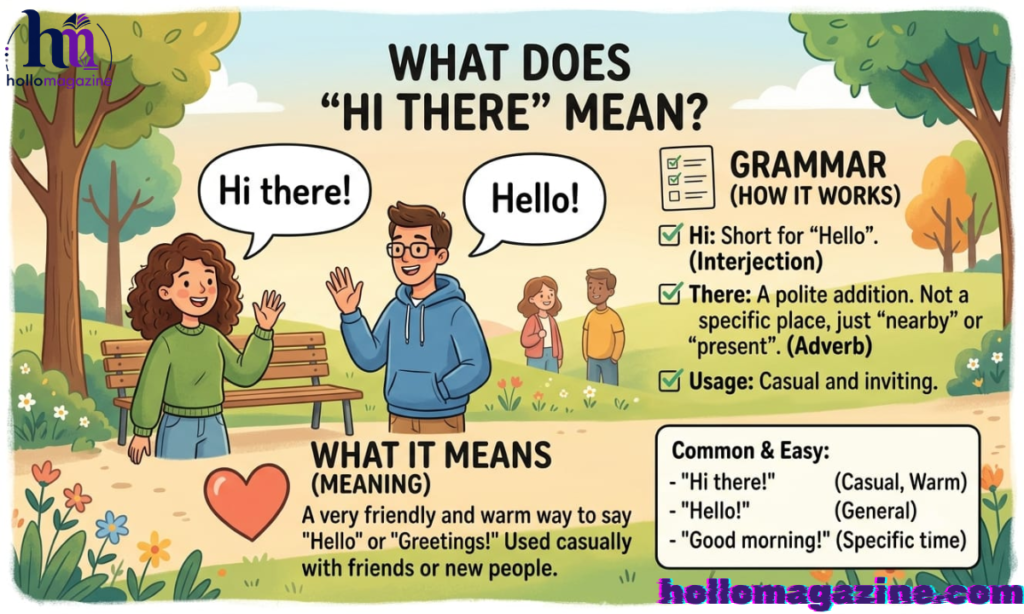
The phrase “Hi there” is one of the most common greetings in modern English. You’ll hear it in emails, text messages, customer service conversations, social media interactions, and everyday face-to-face communication. Despite its simplicity, many people wonder what it actually means and what message it sends.
Some view “Hi there” as warm and friendly, while others see it as casual, slightly impersonal, or even awkward in certain situations. Understanding the meaning, tone, and cultural use of this greeting can help you communicate more effectively and avoid misunderstandings.
Why “Hi There” Causes So Much Confusion
Unlike greetings such as “Hello,” “Good morning,” or “Hey,” the phrase “Hi there” carries a subtle emotional tone.
People often ask questions like:
- Is “Hi there” professional?
- Does it sound friendly?
- Is it too casual?
- Can it sound flirty?
- Why do customer service agents use it so often?
The confusion exists because “Hi there” sits between formal and informal language. It is friendlier than “Hello” but usually less personal than greeting someone by name.
Quick Meaning Summary
| Greeting | Tone |
| Hello | Neutral |
| Hi | Friendly |
| Hi There | Warm and approachable |
| Hey | Casual |
| Greetings | Formal |
Because it balances friendliness and politeness, it is widely used in modern communication.
The Real History Behind “Hi There”
Understanding where the phrase came from helps explain why it feels so natural today.
Where “Hi” Comes From
The word “hi” emerged as an informal greeting in English during the 19th century.
Originally, it was used to attract attention, similar to expressions like:
- Hey!
- Ho!
- Hi!
Over time, it evolved into a standard greeting and became one of the most popular alternatives to “hello.”
Where “There” Comes From
The word “there” originally referred to a place or location.
However, in greetings, it serves a different purpose. It acts as a friendly conversational marker rather than a literal reference to location.
For example:
- Hello there
- Hi there
- Hey there
In these expressions, “there” simply acknowledges the other person.
Why They Work Well Together
When combined, “hi” and “there” create a greeting that feels:
- Friendly
- Welcoming
- Non-threatening
- Conversational
- Relaxed
The phrase softens the directness of a simple “Hi.”
What “There” Really Adds to “Hi”
Many people assume “there” has no meaning in the phrase, but it actually changes the tone significantly.
Compare:
- Hi.
- Hi there.
The second version feels warmer and more personal.
Psychology Behind It
Communication experts often note that small language choices influence how messages are received.
The word “there” helps:
- Reduce social distance
- Create friendliness
- Signal openness
- Sound less abrupt
- Encourage conversation
As a result, “Hi there” often feels more welcoming than a simple greeting.
What “Hi There” Signals Emotionally
The emotional meaning behind “Hi there” depends on context, but it commonly signals positive intentions.
Common Emotional Signals
- Friendliness
- Approachability
- Politeness
- Warmth
- Informality
In most situations, people interpret the phrase positively.
Emotional Tone Scale
| Greeting | Emotional Warmth |
| Greetings | Low |
| Hello | Moderate |
| Hi | Moderate |
| Hi There | High |
| Hey Buddy | Very High |
Because it sounds pleasant without being overly familiar, many people choose it when speaking to someone they don’t know well.
Read This: Company-Wide or Companywide– Which Is Correct? 2026
How People Use “Hi There” Across Cultures
The interpretation of greetings varies around the world.
United States and Canada
In North America, “Hi there” is extremely common.
It is often used in:
- Customer service
- Emails
- Retail interactions
- Online communication
Most people view it as friendly and approachable.
United Kingdom and Ireland
British and Irish speakers generally understand the phrase as polite and informal.
However, people may use traditional greetings more often in formal settings.
Australia and New Zealand
The greeting fits naturally within the relaxed communication styles common in both countries.
It is usually perceived as friendly and welcoming.
South Asia
In countries such as India, Pakistan, Bangladesh, and Sri Lanka, English speakers frequently use “Hi there” in emails and online communication.
It is generally viewed as modern, friendly, and professional enough for many situations.
Formal European Cultures
In some European business environments, the phrase may feel slightly informal compared with traditional greetings.
People may prefer:
- Dear Mr. Smith
- Good morning
- Good afternoon
for formal correspondence.
Does Age Change How “Hi There” Feels?
Different generations often interpret greetings differently.
Teens and Gen Z
Younger people generally view “Hi there” as friendly but somewhat less casual than “Hey.”
It can sound polite without feeling overly formal.
Working Adults
Professionals often use it because it strikes a balance between friendliness and professionalism.
This group is among the most frequent users.
Older Generations
Some older adults may prefer traditional greetings such as:
- Hello
- Good morning
- Good afternoon
However, most still view “Hi there” positively.
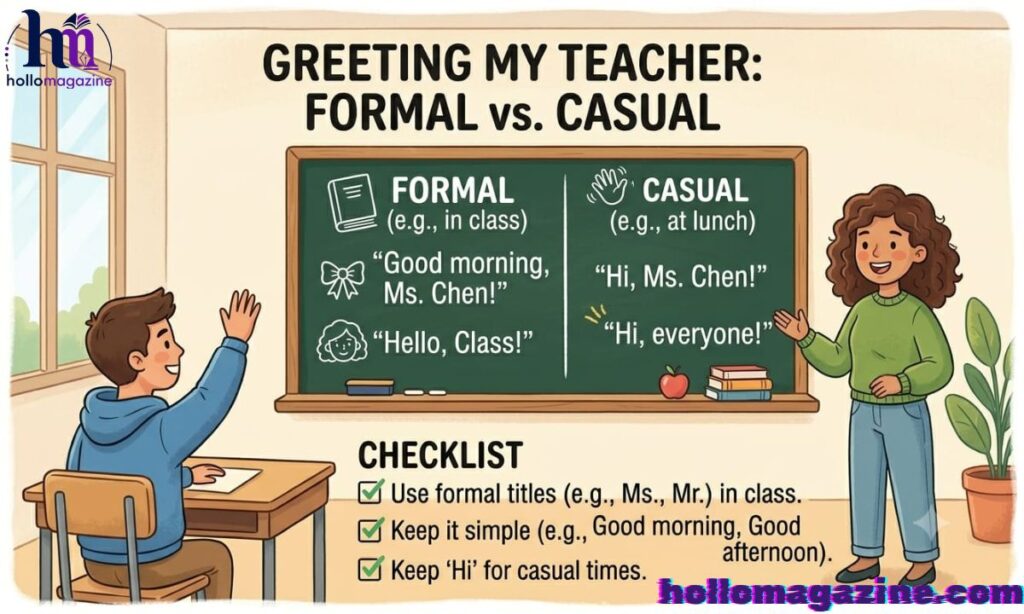
When You SHOULD Use “Hi There”
The greeting works best in situations that benefit from warmth and friendliness.
Smart Situations
Use “Hi there” when:
- Starting a friendly email
- Greeting a customer
- Beginning a chat conversation
- Meeting someone informally
- Sending a message online
- Contacting someone for the first time
Why It Works
The phrase:
- Feels welcoming
- Avoids sounding stiff
- Encourages conversation
- Creates a positive first impression
These qualities explain its popularity in customer-facing communication.
When You Should NOT Use “Hi There”
Although versatile, the greeting isn’t appropriate everywhere.
Bad Situations
Avoid using it:
- In highly formal legal documents
- During official government correspondence
- When addressing senior executives in conservative industries
- In academic applications requiring formality
- When a more respectful greeting is expected
In such situations, traditional greetings may be a better choice.
Is “Hi There” Professional or Casual?
The answer depends on context.
Professional Enough?
Yes. In many modern workplaces, “Hi there” is considered sufficiently professional.
It appears regularly in:
- Business emails
- Customer support messages
- Marketing communication
Not Strong Enough?
Sometimes.
Very formal environments may require:
- Dear Sir or Madam
- Dear Professor
- Good Morning
instead.
Rule of Thumb
If the communication is professional but friendly, “Hi there” is usually acceptable.
Does “Hi There” Sound Flirty, Cold, or Kind?
Context determines interpretation.
Flirty Only If
It may sound flirty when:
- Combined with romantic language
- Used repeatedly in personal conversations
- Accompanied by obvious interest
By itself, it is not inherently flirtatious.
Cold Only If
It may feel cold if:
- No name is used where one is expected
- The rest of the message is abrupt
- The conversation lacks warmth
Friendly When
Most commonly, it sounds friendly when:
- Used naturally
- Followed by polite conversation
- Accompanied by positive language
Real Examples With Meaning
Text Messages
Hi there! How’s your day going?
Meaning: Friendly and approachable.
Email Openers
Hi there, I wanted to follow up regarding your request.
Meaning: Professional but warm.
In-Person Greetings
Hi there! Nice to meet you.
Meaning: Welcoming and polite.
How to Respond to “Hi There” Naturally
Neutral Responses
- Hi.
- Hello.
- Good morning.
Friendly Responses
- Hi there!
- Hey, how are you?
- Nice to hear from you.
Professional Responses
- Hello, thank you for reaching out.
- Hi, how can I help you today?
- Good afternoon.
Avoid
- Ignoring the greeting
- Responding rudely
- Using overly formal language when the tone is friendly
Better Alternatives to “Hi There”
Casual Alternatives
- Hey
- Hey there
- Hi
Professional Alternatives
- Hello
- Good morning
- Good afternoon
Warm Alternatives
- Hello there
- Nice to hear from you
- Hope you’re doing well
Assertive Alternatives
- Greetings
- Good day
- Welcome
Why “Hi There” Still Works Today
The phrase remains popular because it successfully combines friendliness and politeness.
Modern communication values:
- Approachability
- Authenticity
- Simplicity
“Hi there” delivers all three without sounding forced or overly formal.
Common Myths About “Hi There”
Myth 1: It Is Unprofessional
Not true. Many professionals use it daily.
Myth 2: It Is Flirty
Not inherently. Context creates flirtation, not the greeting itself.
Myth 3: It Sounds Robotic
Only when used repeatedly without personalization.
Myth 4: It Is Outdated
The phrase remains common in modern English communication.
What Does “Hi There” Really Mean? A Final Answer
At its core, “Hi there” means a friendly acknowledgment of another person. It combines the casual warmth of “hi” with the welcoming tone added by “there.”
The phrase signals openness, friendliness, and politeness without becoming overly personal. That balance explains why it remains one of the most effective greetings in both personal and professional communication.
Conclusion
“Hi there” is much more than a simple greeting. It serves as a bridge between formal and informal communication, making interactions feel warmer, more approachable, and more conversational. Whether used in emails, text messages, customer service conversations, or everyday encounters, it generally communicates friendliness and positive intent.
The reason the phrase continues to thrive is its flexibility. It works across cultures, age groups, and communication styles while remaining easy to understand. In most situations, “Hi there” is a safe, friendly, and effective way to start a conversation.
Frequently Asked Questions
What does “Hi there” mean?
It is a friendly greeting used to acknowledge someone in a warm and approachable way.
Is “Hi there” professional?
Yes. It is considered professional enough for many modern workplaces and business emails.
Does “Hi there” sound flirty?
Not usually. It only sounds flirty when combined with romantic context or language.
Why do customer service agents use “Hi there”?
It creates a welcoming tone and helps customers feel comfortable.
Is “Hi there” formal or informal?
It is generally informal to semi-professional, depending on context.
Can I use “Hi there” in an email?
Yes. It works well in friendly and moderately professional email communication.
What is a good response to “Hi there”?
Simple responses such as “Hi,” “Hello,” or “Hi there!” work naturally.

Rimsha creates simple grammar guides, English writing tips, and word meaning content for readers at Hollo Magazine.