Birthday greetings seem simple, yet certain phrases create surprising confusion. One expression that frequently appears on social media, greeting cards, and text messages is “Happiest Birthday.” Some people use it naturally, while others feel it sounds grammatically awkward. This raises an important question: Is “Happiest Birthday” actually correct English?
The answer is more nuanced than a simple yes or no. While native English speakers understand the intention behind the phrase, it doesn’t follow the most natural grammatical patterns used in traditional birthday greetings. This guide explores the grammar, meaning, cultural influences, and practical alternatives to help you choose the best birthday wishes in any situation.
Understanding “Happiest Birthday” and Why It Confuses People
The confusion comes from the word happiest, which is the superlative form of happy.
English speakers commonly say:
- Happy Birthday
- Have a happy birthday
- Wishing you a happy birthday
However, many people wonder whether making the adjective stronger automatically creates a better greeting.
Examples include:
- Happier Birthday
- Happiest Birthday
- Very Happy Birthday
- Most Happy Birthday
While these phrases may sound logical, English greetings often follow fixed expressions rather than purely grammatical rules.
Quick Answer
| Phrase | Natural English Usage |
| Happy Birthday | Yes |
| Happiest Birthday | Sometimes, but less natural |
| Happiest of Birthdays | Yes |
| Wishing You the Happiest Birthday | Yes |
| Most Happy Birthday | Rare |
The key difference lies in how superlatives function within English greetings.
Is It Correct to Say “Happiest Birthday”?
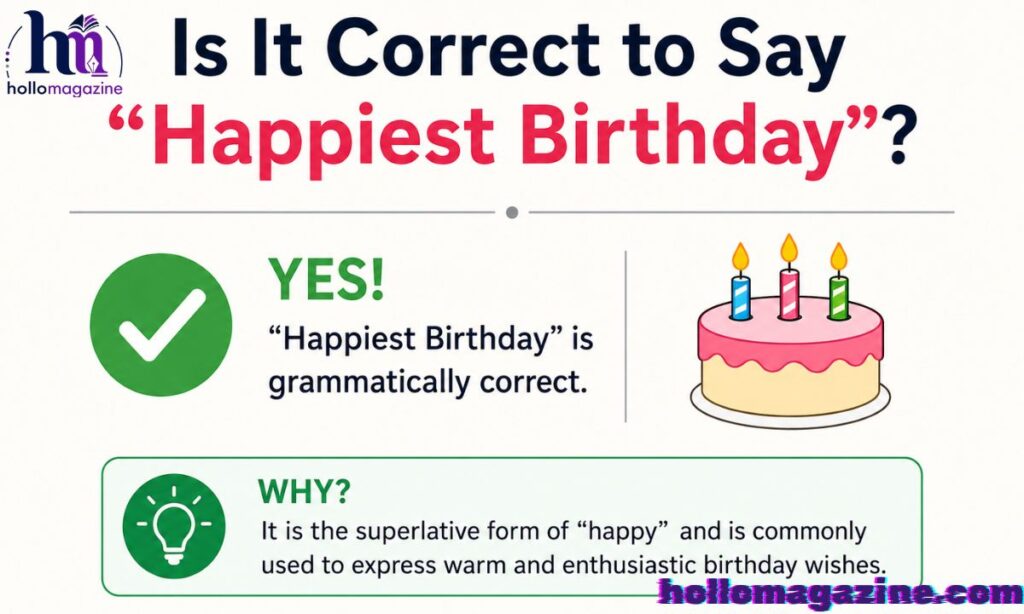
Technically, “Happiest Birthday” is understandable and not completely ungrammatical, but it is not the standard birthday greeting used by most native English speakers.
Why It Sounds Unusual
English generally treats Happy Birthday as a fixed expression.
Similar examples include:
- Merry Christmas
- Happy Anniversary
- Happy New Year
People rarely modify these greetings with superlatives.
For example:
- Merry Christmas ✔
- Merriest Christmas ✖ (less common)
- Happy Anniversary ✔
- Happiest Anniversary ✖ (unusual)
Because birthday greetings follow a familiar pattern, changing “happy” to “happiest” can sound slightly unnatural.
When People Still Use It
You’ll often see “Happiest Birthday” in:
- Social media captions
- Informal messages
- Birthday cards
- Emotional greetings
- Creative writing
In these situations, the phrase functions more as an expression of enthusiasm than strict grammar.
What You Actually Mean When You Say “Happiest Birthday”
When someone says “Happiest Birthday,” they are usually trying to express:
- Extra happiness
- Strong affection
- Warm wishes
- Excitement
- Emotional emphasis
The intended meaning is often:
I hope this is your happiest birthday ever.
or
I wish you an extremely happy birthday.
Emotional Meaning vs Grammar
| Phrase | Intended Meaning |
| Happy Birthday | Standard birthday wish |
| Happiest Birthday | Extremely happy birthday |
| Wishing You the Happiest Birthday | I hope this birthday is your best one yet |
This explains why the phrase remains popular despite sounding unconventional to some native speakers.
Natural Alternatives to “Happiest Birthday”
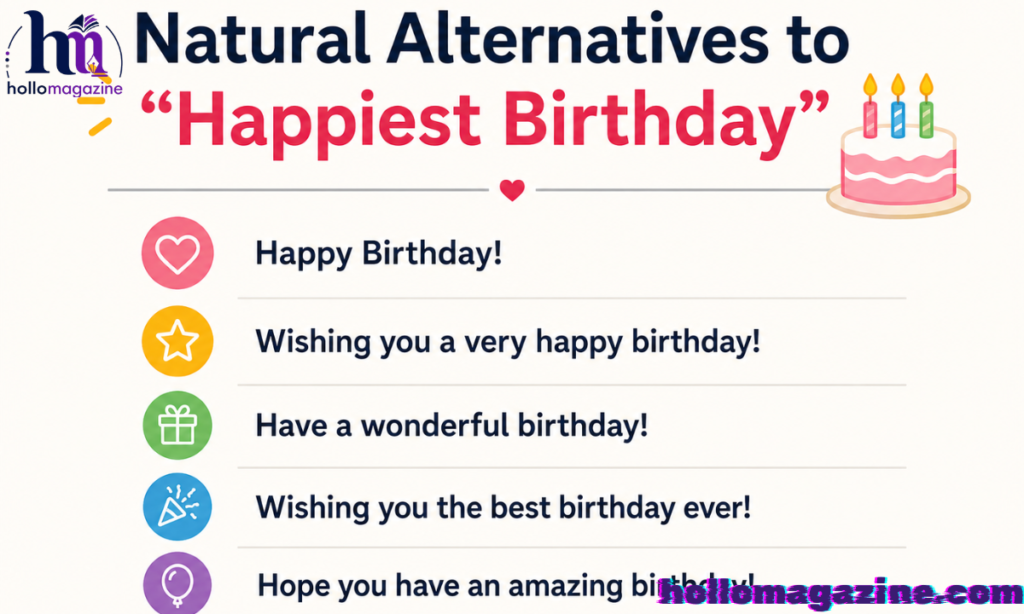
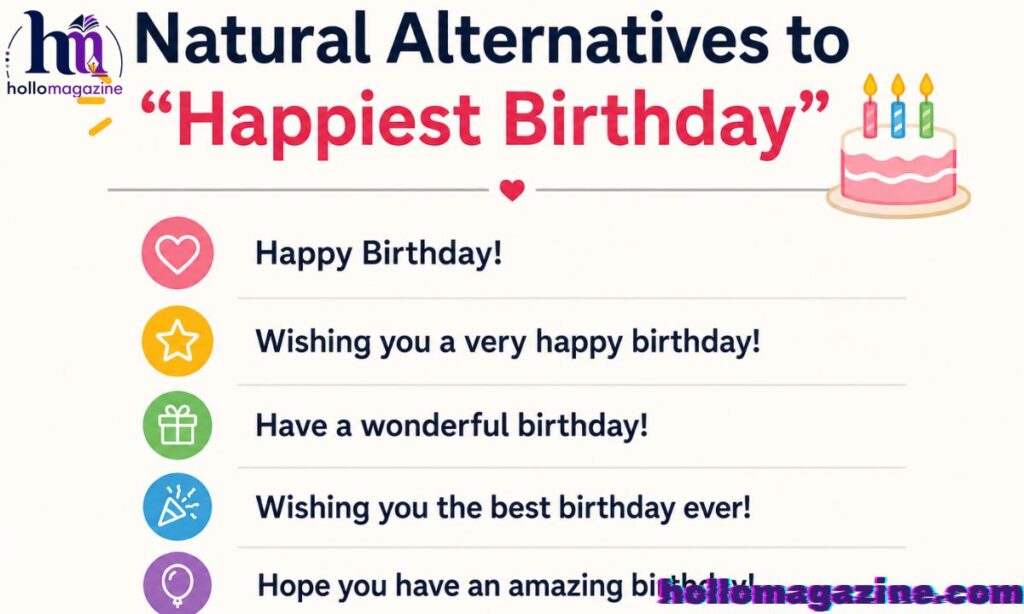
If you want a birthday greeting that sounds both natural and expressive, several alternatives work better.
Standard and Correct Options
These are universally accepted:
- Happy Birthday!
- Wishing you a happy birthday.
- Have a wonderful birthday.
- Hope you have a fantastic birthday.
- Best wishes on your birthday.
More Emotional Alternatives
For close friends and family:
- Wishing you the happiest birthday ever.
- Hope this is your best birthday yet.
- Wishing you endless happiness on your special day.
- Have the most amazing birthday.
- Hope your birthday is filled with joy.
Social Media Style Options
Popular online variations include:
- Happiest of birthdays!
- Happy Birthday to the best person ever!
- Sending birthday love your way!
- Hope your day is absolutely amazing!
- Birthday blessings and happiness to you!
These alternatives maintain warmth while sounding more natural.
Why “Happiest of Birthdays” Works but “Happiest Birthday” Doesn’t
Many native speakers comfortably use “Happiest of Birthdays” but hesitate with “Happiest Birthday.”
Why the Difference Matters
The phrase “Happiest of Birthdays” creates a complete superlative expression.
Examples:
- Happiest of birthdays to you!
- Wishing you the happiest of birthdays.
- Have the happiest of birthdays today.
The addition of of provides grammatical support for the superlative.
Comparison Table
| Phrase | Naturalness |
| Happy Birthday | Very Natural |
| Happiest Birthday | Less Natural |
| Happiest of Birthdays | Very Natural |
| Wishing You the Happiest Birthday | Natural |
This is why many writers prefer the longer form.
Read This: Envolved or Involved– Which Is Correct? 2026
Grammar Breakdown: Why “Happiest Birthday” Feels Wrong
The phrase isn’t entirely incorrect, but several grammar principles explain why it feels unusual.
Adjective + Noun Structure
Normally, adjectives modify nouns directly.
Examples:
- Happy child
- Happy family
- Happy customer
The phrase Happy Birthday functions as a fixed greeting rather than a standard adjective-noun combination.
Because of this, changing the adjective doesn’t always sound natural.
Superlatives Need Context
Superlatives usually compare something against a group.
Examples:
- The happiest person
- The happiest day
- The happiest moment
Readers naturally wonder:
The happiest birthday compared to which birthdays?
Without context, the superlative may feel incomplete.
English Prefers Simplicity in Greetings
Many English greetings remain simple.
Examples:
- Happy Birthday
- Merry Christmas
- Happy Holidays
- Congratulations
Adding extra grammatical complexity often sounds less natural than the traditional version.
Role of Articles in Birthday Greetings
Articles also influence how natural the phrase feels.
Compare:
- Happy Birthday ✔
- The Happiest Birthday ✔
- A Happy Birthday ✔
- Happiest Birthday ⚠
The absence of an article before a superlative can make the phrase sound incomplete to some speakers.
Example
More natural:
- Wishing you the happiest birthday ever.
Less natural:
- Wishing you happiest birthday ever.
Small grammatical details significantly affect fluency.
Cultural Differences in Birthday Greetings
Birthday language varies around the world.
English-Speaking Countries
Native speakers in countries such as:
- United States
- Canada
- United Kingdom
- Australia
- New Zealand
typically favor:
- Happy Birthday
- Wishing you a happy birthday
- Have a wonderful birthday
South Asian Influence
In South Asia, creative birthday expressions are very common.
Examples include:
- Happiest Birthday
- Many many happy returns of the day
- Most happiest birthday
These phrases are widely understood but may differ from standard native English usage.
Social Media Effect
Platforms such as Instagram, Facebook, and TikTok encourage expressive language.
As a result, phrases like:
- Happiest Birthday
- Happiest Birthday Ever
- The Happiest Soul Deserves the Happiest Birthday
have become increasingly popular online.
Common Mistakes People Make
Over-Intensifying Simple Phrases
People often assume stronger words automatically improve greetings.
Examples:
- Most happiest birthday
- Very happiest birthday
These constructions are grammatically unnecessary.
Direct Translation Errors
Many greetings are translated from other languages into English.
This can create expressions that sound unusual to native speakers.
Ignoring Fixed Expressions
Birthday greetings are largely formulaic.
Changing them too much may reduce naturalness.
Mixing Grammar Rules
Examples:
- Most happiest birthday ❌
- Happier birthday ❌
- The happiest of birthdays ✔
Understanding superlatives helps avoid these errors.
Special Cases in Birthday Greetings
Belated Birthday Wishes
Use:
- Belated Happy Birthday
- Wishing you a belated happy birthday
Avoid:
- Belated Happiest Birthday
Group Messages
Good examples include:
- Happy Birthday from all of us!
- Wishing you a wonderful birthday.
Formal Situations
Professional greetings work best when simple:
- Happy Birthday and best wishes.
- Wishing you a very happy birthday.
When Creative Variations Are Acceptable
Creative language is perfectly acceptable when:
- Writing to close friends
- Posting on social media
- Creating personalized cards
- Expressing strong emotions
In these situations, style matters more than strict grammatical precision.
Quick Guide to Choosing the Right Phrase
| Situation | Best Phrase |
| Professional | Happy Birthday |
| Friend | Happy Birthday |
| Family Member | Wishing You the Happiest Birthday |
| Social Media | Happiest of Birthdays |
| Formal Card | Best Wishes on Your Birthday |
Quick Tips for Writing Perfect Birthday Wishes
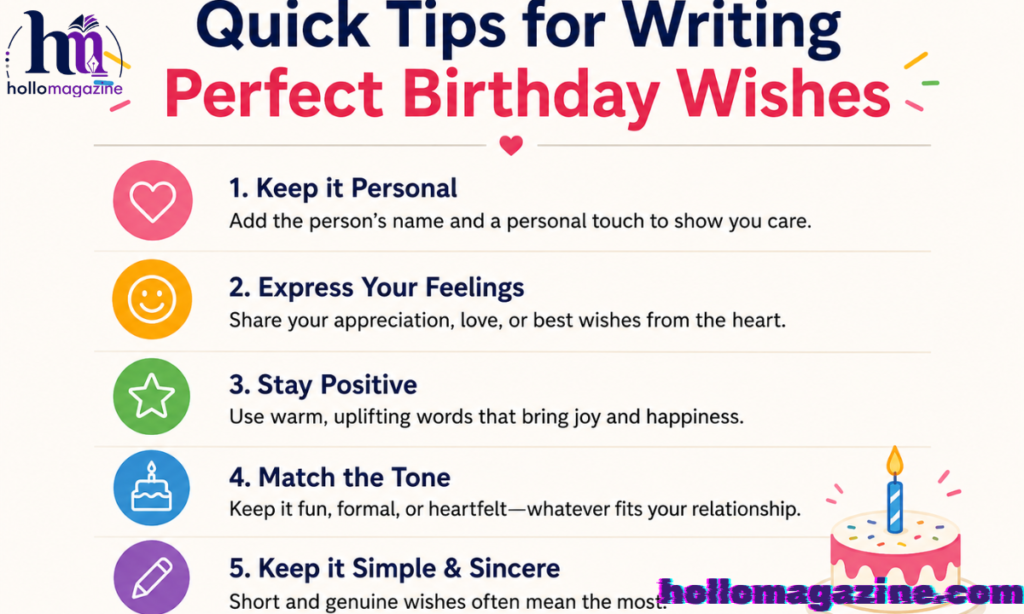
- Keep greetings simple.
- Use natural English expressions.
- Match the tone to the relationship.
- Avoid unnecessary superlatives.
- Personalize the message whenever possible.
- Focus on sincerity rather than complexity.
Conclusion
The phrase “Happiest Birthday” is widely understood and commonly used online, but it is not the most natural birthday greeting in standard English. Native speakers generally prefer traditional expressions such as “Happy Birthday” or expanded forms like “Wishing you the happiest birthday” and “Happiest of birthdays.”
Ultimately, the best birthday greeting depends on context. For professional situations, simple expressions work best. For friends and family, creative variations can add warmth and personality. As long as your message is sincere, the recipient will appreciate the thought behind it.
Frequently Asked Questions
Is “Happiest Birthday” grammatically correct?
It is understandable but less natural than standard expressions such as “Happy Birthday.”
Why does “Happiest Birthday” sound strange?
Because English treats “Happy Birthday” as a fixed greeting that is rarely modified.
Is “Happiest of Birthdays” correct?
Yes. It is a natural and widely accepted superlative birthday expression.
What is the best alternative to “Happiest Birthday”?
“Wishing you the happiest birthday” is one of the most natural alternatives.
Do native English speakers say “Happiest Birthday”?
Some do, especially on social media, but it is less common than “Happy Birthday.”
Is “Most Happiest Birthday” correct?
No. It uses a double superlative and is grammatically incorrect.
Can I use “Happiest Birthday” in a birthday card?
Yes. It is acceptable in informal and personal messages where emotional expression matters most.

Rimsha creates simple grammar guides, English writing tips, and word meaning content for readers at Hollo Magazine.