
Expressing gratitude is one of the most important parts of effective communication. Whether you’re thanking coworkers after a successful project, appreciating attendees at an event, or responding to support from friends and family, choosing the right words matters. Two commonly used expressions are “Thank You Everyone” and “Thank You All.” While both convey appreciation, many English learners and even native speakers wonder whether one is more correct than the other.
The good news is that both phrases are widely used and generally understood. However, they differ slightly in tone, audience perception, and usage. Understanding these differences can help you sound more natural, professional, and confident in both spoken and written English.
Are “Thank You Everyone” and “Thank You All” Grammatically Correct?
The short answer is yes and no.
While both expressions are commonly used in everyday communication, grammar experts generally consider “Thank you, everyone” and “Thank you all” the correct forms.
Why Punctuation Matters
Consider these examples:
- Thank you, everyone.
- Thank you all.
In the first sentence, everyone functions as a direct form of address, so a comma is traditionally recommended.
Without the comma:
- Thank you everyone.
The phrase is still widely used, especially in emails, text messages, and social media, but it is slightly less formal from a grammatical perspective.
Quick Grammar Table
| Expression | Grammatically Accepted | Common Usage |
| Thank you, everyone | Yes | Very common |
| Thank you everyone | Informally accepted | Very common |
| Thank you all | Yes | Very common |
| Thanks everyone | Informally accepted | Common |
| Thanks all | Informally accepted | Common |
For professional writing, using proper punctuation is usually the safest option.
The Real Difference Between “Thank You Everyone” and “Thank You All”
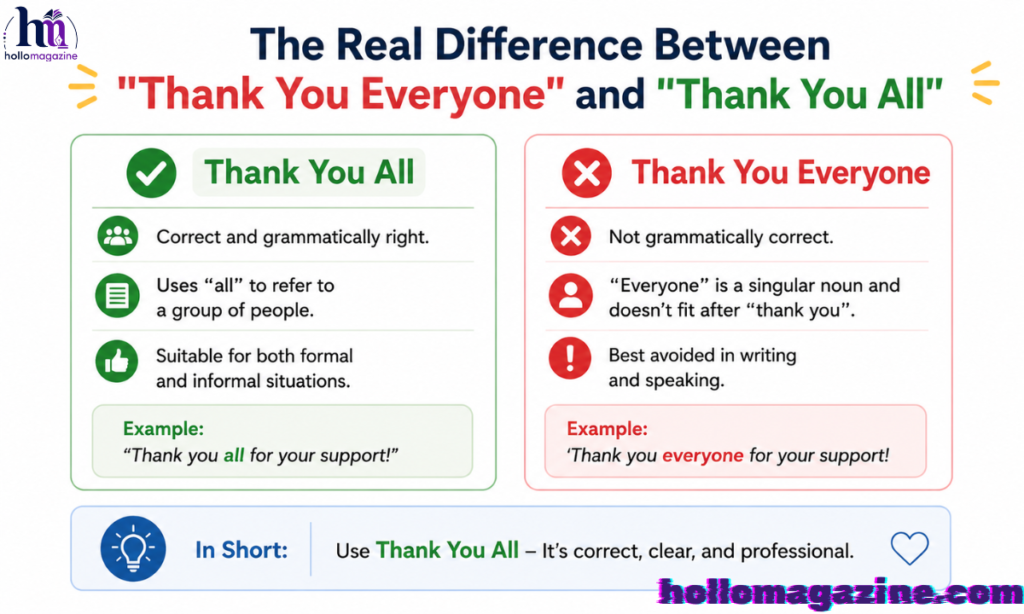
Although both phrases express gratitude toward a group, they create slightly different impressions.
“Thank You Everyone”
“Thank you, everyone” feels a bit more direct because it addresses each individual within the group.
It often sounds:
- More personal
- More intentional
- Slightly more formal
- Suitable for speeches and presentations
Examples:
- Thank you, everyone, for attending today’s meeting.
- Thank you, everyone, for your hard work.
- Thank you, everyone, for supporting this project.
“Thank You All”
“Thank you all” focuses more on the group as a collective unit.
It often sounds:
- Warmer
- More conversational
- Slightly more relaxed
- Natural in everyday speech
Examples:
- Thank you all for being here.
- Thank you all for your support.
- Thank you all for making this event successful.
How Native Speakers Choose Without Thinking
Most native English speakers do not consciously analyze the grammar when choosing between these expressions.
Instead, they often select based on:
- Context
- Audience size
- Communication style
- Personal preference
Generally:
- Public speech → Thank you, everyone
- Team email → Either works
- Casual conversation → Thank you all
- Social media post → Either works
This is why you’ll frequently encounter both versions in authentic English communication.
When to Use “Thank You Everyone”
This phrase works particularly well when you want to acknowledge individuals within a group.
Ideal Situations for “Thank You Everyone”
Use it for:
- Business presentations
- Team meetings
- Classroom settings
- Award speeches
- Conference sessions
- Volunteer recognition
Examples:
- Thank you, everyone, for your valuable contributions.
- Thank you, everyone, for staying late to finish the project.
- Thank you, everyone, for your patience.
Why It Feels More Intentional
The word everyone naturally highlights individual members.
As a result, the phrase can feel:
- More personal
- More appreciative
- More thoughtful
- More inclusive
Many managers and leaders prefer it when recognizing a group’s efforts.
Examples of “Thank You Everyone” Used Naturally
Here are some realistic examples:
- Thank you, everyone, for joining today’s webinar.
- Thank you, everyone, for your continued support.
- Thank you, everyone, for helping organize the event.
- Thank you, everyone, for making my birthday special.
- Thank you, everyone, for your encouraging messages.
These examples work well in both spoken and written communication.
When to Use “Thank You All”
“Thank you all” is often preferred when addressing a group collectively.
Ideal Situations for “Thank You All”
Use it in:
- Casual conversations
- Team chats
- Social media posts
- Family gatherings
- Community events
- Informal workplace communication
Examples:
- Thank you all for coming.
- Thank you all for your kindness.
- Thank you all for the wonderful memories.
The phrase tends to flow naturally and feels slightly more conversational.
Read This: What Does “Hi There” Mean? The Complete Guide
Examples of “Thank You All” Used Naturally
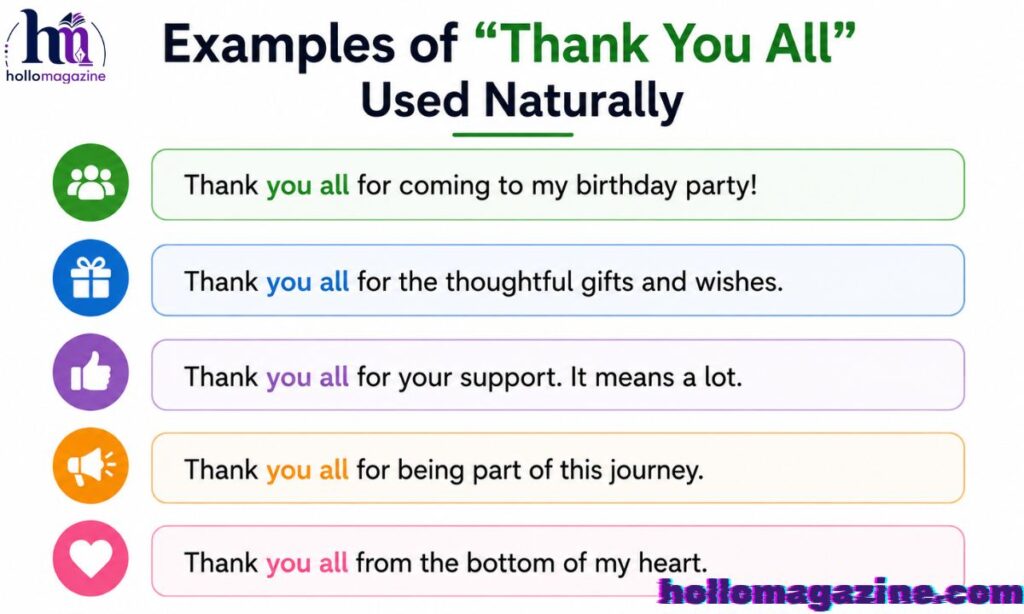
Common examples include:
- Thank you all for your support during this difficult time.
- Thank you all for attending the celebration.
- Thank you all for your feedback.
- Thank you all for believing in this project.
- Thank you all for making this possible.
These expressions sound natural in both personal and professional settings.
Tone, Audience, and Medium: How to Choose Instantly
Choosing between the two phrases often comes down to tone and audience.
Ask Yourself Three Questions
- Am I speaking formally or casually?
- Do I want to emphasize individuals or the group?
- Is this spoken communication or written communication?
Your answers will usually determine the best option.
Quick Comparison Table
| Factor | Thank You Everyone | Thank You All |
| Formality | Slightly higher | Slightly lower |
| Personal Feel | Stronger | Moderate |
| Conversational Tone | Moderate | Strong |
| Public Speaking | Excellent | Good |
| Social Media | Good | Excellent |
| Workplace Emails | Excellent | Excellent |
| Group Recognition | Excellent | Excellent |
Common Mistakes People Make
Thinking One Is Always Politer
Many people assume one phrase is automatically more polite.
In reality, both are polite when used appropriately.
The surrounding message usually matters more than the phrase itself.
Overusing One Phrase
Repeatedly using the same expression can make communication feel repetitive.
Consider alternating with other gratitude expressions when appropriate.
Overthinking Grammar
Some writers spend too much time choosing between these two phrases.
Since both are accepted and widely understood, clarity and sincerity should remain the priority.
Polished Alternatives to “Thank You Everyone” and “Thank You All”
Sometimes you may want a different expression to match the occasion.
Formal Alternatives
- Thank you for your support.
- I sincerely appreciate your assistance.
- My sincere thanks to everyone involved.
- I am grateful for your contributions.
Friendly Alternatives
- Thanks, everyone!
- Thanks, everyone, for being amazing.
- I appreciate you all.
- Many thanks to all of you.
Professional Email Alternatives
- Thank you for your continued support.
- Thank you for your cooperation.
- Thank you for your time and effort.
- I appreciate everyone’s contributions.
Situational Alternatives Table
| Situation | Recommended Alternative |
| Business Meeting | Thank you for your contributions |
| Volunteer Event | Thank you for your dedication |
| Classroom | Thank you, everyone, for participating |
| Team Project | I appreciate everyone’s hard work |
| Social Media | Thanks, everyone! |
Case Studies: How These Phrases Are Used in Real Life
Case Study: Workplace Announcement
A manager concludes a meeting by saying:
“Thank you, everyone, for your commitment to this project.”
This sounds professional and acknowledges individual effort.
Case Study: Charity Event Post
A nonprofit organization writes:
“Thank you all for supporting our fundraising campaign.”
The phrase feels warm and community-focused.
Case Study: Classroom Setting
A teacher ends class with:
“Thank you, everyone, for your participation today.”
This recognizes each student’s contribution.
What Style Guides and Usage Experts Agree On
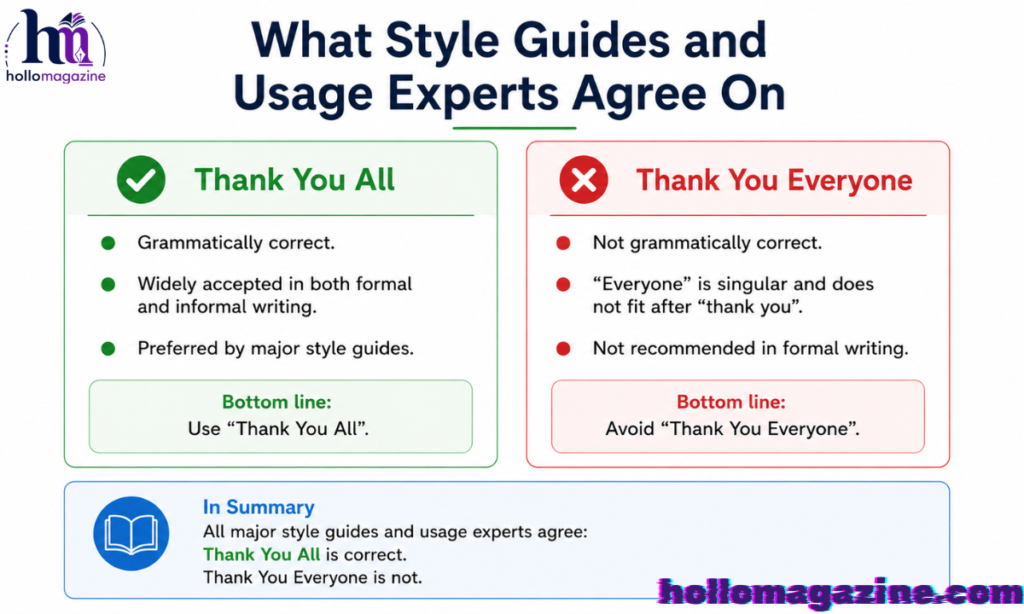
Most grammar and usage experts agree on several key points:
- Both expressions are acceptable.
- Context matters more than strict preference.
- “Thank you, everyone” is slightly more formal.
- “Thank you all” sounds slightly more conversational.
- Proper punctuation improves professionalism.
- Sincerity matters more than wording.
In modern English, native speakers regularly use both phrases without confusion. The best choice depends on audience, tone, and communication goals.
Conclusion
Both “Thank you, everyone” and “Thank you all” are correct and widely used expressions of gratitude. While “Thank you, everyone” often feels a bit more personal and formal, “Thank you all” tends to sound warmer and more conversational. Neither option is inherently better; the right choice depends on context and audience.
For professional presentations, workplace communication, and formal acknowledgments, “Thank you, everyone” is often preferred. For casual conversations, social media posts, and community interactions, “Thank you all” works beautifully. Most importantly, genuine appreciation will always matter more than the exact phrase you choose.
Frequently Asked Questions
Is “Thank You Everyone” grammatically correct?
Yes, although the formally punctuated version is “Thank you, everyone.”
Is “Thank You All” correct English?
Yes, it is a grammatically correct and commonly used expression.
Which sounds more professional?
“Thank you, everyone” generally sounds slightly more professional.
Which sounds more friendly?
“Thank you all” often feels warmer and more conversational.
Can I use both phrases in business emails?
Yes, both are appropriate in most professional email situations.
Do native speakers use both expressions?
Yes, native English speakers regularly use both forms.
Which one should I choose?
Choose “Thank you, everyone” for a more formal tone and “Thank you all” for a more casual, group-oriented tone.

Rimsha creates simple grammar guides, English writing tips, and word meaning content for readers at Hollo Magazine.