
Language is full of colorful expressions, and few are as direct and memorable as “kick rocks.” The phrase has become a popular way to dismiss someone, reject a request, or tell a person to leave. While it may sound harmless on the surface, its meaning depends heavily on context, tone, and cultural background.
Today, “kick rocks” appears in conversations, social media posts, music lyrics, and online discussions. Understanding its meaning, origins, and alternatives can help you use it appropriately and recognize when a different expression might communicate your message more effectively.
Why “Kick Rocks” Still Shows Up in Everyday Language
The phrase remains popular because it is short, expressive, and easy to understand.
People use it because:
- It conveys frustration quickly.
- It feels less harsh than some insults.
- It works in casual conversations.
- It has strong cultural roots in American slang.
- It is widely recognized online.
Unlike many slang expressions that fade away, “kick rocks” continues to appear across generations because its meaning remains clear and adaptable.
Kick Rocks Meaning: What the Expression Actually Says
At its core, kick rocks means:
- Go away.
- Leave me alone.
- Stop bothering me.
- Your request has been rejected.
- I do not want to engage with you.
The phrase is often dismissive but not necessarily aggressive.
Primary Interpretations
Depending on context, kick rocks can mean:
- Leave immediately.
- Accept rejection and move on.
- Stop wasting someone’s time.
- Go find something else to do.
- You’re not welcome in this conversation.
Examples:
- He asked for another favor, and she told him to kick rocks.
- The company rejected the unreasonable demand and essentially said, “kick rocks.”
Tone Matters
Tone significantly changes how the phrase is received.
It can sound:
- Playful among friends
- Firm during disagreements
- Dismissive in professional settings
- Humorous in online conversations
- Hostile during arguments
Always consider your audience before using it.
Kick Rocks Origin: Where the Phrase Comes From
The exact origin is difficult to trace, but language experts generally connect it to American slang culture.
Early American Street Slang
One theory suggests the phrase developed from the image of someone walking aimlessly down a road and literally kicking rocks as they go.
The message was simple:
“There’s nothing for you here. Move along.”
This visual imagery helped the phrase gain popularity.
Military Usage
Some language historians believe variations of the expression appeared among military personnel.
When soldiers wanted someone to leave or stop interfering, phrases involving walking away or finding another task were common.
While direct documentation is limited, military slang likely contributed to its spread.
Urban and Hip Hop Influence
The phrase gained broader visibility through urban communities and later through hip hop culture.
Rappers, entertainers, and public figures used “kick rocks” as a cleaner alternative to stronger dismissive language.
This helped introduce the expression to mainstream audiences.
Youth Culture
Teenagers and young adults adopted the phrase because it sounds less offensive than many other ways of telling someone to go away.
Today, it remains common in:
- Group chats
- Social media
- Online gaming communities
- Informal conversations
When to Use the Phrase “Kick Rocks”
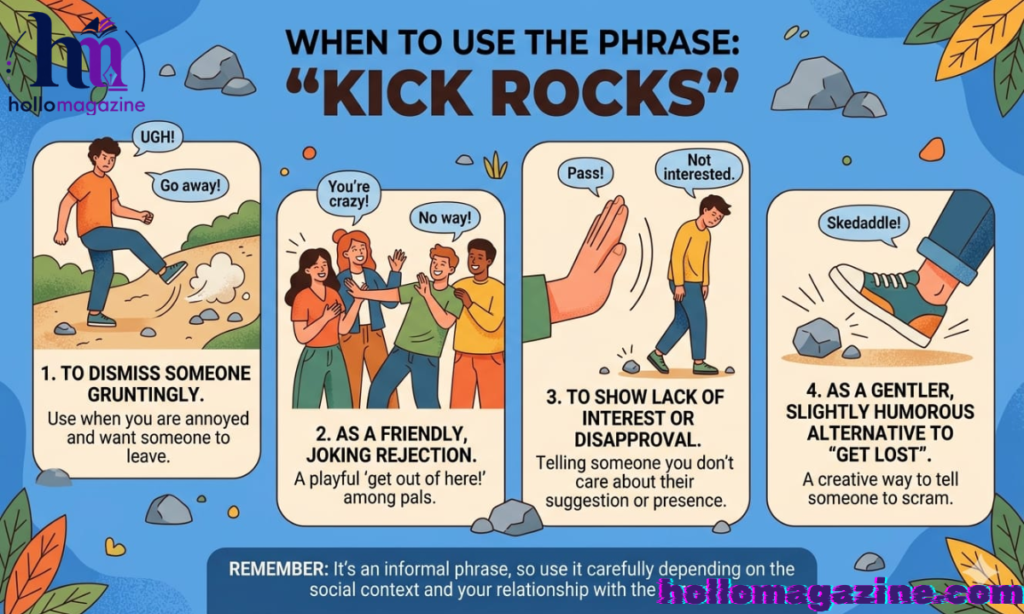
Good Times to Use It
The phrase works best in casual situations.
Examples:
- Friendly teasing
- Lighthearted disagreements
- Informal conversations
- Social media banter
- Setting minor boundaries
Example:
- If you’re going to keep spoiling the movie, you can kick rocks.
Times to Avoid It
Avoid using it in situations that require professionalism or diplomacy.
Examples:
- Business emails
- Workplace conflicts
- Academic communication
- Customer service interactions
- Formal negotiations
In these settings, more respectful language is usually better.
Read This: Moment vs Momment Spelling, Definition, and Usage
Cultural and Social Nuances Behind “Kick Rocks”
Age Groups
Different generations may interpret the phrase differently.
- Younger speakers often view it as playful.
- Middle-aged speakers may see it as dismissive slang.
- Older speakers may be less familiar with the expression.
Regions
The phrase is most common in North America but is increasingly recognized through social media worldwide.
Regional familiarity varies, so some audiences may not immediately understand it.
Communication Styles
People who prefer direct communication may use the phrase comfortably.
Those who favor diplomacy may view it as unnecessarily blunt.
Understanding communication styles helps avoid misunderstandings.
The Psychological Impact of Dismissive Phrases
Why People Use Dismissive Slang
Dismissive expressions serve social and emotional functions.
People use them to:
- Establish boundaries
- Express frustration
- Reject unwanted requests
- Signal disapproval
- End conversations quickly
Such phrases can save time but may also damage relationships if used carelessly.
Emotional Effects
Being told to kick rocks can trigger different reactions:
- Embarrassment
- Frustration
- Humor
- Resentment
- Acceptance
The emotional impact depends largely on the relationship between the speakers.
Twenty Five Alternatives to “Kick Rocks” (Organized by Tone)
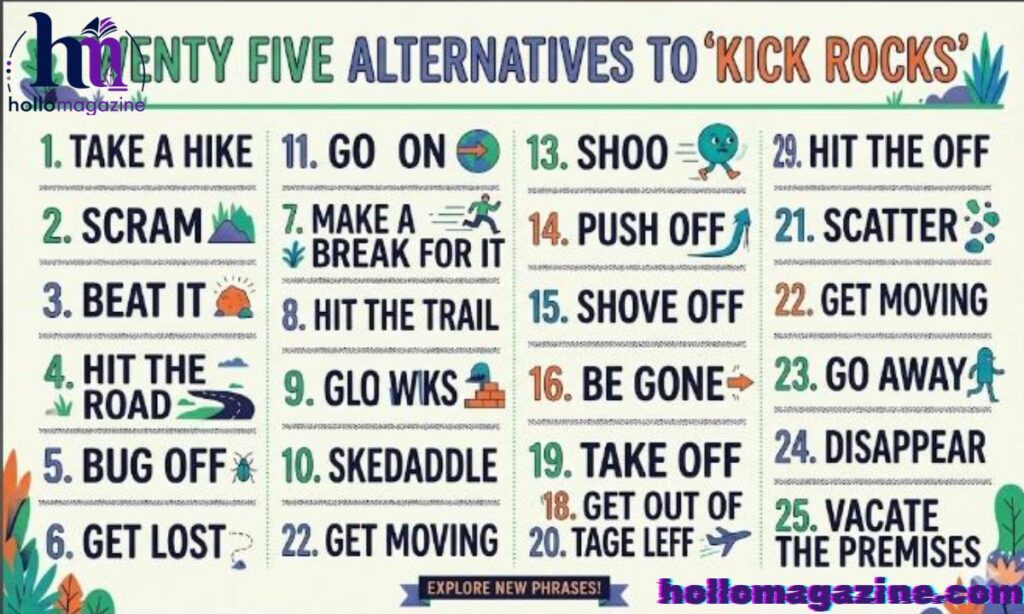
Direct and Firm Alternatives
- Move along.
- Go elsewhere.
- Leave me alone.
- Take a hike.
- Get lost.
- Walk away.
- Find something else to do.
Casual and Playful Alternatives
- Keep it moving.
- Try your luck somewhere else.
- Not happening.
- Better luck next time.
- Nice try.
- Maybe another day.
Sarcastic or Humorous Alternatives
- Join the line.
- Dream on.
- Good luck with that.
- That’s adorable.
- Keep wishing.
- Don’t hold your breath.
Polite (but firm) Alternatives
- I have to decline.
- That’s not possible.
- I’ll pass.
- I disagree.
- Let’s end this discussion.
- Thank you, but no.
These alternatives help you match your message to the situation.
How to Choose the Right Alternative
Consider the Relationship
Ask yourself:
- Is this a friend?
- A coworker?
- A family member?
- A stranger?
Closer relationships often allow more informal language.
the Situation
Context matters.
A playful joke may permit stronger slang, while serious conversations require greater care.
Consider the Setting
Different settings demand different communication styles.
| Setting | Recommended Approach |
| Social Media | Casual alternatives |
| Workplace | Professional alternatives |
| Family | Respectful alternatives |
| Friend Groups | Playful alternatives |
| Public Discussions | Neutral alternatives |
Modern Variations and Online Versions of “Kick Rocks”
The internet has created several variations.
Examples include:
- Go kick rocks.
- Kick gravel.
- Touch grass.
- Keep it moving.
- Move around.
- Take several seats.
Many of these expressions serve the same purpose: ending a conversation or rejecting an idea.
Case Studies: Real Uses of “Kick Rocks”
Case Study 1: Friendly Teasing
Two friends argue over a sports prediction.
One says:
“You picked the wrong team again. Kick rocks.”
The tone is playful, and neither person feels offended.
Case Study 2: Boundary Setting
Someone repeatedly asks for favors after being told no.
The response:
“I’ve already answered. Kick rocks.”
Here the phrase communicates a firm boundary.
Case Study 3: Rejecting Unwanted Attention
A person receives persistent unwanted messages online.
They reply:
“Not interested. Kick rocks.”
The phrase dismisses the interaction without a lengthy explanation.
Table: Comparing “Kick Rocks” to Similar Expressions

| Expression | Meaning | Tone |
| Kick Rocks | Go away | Dismissive |
| Take a Hike | Leave | Firm |
| Get Lost | Go away | Harsh |
| Move Along | Continue elsewhere | Neutral |
| Keep It Moving | Leave politely | Casual |
| Touch Grass | Disconnect and calm down | Humorous |
| Beat It | Leave immediately | Informal |
This comparison shows how tone changes from phrase to phrase.
Why “Kick Rocks” Remains a Popular Dismissive Phrase
Several factors explain its longevity:
- Easy to remember
- Strong imagery
- Less offensive than profanity
- Popular in online culture
- Flexible across situations
The phrase communicates rejection clearly without relying on explicit insults, which contributes to its continued popularity.
Reference: Cambridge Dictionary Definitions
Cambridge Dictionary does not currently list “kick rocks” as a standalone formal dictionary entry. However, the phrase functions as an idiomatic slang expression in modern English.
The individual words are defined separately:
- Kick refers to striking something with the foot.
- Rock refers to a stone or piece of stone.
When combined, the phrase takes on a figurative meaning that cannot be understood solely from the individual words.
Conclusion
The expression “kick rocks” has evolved into a widely recognized piece of modern slang that communicates dismissal, rejection, or the desire to end an interaction. Its roots in American informal speech, combined with influence from urban culture and social media, have helped it remain relevant for decades.
While the phrase can be humorous among friends, it may sound rude or dismissive in professional settings. Understanding its meaning, cultural context, and suitable alternatives allows you to choose the right words for every situation and communicate more effectively.
Frequently Asked Questions
What does kick rocks mean?
It generally means “go away,” “leave me alone,” or “move on.”
Is kick rocks rude?
It can be. The level of rudeness depends on tone, context, and the relationship between speakers.
Where did kick rocks originate?
The phrase is believed to have originated in American slang and later spread through urban culture and popular media.
Is kick rocks still popular?
Yes. It remains common in social media, casual conversations, and online communities.
Can I use kick rocks at work?
It is usually best to avoid it in professional environments.
Is kick rocks an insult?
Not always, but it is typically dismissive and may be perceived negatively.
What is a polite alternative to kick rocks?
Options include “I’ll pass,” “Thank you, but no,” or “Let’s move on.”
Why do people say kick rocks?
People use it to reject requests, set boundaries, or end unwanted conversations.

Rimsha creates simple grammar guides, English writing tips, and word meaning content for readers at Hollo Magazine.