
English spelling mistakes often occur when words sound similar but have different meanings or accepted spellings. One of the most common examples is Dutchess vs Duchess. While both versions frequently appear online, only one is correct when referring to a female royal title.
Understanding the difference is important for students, writers, journalists, and anyone interested in grammar or royal terminology. Using the correct spelling helps maintain professionalism, accuracy, and credibility in both formal and informal writing.
The Origin of the Duchess Title
The title Duchess is the feminine form of Duke, one of the highest-ranking noble titles in many European monarchies.
Historically, a duchess could be:
- The wife of a duke
- A woman holding the rank of duchess in her own right
- A female member of the nobility associated with a duchy
The title has been used for centuries across European royal families and remains part of modern royal traditions.
Dutchess vs Duchess: Understanding the Difference
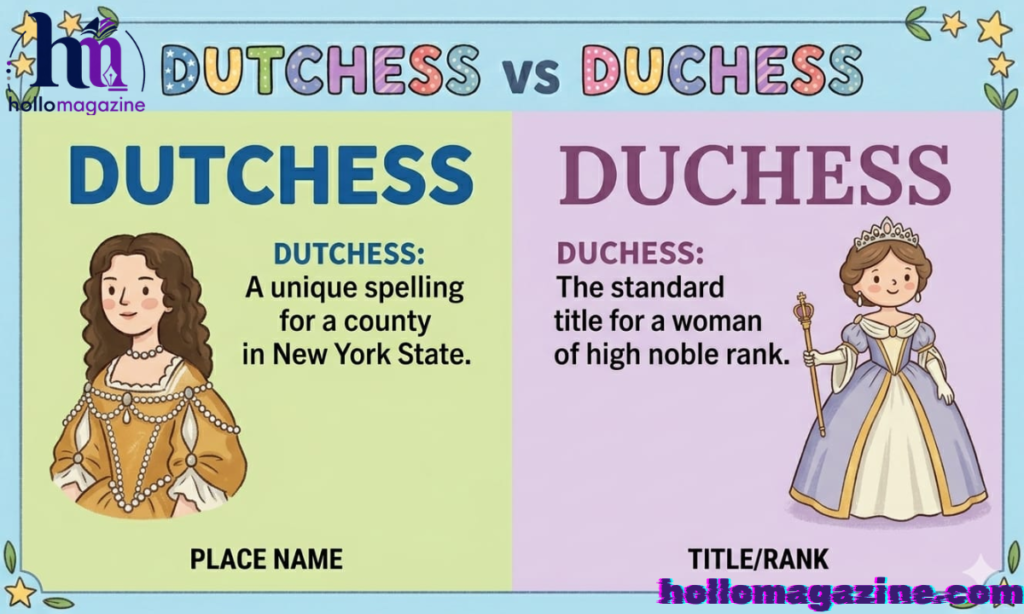
Many people mistakenly write Dutchess when they mean Duchess. However, these words are not interchangeable.
| Word | Correct? | Meaning |
| Duchess | ✅ Yes | A female holder of the rank of duke or the wife of a duke |
| Dutchess | ❌ Usually No | Common misspelling of Duchess; occasionally appears in place names or proper nouns |
When referring to a royal title, Duchess is always the correct spelling.
Comparison Table Dutchess vs Duchess
| Feature | Duchess | Dutchess |
| Standard English word | Yes | No |
| Royal title | Yes | No |
| Dictionary recognized | Yes | Generally No |
| Suitable in formal writing | Yes | No |
| Common spelling mistake | No | Yes |
| Used for nobility | Yes | No |
The simple rule is easy to remember: if you are talking about royalty, use Duchess.
When to Use Each Spelling
Use Duchess when:
- Referring to a female noble title
- Discussing royal families
- Writing historical content
- Mentioning aristocratic ranks
- Creating academic or professional content
Examples:
- The Duchess attended the charity event.
- She became a duchess after marrying the duke.
- Historians studied the life of the duchess.
Use Dutchess only when it is part of a specific proper name, business name, or geographic location.
Examples:
- Dutchess County in New York
- A company or brand named Dutchess
Outside such special cases, Duchess is the correct choice.
Common Mistakes and Why They Happen
Several factors contribute to the spelling confusion.
Common Causes
- Similar pronunciation
- Fast typing
- Autocorrect issues
- Limited familiarity with royal titles
- Confusion with the word “Dutch”
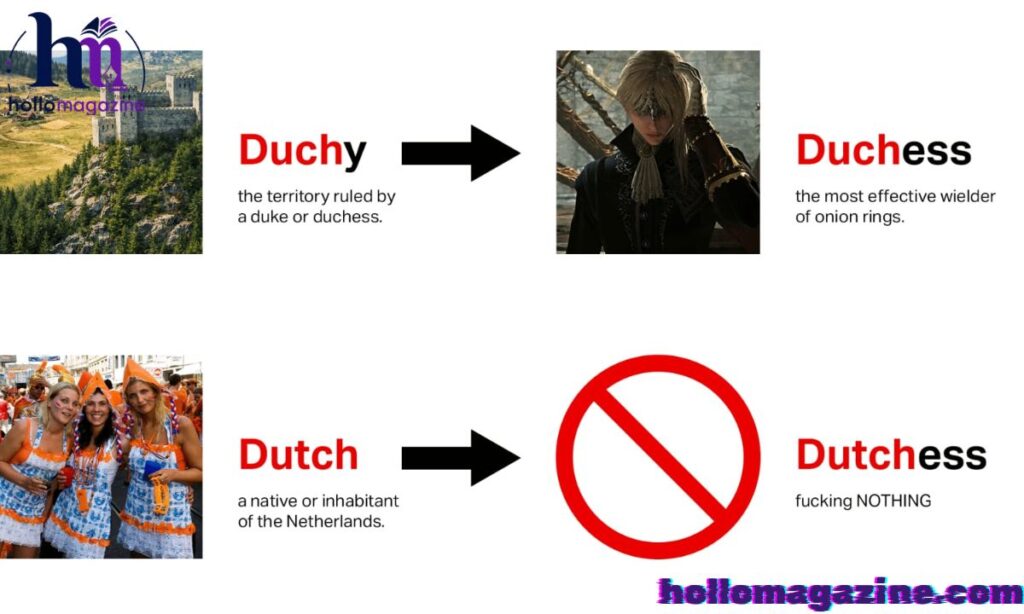
Many people subconsciously associate “Duchess” with “Dutch,” leading them to insert an extra “t.”
Common Errors
❌ Dutchess of Cambridge
✅ Duchess of Cambridge
❌ The Dutchess attended the ceremony.
✅ The Duchess attended the ceremony.
❌ A famous Dutchess in history
✅ A famous Duchess in history
Read This: Natzi or Nazi What’s Correct and Why It Matters
Dutchess vs Duchess in Everyday Life
Emails
Professional emails should always use the correct title.
Example:
✅ The Duchess will attend the conference.
Using “Dutchess” in business communication may appear careless and unprofessional.
News Headlines
Journalists and editors consistently use “Duchess” when reporting on royal figures.
Examples:
- Duchess Visits Local Hospital
- Duchess Attends State Banquet
- Duchess Launches Charity Campaign
Accuracy is essential in media reporting.
Social Media
Social media users frequently misspell the title because of fast typing and limited proofreading.
Examples:
❌ The Dutchess looked amazing today.
✅ The Duchess looked amazing today.
Even casual content benefits from correct spelling.
Formal Writing
Academic papers, biographies, history books, and official publications always use the spelling “Duchess.”
Formal writing requires consistency and accuracy.
Duchess Meaning Explained
A Duchess is:
- The wife or widow of a duke.
- A woman who independently holds the rank of duke.
- A female member of the highest levels of nobility.
The title traditionally ranks below a princess in some royal systems but above many other noble ranks.
The exact status may vary depending on the country’s aristocratic structure.
Duchess Title: History and Etymology
The word Duchess originates from Old French duchesse.
Its linguistic journey includes:
- Latin: dux meaning leader
- Old French: duc meaning duke
- Old French: duchesse meaning female duke
- Middle English: duchess
The spelling evolved naturally through centuries of usage and has remained stable in modern English.
This historical development explains why the title contains only one “t.”
Comparative Royal Titles
Understanding where duchess fits among royal ranks can be helpful.
| Male Title | Female Title |
| King | Queen |
| Prince | Princess |
| Duke | Duchess |
| Earl | Countess |
| Viscount | Viscountess |
| Baron | Baroness |
These titles form part of the traditional European aristocratic hierarchy.
Spelling Rules for Duchess
One “t” for Royal Titles
The correct royal title is always spelled Duchess with a single “t.”
Remember:
D-U-C-H-E-S-S
Not:
D-U-T-C-H-E-S-S
Two “t’s” for Place Names Only
Some place names and proper nouns use “Dutchess.”
Examples include:
- Dutchess County
- Certain business names
- Specific organizations
These are exceptions because they are proper names rather than royal titles.
Capitalize the Title Properly
Capitalize the title when it appears before a name.
Examples:
- Duchess Catherine
- Duchess Sarah
Use lowercase in general references.
Examples:
- The duchess attended the event.
- Several duchesses attended the ceremony.
Plural Form
The plural form is:
Duchesses
Examples:
- The duchesses attended the reception.
- Several duchesses influenced European history.
Avoid Confusion with Duke
Remember that the feminine form of duke is duchess.
Examples:
- Duke → Duchess
- Prince → Princess
- Earl → Countess
This pattern helps reinforce the correct spelling.
Mnemonic to Remember
A simple memory trick:
A Duchess lives in a Duchy, not in Dutch-land.
This helps separate the title from the word “Dutch.”
Common Mistakes to Avoid
Avoid these frequent errors:
- Adding an unnecessary “t”
- Writing Dutchess in academic papers
- Using Dutchess in royal biographies
- Confusing the title with Dutch nationality
- Failing to capitalize proper titles
Practical Tips to Avoid Mistakes
Follow these strategies:
- Read the word carefully before publishing.
- Use trusted dictionaries for verification.
- Remember that Duchess comes from Duke.
- Run spell-check tools before submission.
- Learn common royal vocabulary.
Quick review:
✅ Duchess
❌ Dutchess
✅ Duchess of York
❌ Dutchess of York
✅ Royal duchess
❌ Royal dutchess
Reference Cambridge Dictionary Definitions

According to Cambridge Dictionary, Duchess refers to:
- A woman who holds the rank of duke.
- The wife or widow of a duke.
The dictionary recognizes Duchess as a standard English noun associated with nobility and aristocracy.
“Dutchess” does not appear as the accepted spelling for the royal title, reinforcing that Duchess is the correct choice in standard English.
Conclusion
The distinction between Dutchess and Duchess is straightforward but important. When referring to a female royal title, Duchess is the only correct spelling. Dutchess is generally a spelling mistake unless it forms part of a specific place name, business name, or proper noun.
Whether you are writing about royal history, modern monarchy, literature, journalism, or everyday topics, choosing the correct spelling improves clarity and professionalism. Remember that a duchess is connected to a duke, and neither title contains an extra “t.”
Frequently Asked Questions
Is Dutchess or Duchess correct?
Duchess is correct when referring to a female royal title.
What does Duchess mean?
A duchess is the wife of a duke or a woman holding the rank independently.
Why do people spell Duchess as Dutchess?
Many writers mistakenly associate the word with “Dutch” and add an extra “t.”
Is Dutchess a real word?
It may appear in certain place names or proper nouns, but not as the royal title.
How do you spell Duchess correctly?
The correct spelling is D-U-C-H-E-S-S.
What is the plural of Duchess?
The plural form is duchesses.
Should Duchess be capitalized?
Capitalize it when used before a person’s name or as an official title.
Is Duchess used outside royalty?
Primarily it refers to nobility, though it may occasionally appear in metaphorical or literary contexts.

Rimsha creates simple grammar guides, English writing tips, and word meaning content for readers at Hollo Magazine.