
Many English word pairs appear interchangeable at first glance but carry subtle differences in meaning and usage. One common example is nonresponsive and unresponsive. Both words describe a lack of response, yet they are often used in different contexts, especially in medicine, technology, business, and communication.
Understanding the distinction between nonresponsive and unresponsive can improve writing accuracy and help you choose the most appropriate term for a given situation. This guide explains the meanings, differences, examples, and common mistakes associated with these frequently confused words.
What Nonresponsive Really Means
Nonresponsive generally describes someone or something that does not provide a response when one is expected.
The term is commonly used in:
- Business communication
- Surveys and research
- Customer service
- Administrative processes
- Government reporting
Examples:
- Several participants were nonresponsive to the survey request.
- The client remained nonresponsive despite multiple emails.
- The agency classified the account as nonresponsive.
The emphasis is usually on a failure to reply or engage.
What Unresponsive Really Means
Unresponsive refers to a person, object, device, or system that does not react to stimuli, commands, or attempts at interaction.
Common contexts include:
- Medical situations
- Technology
- Human behavior
- Emotional reactions
Examples:
- The patient was unresponsive when paramedics arrived.
- My laptop became unresponsive during the update.
- He appeared emotionally unresponsive.
The focus is generally on an inability or failure to react.
Core Differences Between Nonresponsive Vs Unresponsive
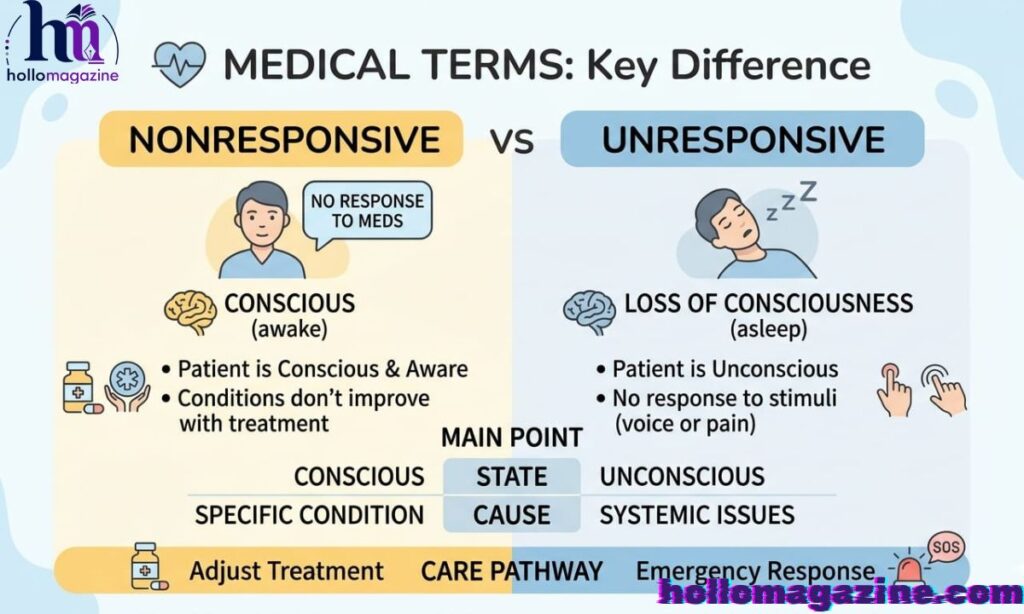
Although both words involve a lack of response, they are not always interchangeable.
| Feature | Nonresponsive | Unresponsive |
| Main Meaning | Does not reply | Does not react |
| Business Usage | Common | Less Common |
| Medical Usage | Rare | Very Common |
| Technology Usage | Occasional | Very Common |
| Surveys and Forms | Common | Uncommon |
| Emotional Context | Rare | Common |
A simple rule:
- Nonresponsive = no reply
- Unresponsive = no reaction
How People Use These Words
Understanding real-world usage helps clarify the distinction.
Unresponsive in Everyday Life
People often use unresponsive when describing:
- A person who does not react
- A medical emergency
- A frozen computer
- Emotional withdrawal
Examples:
- The child became unresponsive after fainting.
- The application is completely unresponsive.
- She seemed unresponsive during the discussion.
Nonresponsive in Everyday Life
Nonresponsive often appears in situations involving communication.
Examples:
- The vendor remained nonresponsive.
- Several customers were nonresponsive to follow-up messages.
- The organization labeled inactive accounts as nonresponsive.
The emphasis is on failure to answer rather than inability to react.
Examples in Sentences
Unresponsive
Examples include:
- The patient was unresponsive to treatment.
- My phone became unresponsive.
- He remained unresponsive to criticism.
- The software turned unresponsive after installation.
- The witness appeared unresponsive during questioning.
Nonresponsive
Examples include:
- The company was nonresponsive to complaints.
- The participant became nonresponsive after enrollment.
- Several suppliers were nonresponsive.
- The customer remained nonresponsive for weeks.
- The survey included numerous nonresponsive entries.
Read This: Shakey or Shaky the Complete Guide
Quick Guide When to Use Which
1. Human or Patient Reactions → Use Unresponsive
Medical professionals typically use unresponsive when someone fails to react physically or mentally.
Examples:
- Unresponsive patient
- Unresponsive individual
- Unresponsive to stimuli
2. Device or System Failures → Usually Unresponsive
Technology contexts almost always favor unresponsive.
Examples:
- Unresponsive computer
- Unresponsive application
- Unresponsive touchscreen
3. Emails, Surveys, or Formal Communication → Use Nonresponsive
Administrative settings generally use nonresponsive.
Examples:
- Nonresponsive client
- Nonresponsive respondent
- Nonresponsive account holder
4. Emotional Detachment → Use Unresponsive
When discussing emotions or behavior, unresponsive is usually preferred.
Examples:
- Emotionally unresponsive
- Socially unresponsive
- Unresponsive partner
5. Quick Memory Hack Nonresponsive Vs Unresponsive
Remember:
- Nonresponsive = No Reply
- Unresponsive = No Reaction
This simple distinction works in most situations.
Bonus Table Quick Reference
| Situation | Preferred Word |
| Medical Emergency | Unresponsive |
| Frozen Software | Unresponsive |
| Ignored Emails | Nonresponsive |
| Survey Participants | Nonresponsive |
| Emotional Behavior | Unresponsive |
| Customer Follow-Up | Nonresponsive |
Case Studies
Case Study 1: Medical Context
A paramedic arrives at an accident scene.
Correct usage:
“The patient was unresponsive.”
Why?
Because the patient is not reacting to physical stimuli, which falls under the meaning of unresponsive.
Using nonresponsive here would sound unusual and potentially incorrect in medical communication.
Case Study 2: Business Context
A company repeatedly contacts a supplier regarding an overdue contract.
Correct usage:
“The supplier remained nonresponsive.”
Why?
The issue involves communication and a lack of reply rather than a lack of physical or emotional reaction.
This makes nonresponsive the better choice.
Common Mistakes Nonresponsive Vs Unresponsive
1. Using “Unresponsive” for Clients or Survey Entries
While not always wrong, nonresponsive is often more precise.
Less precise:
- The survey participant was unresponsive.
More precise:
- The survey participant was nonresponsive.
2. Using “Nonresponsive” for Patients or Medical Situations
This is one of the most common errors.
Incorrect:
- The patient was nonresponsive.
Preferred:
- The patient was unresponsive.
Medical professionals overwhelmingly favor unresponsive.
3. Confusing Emotional Indifference with Procedural Non-Reply
Examples:
- Emotionally distant person → Unresponsive
- Customer ignoring emails → Nonresponsive
Understanding the context is essential.
4. Hyphenation Errors
Writers sometimes use:
- Non-responsive
- Un-responsive
Modern style guides generally prefer:
- Nonresponsive
- Unresponsive
Single-word forms are usually recommended.
5. Overusing “Irresponsive”
Some writers mistakenly use irresponsive.
Although it exists historically, it is uncommon in modern English.
Prefer:
- Nonresponsive
- Unresponsive
Quick Recap of Common Mistakes
Avoid:
- Using nonresponsive in medical emergencies
- Using unresponsive for survey data
- Mixing emotional and administrative meanings
- Adding unnecessary hyphens
- Using outdated alternatives
Everyday Usage Table
| Everyday Situation | Correct Choice |
| Person ignores email | Nonresponsive |
| Patient won’t react | Unresponsive |
| Frozen phone screen | Unresponsive |
| Customer avoids communication | Nonresponsive |
| Emotionally detached friend | Unresponsive |
| Survey participant skips responses | Nonresponsive |
| Software stops functioning | Unresponsive |
| Vendor ignores requests | Nonresponsive |
Reference Cambridge Dictionary Definitions
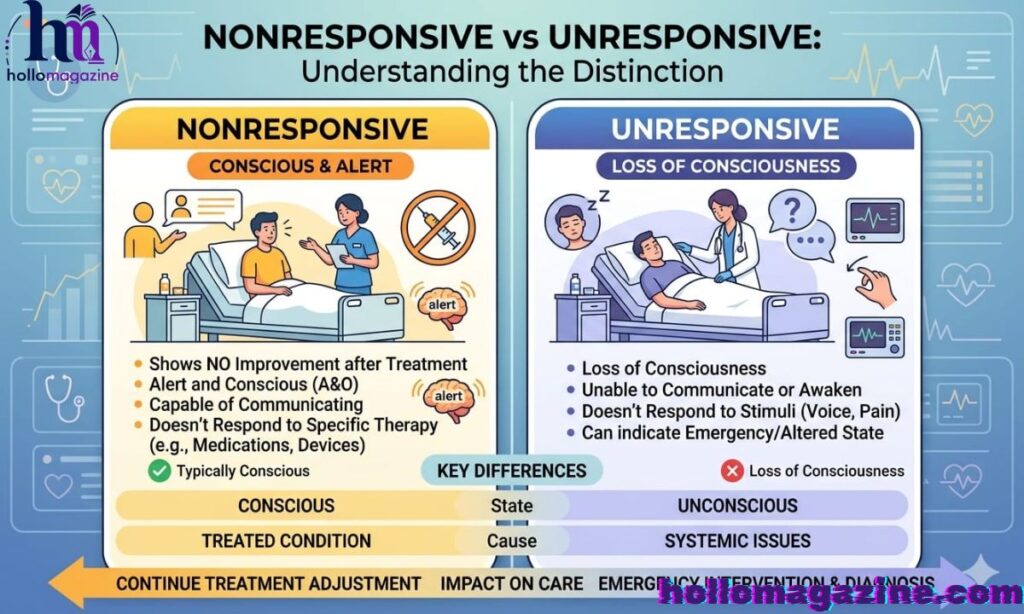
Cambridge Dictionary generally defines unresponsive as not reacting or showing a reaction to something. The term is commonly used for people, medical conditions, technology, and emotional behavior.
The word nonresponsive is typically used in formal, administrative, and communication contexts to describe someone or something that does not respond when a response is expected. The distinction often depends on whether the issue involves a lack of reaction or a lack of reply.
Conclusion
The difference between nonresponsive and unresponsive is subtle but important. While both words involve an absence of response, unresponsive usually refers to a lack of reaction, especially in medical, emotional, or technological contexts. Nonresponsive, on the other hand, is most often used when someone fails to reply in business, administrative, or communication settings.
Choosing the correct term improves clarity and professionalism. A simple way to remember the distinction is that nonresponsive typically means “no reply,” while unresponsive usually means “no reaction.” Keeping this rule in mind will help you use both words accurately.
Frequently Asked Questions
Is nonresponsive the same as unresponsive?
No. Nonresponsive usually means not replying, while unresponsive usually means not reacting.
Which word is used in medicine?
Unresponsive is the standard term in medical settings.
Is nonresponsive a real word?
Yes. It is widely used in business, administration, and research.
Can a computer be nonresponsive?
It can, but unresponsive is much more common and preferred.
Which word should I use for ignored emails?
Nonresponsive is usually the better choice.
Is unresponsive used for emotions?
Yes. It often describes emotional detachment or lack of reaction.
Should I hyphenate nonresponsive?
Most modern style guides prefer the single-word form nonresponsive.
What is the easiest way to remember the difference?
Think: nonresponsive equals no reply, while unresponsive equals no reaction.

Rimsha creates simple grammar guides, English writing tips, and word meaning content for readers at Hollo Magazine.