
Learning the difference between shown and showed is important for clear and professional English. Many learners use these words interchangeably because both come from the verb show. However, they have different grammatical functions and cannot always replace one another.
Understanding when to use showed and when to use shown will improve your writing, speaking, and exam performance. In this guide, you will learn the definitions, grammar rules, examples, common mistakes, and practical tips that make this topic easy to master.
Definition
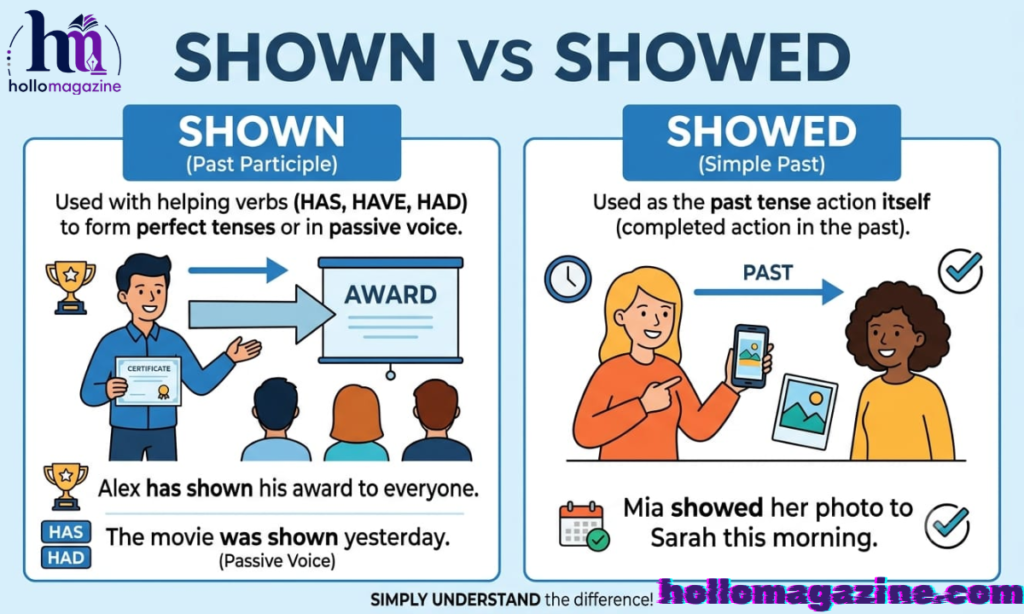
Showed is the simple past tense form of the verb show.
Shown is the past participle form of show and is usually used with helping verbs such as has, have, had, was, or were.
| Word | Grammar Function | Example |
| Showed | Simple Past Tense | She showed me the report. |
| Shown | Past Participle | She has shown me the report. |
Understanding the Verb “Show”
The verb show is an irregular verb. Unlike regular verbs, its past tense and past participle forms are different.
| Verb Form | Word |
| Base Form | Show |
| Simple Past | Showed |
| Past Participle | Shown |
Examples:
- I show my work every day.
- I showed my work yesterday.
- I have shown my work many times.
When to Use “Showed” — The Simple Past Tense
Use showed when describing an action that happened and finished in the past.
Examples
- She showed me her new phone.
- They showed the presentation yesterday.
- The teacher showed us the correct answer.
- He showed great courage during the competition.
When to Use It
Use showed when:
- The action is complete.
- A specific past time is mentioned.
- No helping verb is present.
Examples:
- We showed our project last week.
- She showed the documents this morning.
- He showed me the photos yesterday.
When to Use “Shown” — The Past Participle
Shown is the past participle form and normally appears with helping verbs.
Examples
- She has shown remarkable improvement.
- The results were shown on the screen.
- I have shown my passport.
- They had shown interest before the meeting.
How to Spot It
A simple trick:
If you see a helping verb such as has, have, had, was, were, been, use shown.
Correct:
- Has shown
- Have shown
- Had shown
- Was shown
Incorrect:
- Has showed
- Have showed
Why “Shown” Matters in Perfect Tenses
Perfect tenses connect actions across time. Because shown is a past participle, it is required in perfect tenses.
Examples:
- She has shown excellent leadership.
- They have shown dedication throughout the project.
- He had shown signs of improvement before the exam.
Using showed in these situations is considered incorrect in standard English.
Read This: Persue or Pursue: Correct Spelling, Meaning, and Usage Guide
Breaking Down Perfect Tenses (with “Shown”)
| Tense | Structure | Example |
| Present Perfect | Has/Have + Shown | She has shown progress. |
| Past Perfect | Had + Shown | He had shown interest. |
| Future Perfect | Will Have + Shown | They will have shown the results. |
Remember:
- Perfect tenses require shown.
- They do not require showed.
“Have Showed” vs “Have Shown” — The Grammar Test
This is one of the most common grammar mistakes.
| Phrase | Correct? |
| Have shown | ✔ Correct |
| Have showed | ✘ Incorrect |
Examples:
✔ I have shown my identification.
✘ I have showed my identification.
Pronunciation Flow
In everyday speech, have shown flows naturally together, which is one reason native speakers use it consistently.
Examples:
- We have shown improvement.
- They have shown great effort.
Real-Life Examples and Common Usage Notes
You will encounter these forms in many situations.
Examples:
Business Writing
- I have shown the latest report to the manager.
School Writing
- The teacher showed us how to solve the equation.
Everyday Conversation
- She showed me the restaurant.
- He has shown me that website before.
Regional Note
In some informal dialects, people occasionally say have showed, but standard grammar strongly prefers have shown in professional, academic, and formal writing.
Side-by-Side Comparison: “Shown” vs “Showed”
| Feature | Showed | Shown |
| Verb Form | Simple Past | Past Participle |
| Needs Helper Verb | No | Yes |
| Used for Completed Past Actions | Yes | No |
| Used in Perfect Tenses | No | Yes |
| Used in Passive Voice | No | Yes |
Examples:
- She showed me the map.
- She has shown me the map.
Quick Reference Summary Table
| Situation | Correct Form |
| Yesterday | Showed |
| Last week | Showed |
| Has/Have/Had | Shown |
| Passive voice | Shown |
| Present perfect | Shown |
| Past perfect | Shown |
Quick Memory Tips to Remember
Use these simple tricks:
- Showed = Past Action
- Shown = Needs a Helper
- Remember the sequence: Show → Showed → Shown
Examples:
- Yesterday = Showed
- Has = Shown
- Have = Shown
- Had = Shown
Common Mistakes and How to Avoid Them
Mistake 1: Using “Have Showed”
Incorrect:
- I have showed the report.
Correct:
- I have shown the report.
Mistake 2: Using “Shown” Alone
Incorrect:
- I shown the report yesterday.
Correct:
- I showed the report yesterday.
Mistake 3: Confusing Past Tense and Past Participle
Incorrect:
- She has showed improvement.
Correct:
- She has shown improvement.
Case Study: A Common Workplace Mix-Up
Imagine an employee writing:
“I have showed the presentation to the client.”
Although the meaning is understood, it appears grammatically incorrect in professional communication.
A better version is:
“I have shown the presentation to the client.”
Small grammar improvements like this increase credibility and professionalism.
Linguistic Insight & Expert Opinion
English contains many irregular verbs with different past tense and past participle forms.
Examples:
| Base Verb | Past Tense | Past Participle |
| Show | Showed | Shown |
| See | Saw | Seen |
| Write | Wrote | Written |
| Speak | Spoke | Spoken |
Learning these patterns helps improve overall grammar accuracy and fluency.
Self Assessment Section
Choose the correct answer:
- She _____ me the report yesterday.
- A) shown
- B) showed
- They have _____ great improvement.
- A) showed
- B) shown
- The results were _____ on the screen.
- A) showed
- B) shown
Answers:
- B) showed
- B) shown
- B) shown
Conclusion
Understanding the difference between shown and showed is easier once you know their grammatical roles. Showed is the simple past tense used for completed actions in the past, while shown is the past participle used with helping verbs and passive constructions.
Mastering this distinction will make your writing more accurate, professional, and confident. Whenever you are unsure, remember the simple rule: if a helping verb is present, use “shown”; if not, use “showed.”
Frequently Asked Questions
Is “shown” or “showed” correct?
Both are correct, but they serve different grammatical purposes.
Can I say “have showed”?
Standard English prefers have shown, not have showed.
Is “shown” a past tense?
No. Shown is the past participle form of show.
When should I use “showed”?
Use showed for completed actions in the simple past tense.
Why is “show” an irregular verb?
Because its past tense and past participle forms are different from the standard “-ed” pattern.

Rimsha creates simple grammar guides, English writing tips, and word meaning content for readers at Hollo Magazine.