
Understanding modern expressions used in science, space missions, and everyday conversation can be confusing, especially when they come from technical fields. One such phrase is “T minus”, which is widely recognized in countdowns, rocket launches, and timing-related announcements. Even though it sounds technical, it has become part of everyday English usage.
In simple terms, “T minus” is used to describe the time remaining before a specific event happens. You will often hear it in movies, news broadcasts, and space agency communications. This article explains its meaning, origin, usage, and alternative expressions in a clear and practical way.
What is the meaning of the phrase ‘T minus’?
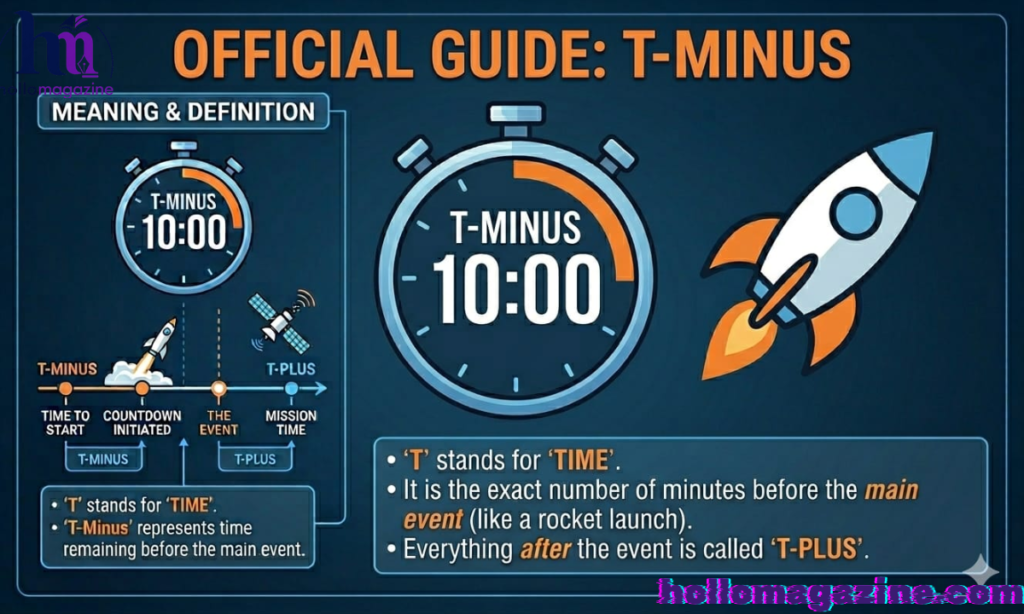
The phrase “T minus” refers to a countdown expression used to indicate the time remaining before a specific event occurs. The “T” stands for a target time or event, and “minus” shows the time left before that moment.
Simple meaning:
- “T minus 10 minutes” = 10 minutes before the event happens
- “T minus 5 seconds” = 5 seconds before launch or start
- It is used in countdown systems for precision timing
Key idea behind the phrase:
- “T” = Target event time
- “Minus” = Time remaining before that event
Common usage examples:
- T minus 60 seconds until launch
- T minus 10 minutes before the ceremony
- T minus 5 seconds and counting
Important note:
It is mainly used in structured timing environments like space missions, aviation, military operations, and sometimes casual speech for dramatic effect.
What is the origin of the phrase ‘T minus’?
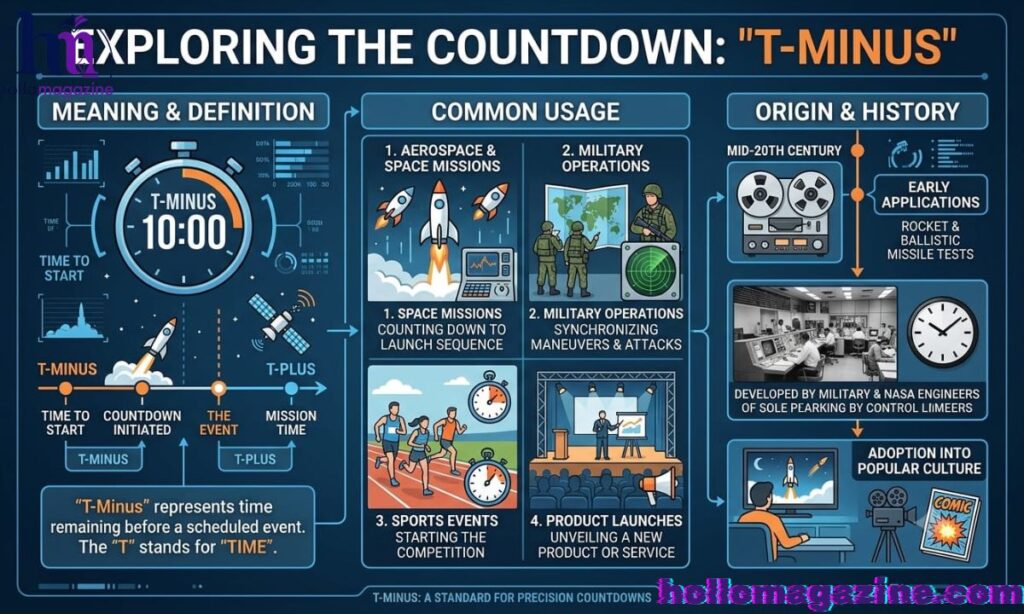
The origin of “T minus” comes from scientific and aerospace terminology, particularly from NASA and rocket launch procedures. Engineers needed a precise and standardized way to communicate countdown timing before liftoff or mission start.
Historical background:
- Developed during early rocket launch systems
- Used in NASA countdown procedures
- Adopted in military and aviation operations
- Later became popular in movies and media
Why “T” was used:
- “T” stands for Time or Target Time
- It represents the exact moment of an event (like launch)
- Everything before that moment is measured as “minus time”
Example from space missions:
- T minus 10 minutes: Final system checks
- T minus 1 minute: Crew readiness confirmation
- T minus 0: Launch moment
Pop culture influence:
The phrase became widely recognized due to:
- Space movies
- Science documentaries
- News coverage of rocket launches
- Live countdown events
Today, it is also used humorously in everyday speech.
How and when can you use the phrase ‘T minus’?
The phrase “T minus” is used in both formal and informal contexts, depending on the situation. It is most commonly used when counting down to an important event.
Formal usage:
- Space launches
- Aviation timing
- Military operations
- Scientific experiments
Informal usage:
- Event countdowns
- Parties or weddings
- Exams or deadlines
- Social media posts
Example sentences:
- T minus 2 hours until the concert starts.
- We are at T minus 10 minutes before the meeting begins.
- T minus 30 seconds before the fireworks.
When to use it:
- When you want to emphasize anticipation
- When describing countdowns
- When talking about scheduled events
When NOT to use it:
- Casual conversations without timing context
- General statements not involving countdowns
- Overusing in formal academic writing
Read This: Reevaluation or Re-evaluation: Hyphen Rules in American English
What are some other ways of saying T minus’?
There are several alternative ways to express the same idea as “T minus,” depending on tone and context.
Simple alternatives:
- X minutes before
- Time remaining: X minutes
- X minutes to go
- Countdown of X minutes
Formal alternatives:
- Remaining time before event
- Time until scheduled event
- Pre-event countdown
- Time left until initiation
Informal alternatives:
- Almost time
- Just a few minutes left
- Getting close
- About to start soon
Comparison table:
| Expression | Usage Style | Example |
| T minus 10 | Technical / dramatic | T minus 10 minutes |
| 10 minutes left | Neutral | 10 minutes left before start |
| Almost time | Informal | Almost time for launch |
| Time remaining | Formal | Time remaining: 10 minutes |
Language tip:
Use “T minus” when you want a dramatic or technical tone, especially in storytelling or structured events.
Why “T minus” became popular
The popularity of this phrase is linked to science communication and entertainment media.
Key reasons:
- Used in NASA broadcasts
- Featured in movies and documentaries
- Easy to understand globally
- Creates excitement and anticipation
Modern usage trend:
Today, people use it not only for rockets but also for:
- Exams
- Meetings
- Events
- Product launches
Real-life examples
- T minus 5 minutes until the exam starts.
- T minus 1 hour before the wedding ceremony.
- T minus 30 seconds until the countdown ends.
- T minus 3 days to the product launch.
conclusion
The phrase “T minus” is a widely used countdown expression that originated in aerospace and scientific communication. It represents the time remaining before a specific event, where “T” stands for the target moment and “minus” indicates time left. Over time, it has evolved from technical jargon into everyday language used in media, events, and casual conversation.
Understanding this phrase helps learners interpret countdown-based communication more clearly and use it effectively in both formal and informal contexts. Whether in space launches or simple daily events, “T minus” adds clarity, structure, and a sense of anticipation to timing expressions.
Frequently Asked Questions
What does T minus mean?
It means the time remaining before a specific event occurs.
Why is it called T minus?
“T” stands for target time, and “minus” shows time left before that moment.
Is T minus only used in space launches?
No, it is also used in everyday events and informal speech.
Can I use T minus in writing?
Yes, especially when describing countdowns or scheduled events.
What is the opposite of T minus?
“T plus,” which indicates time after the event has started.
Is T minus formal or informal?
It can be both, depending on context, but it is more technical in origin.

Rimsha creates simple grammar guides, English writing tips, and word meaning content for readers at Hollo Magazine.