
English spelling and punctuation rules can sometimes create confusion, especially when prefixes are involved. One common question writers ask is whether the correct form is reevaluation or re-evaluation. Both versions appear in books, articles, and online content, making it difficult to know which one should be used.
The good news is that understanding a few simple hyphenation rules can solve this problem. In modern American English, language authorities generally favor reevaluation without a hyphen, but there are situations where writers still choose the hyphenated form for clarity and style.
What Is Hyphenation and Why It’s Confusing
A hyphen is a punctuation mark used to connect words or parts of words. It often appears in compound adjectives, compound nouns, and words formed with prefixes.
Examples include:
- Well-known author
- Long-term project
- Self-esteem
- Re-enter
The confusion arises because English hyphenation rules have changed over time. Many words that once required a hyphen are now commonly written as single words.
For example:
| Older Form | Modern Form |
| On-line | Online |
| Co-operation | Cooperation |
| Re-evaluation | Reevaluation |
As language evolves, hyphens tend to disappear unless they improve readability.
The Prefix “Re-”: What It Means and Why It Matters
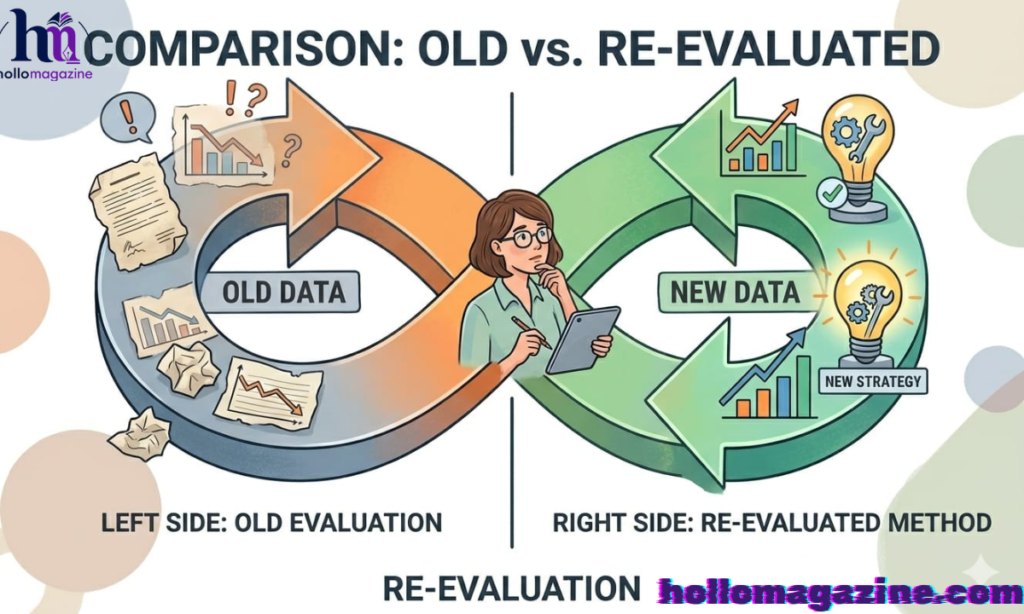
The prefix re- comes from Latin and generally means:
- Again
- Back
- A second time
Examples:
- Rebuild = build again
- Rewrite = write again
- Reconsider = consider again
- Reevaluate = evaluate again
Because the prefix appears so frequently in English, writers often wonder whether it should be attached directly to the base word or separated by a hyphen.
When to Use a Hyphen with “Re-”
In most modern American English writing, words beginning with re- are written as one word.
Examples:
- Reconsider
- Reapply
- Reorganize
- Reevaluate
- Reevaluation
However, a hyphen may still be useful when removing it could create confusion.
Common situations include:
- Re-enter
- Re-elect
- Re-examine
- Re-create (meaning create again)
Without the hyphen, some words become difficult to read or may suggest a different pronunciation.
Reevaluation vs. Re-evaluation: What Authorities Say
Most major dictionaries and style guides recognize reevaluation as the preferred modern spelling.
Professional editors increasingly favor the closed form because it reflects contemporary American English usage.
Language authorities generally recommend:
✔ Reevaluation
rather than:
✖ Re-evaluation
unless a specific style guide requires otherwise.
This trend reflects the broader movement toward simplified spelling and reduced hyphenation.
Reevaluation vs. Re-evaluation in American English
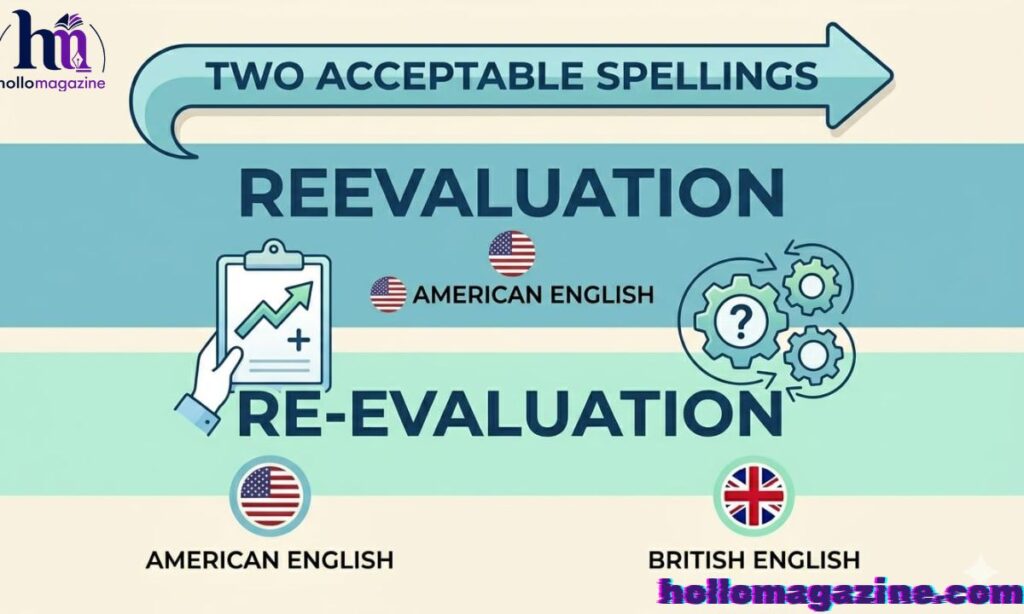
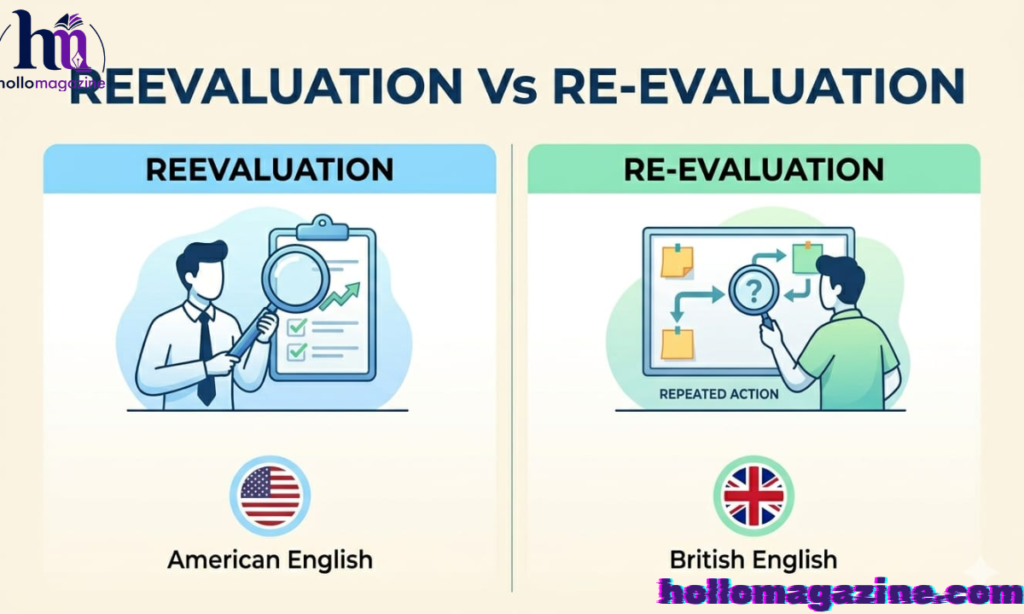
American English strongly favors reevaluation as a single word.
Examples:
- The company completed a reevaluation of its policies.
- A reevaluation of the budget was necessary.
- The school conducted a reevaluation of its curriculum.
Although re-evaluation remains understandable, it often appears less modern and may seem unnecessarily formal.
Quick comparison:
| Form | American English Preference |
| Reevaluation | Preferred |
| Re-evaluation | Acceptable but less common |
For SEO writing, business communication, and academic content, reevaluation is typically the safer choice.
Read This: WRYD Meaning Everything You Need to Know
Why Some Writers Still Use the Hyphen
Despite the growing preference for reevaluation, some writers continue using re-evaluation.
Reasons include:
- Personal style preferences
- Older editorial standards
- Visual clarity
- Traditional publishing conventions
Some readers find the hyphen easier to process because it clearly separates the prefix from the root word.
For example:
- Re-evaluation
can appear visually clearer than:
- Reevaluation
especially in lengthy documents.
Common Errors and Corrections
Writers frequently make mistakes when using reevaluation.
Common errors include:
| Incorrect | Correct |
| Re evaluation | Reevaluation |
| Ree valu ation | Reevaluation |
| Re-Evaluation | Reevaluation |
| Reevaluation processs | Reevaluation process |
Tips:
- Avoid inserting spaces.
- Follow your style guide consistently.
- Use one version throughout a document.
Consistency matters more than switching between forms.
Clarity Always Comes First
The primary purpose of writing is communication.
If removing a hyphen creates confusion, keeping it may be the better choice.
Examples:
- Re-sign (sign again)
- Resign (quit a job)
Here, the hyphen changes meaning completely.
Fortunately, reevaluation rarely creates this problem because the meaning remains clear without punctuation.
Good writing prioritizes reader understanding above rigid rules.
Capitalization and Hyphenation in Titles
Writers often wonder how reevaluation should appear in headlines and titles.
Examples:
- Reevaluation of Business Strategies
- A Reevaluation of Modern Education
- Economic Reevaluation in 2026
If a publication uses the hyphenated form, capitalization follows normal title-case rules:
- Re-Evaluation of Marketing Plans
The key is maintaining consistency across the entire document.
The Future of the Hyphen
Language trends suggest that hyphens will continue disappearing from many words.
Modern English increasingly favors:
- Email instead of e-mail
- Online instead of on-line
- Reevaluation instead of re-evaluation
Digital communication encourages shorter, cleaner spellings that are easier to type and search.
Many editors predict that reevaluation will become even more dominant in future writing.
Quick Reference Chart: “Re-” Hyphen Rules
| Word Type | Preferred Form |
| Reevaluate | No hyphen |
| Reevaluation | No hyphen |
| Rebuild | No hyphen |
| Reconsider | No hyphen |
| Re-enter | Hyphen often recommended |
| Re-elect | Hyphen recommended |
| Re-examine | Hyphen commonly used |
| Re-create | Hyphen for clarity |
This chart covers many of the most common situations writers encounter.
Best Practices for Using “Re-” Words
To write confidently:
- Follow modern dictionary spellings.
- Use reevaluation in most American English contexts.
- Add a hyphen when clarity improves.
- Stay consistent throughout a document.
- Follow organizational style guides when required.
A simple editing review can prevent unnecessary hyphenation mistakes.
Reference: Cambridge Dictionary Definitions
Cambridge Dictionary lists reevaluate as a verb meaning to consider something again in order to make a new judgment or decision. The related noun form, reevaluation, refers to the process of reviewing or assessing something again.
This dictionary treatment aligns with modern American English usage, where the closed form without a hyphen is generally preferred in everyday writing, academic content, and professional communication.
Conclusion
The debate between reevaluation and re-evaluation is largely a matter of modern style rather than meaning. Both forms communicate the same idea, but contemporary American English increasingly favors reevaluation without a hyphen.
For most writers, students, professionals, and content creators, using reevaluation is the best choice because it matches current dictionary preferences and common publishing standards. When clarity is not an issue, the simpler spelling is usually the stronger option.
Frequently Asked Questions
Is reevaluation or re-evaluation correct?
Both are correct, but reevaluation is generally preferred in modern American English.
Why is reevaluation written without a hyphen?
Most modern style guides favor closed forms for common re- words unless clarity requires a hyphen.
Does Cambridge Dictionary use reevaluation?
Yes, Cambridge recognizes reevaluate and related forms without requiring a hyphen.
Is re-evaluation wrong?
No. It is still acceptable, though less common than reevaluation.
Which spelling should I use in academic writing?
Reevaluation is usually the preferred choice unless your institution follows a specific style guide.
Are reevaluate and reevaluation different?
Yes. Reevaluate is a verb, while reevaluation is a noun.
Should all re- words lose their hyphens?
No. Some words such as re-enter and re-elect often keep the hyphen for clarity.
Does British English prefer re-evaluation?
Some British publications still use the hyphen more frequently, but reevaluation is increasingly common there as well.

Rimsha creates simple grammar guides, English writing tips, and word meaning content for readers at Hollo Magazine.