
Many English learners and even native speakers occasionally write “eventhough” as a single word. Because the phrase is spoken quickly in conversation, it often sounds like one word, which leads to confusion when writing. However, standard English grammar follows a clear rule regarding this expression.
Understanding the difference between eventhough vs even though is important for accurate writing, professional communication, academic work, and everyday English. A small spelling mistake can affect clarity and credibility, especially in formal situations. This guide explains everything you need to know in simple, practical language.
Definition: Eventhough vs Even Though
The difference is straightforward:
| Form | Correct? | Meaning |
| Even though | ✅ Yes | Although; despite the fact that |
| Eventhough | ❌ No | Not recognized in standard English |
Even though is a conjunction used to introduce contrast between two ideas.
Examples:
- Even though it was raining, we went outside.
- She finished the race even though she was tired.
- Even though the task was difficult, he completed it successfully.
The single-word form eventhough is considered a spelling error.
Why This Tiny Spelling Error Matters More Than You Think
Many people view this as a minor typo, but correct spelling influences how readers perceive your writing.
Benefits of using the correct form:
- Improves readability
- Demonstrates language proficiency
- Increases professional credibility
- Helps avoid grammar-checker warnings
- Strengthens academic writing
A small mistake repeated throughout a document can create a negative impression.
The Root of the Confusion: Why “Eventhough” Feels Right but Isn’t
People usually write eventhough because of pronunciation.
When spoken naturally, the phrase often sounds blended:
- even though → eventhough
This happens with many English expressions. However, spoken pronunciation does not always determine spelling.
Examples:
- A lot → not alot
- In spite of → not inspiteof
- Even though → not eventhough
The phrase remains two separate words.
The Grammar Rule Explained Simply
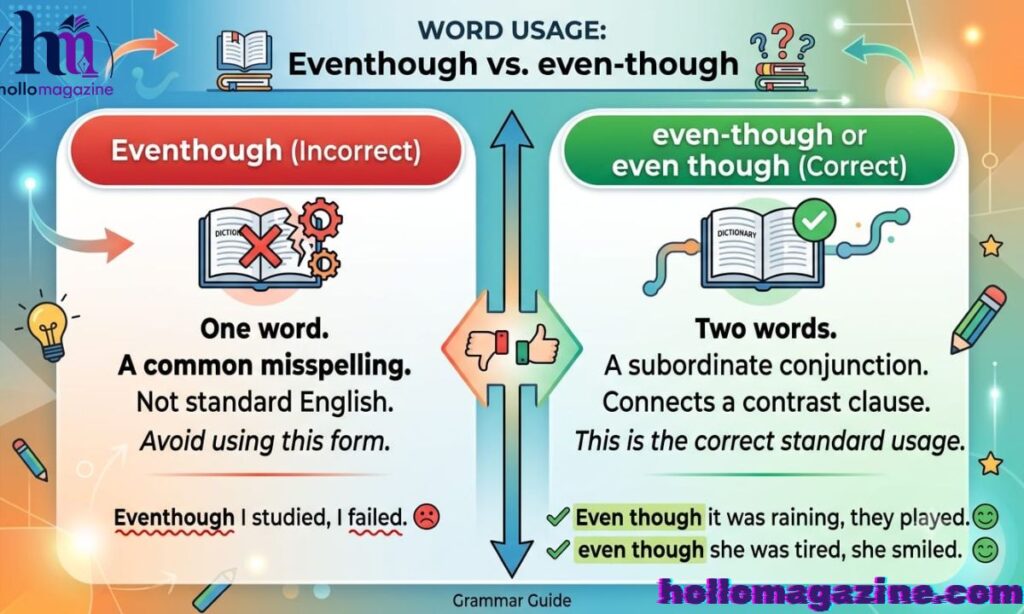
Even though functions as a subordinating conjunction.
It connects two clauses while showing contrast.
Structure:
Even though + clause, main clause
Examples:
- Even though he studied hard, he felt nervous.
- Even though they arrived late, they enjoyed the event.
Alternative structure:
Main clause + even though + clause
Examples:
- We continued working even though the power failed.
- She smiled even though she was disappointed.
A Quick Look Back: Origin & Historical Usage of “Even Though”
The phrase developed from combining:
- Even (used for emphasis)
- Though (meaning although)
For centuries, English writers have treated these words as separate components.
Historical texts consistently show:
- even though
- even if
- even when
The merged spelling eventhough has never become accepted in formal English.
Read This: Distress vs Duress Differences and Correct Usage
Why “Eventhough” Will Never Be Correct — Linguistically or Grammatically
Languages evolve, but not every common typo becomes a legitimate word.
Reasons eventhough remains incorrect:
- Major dictionaries do not recognize it.
- Grammar authorities reject it.
- Academic style guides prohibit it.
- Professional editors correct it automatically.
As a result, even though remains the only accepted spelling.
Real Costs of Using the Wrong Form
Using eventhough can create problems in:
- School assignments
- Job applications
- Professional emails
- Business reports
- Academic papers
Potential consequences include:
- Lower grades
- Editing corrections
- Reduced credibility
- Negative first impressions
Common Myths & Misconceptions About “Eventhough”
Myth 1: Eventhough is British English
False. Both American and British English use even though.
Myth 2: Eventhough is an accepted alternative
False. It is considered a spelling mistake.
Myth 3: Online usage makes it correct
False. Frequent misuse does not create grammatical correctness.
How to Use “Even Though” Naturally in Sentences
Here are practical examples:
- Even though it was cold, we went hiking.
- Even though she disagreed, she remained polite.
- Even though the restaurant was crowded, service was quick.
- Even though he practiced daily, he stayed humble.
- Even though the exam was difficult, many students passed.
These examples show contrast between expectation and reality.
Common Mistakes and How to Fix Them
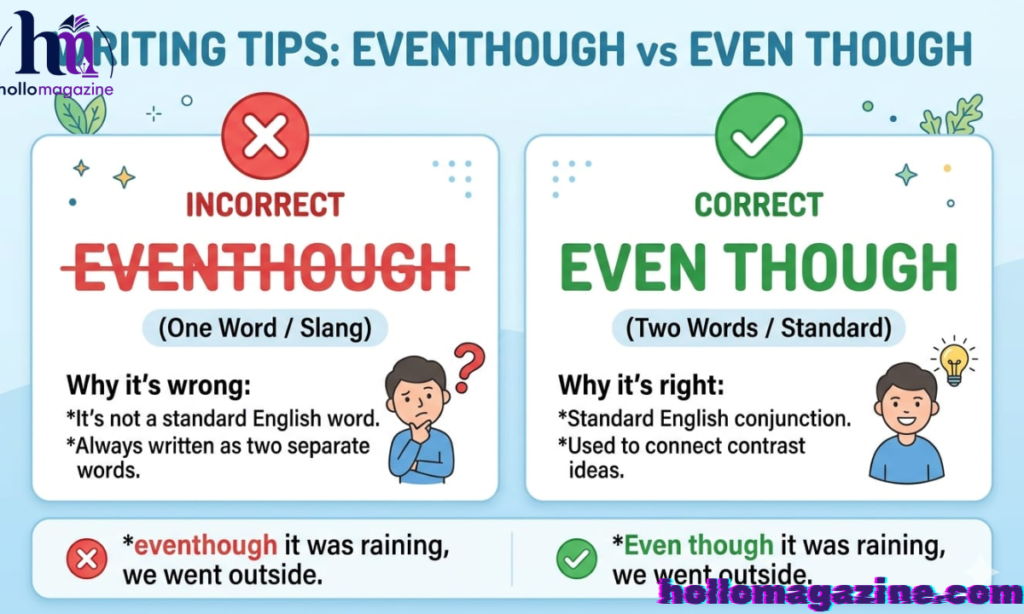
| Incorrect | Correct |
| Eventhough I was tired | Even though I was tired |
| Eventhough it rained | Even though it rained |
| Eventhough she arrived late | Even though she arrived late |
| Eventhough we disagreed | Even though we disagreed |
Quick Fix
Whenever you write eventhough, simply separate it into:
even + though
Table of Comparison: Eventhough vs Even Though
| Feature | Eventhough | Even Though |
| Standard English | No | Yes |
| Dictionary Recognition | No | Yes |
| Formal Writing | Incorrect | Correct |
| Academic Writing | Incorrect | Correct |
| Professional Writing | Incorrect | Correct |
| Everyday Usage | Mistake | Recommended |
Why the Ear Tricks the Eye: Pronunciation vs. Spelling
English pronunciation often compresses words together.
Examples:
- gonna
- wanna
- kinda
Similarly, people may hear even though as one sound.
However, formal writing follows spelling rules rather than pronunciation habits.
The Global View: Do Other Languages Merge Similar Phrases?
Many languages combine words that English keeps separate.
For example:
- German often creates compound words.
- Dutch frequently joins related terms.
- Scandinavian languages also combine words.
English sometimes creates compounds, but even though has remained two separate words.
The Digital Factor: Autocorrect, Spellcheck & Internet Trends
Modern technology has helped reduce this error.
Most:
- Spellcheckers
- Grammar tools
- Writing assistants
automatically flag eventhough and suggest even though.
Still, writers should understand the rule rather than relying entirely on software.
Linguistic Insight: Why Word Separation Matters
Word separation helps readers understand grammatical relationships.
In even though:
- even = intensifier
- though = conjunction
Keeping them separate preserves their grammatical roles and improves clarity.
Expert Opinion: What Grammar Authorities Agree On
Grammar experts consistently agree on one point:
✅ Even though = correct
❌ Eventhough = incorrect
Major dictionaries, style manuals, and educational resources all support this rule.
Tricks to Remember the Correct Form (Mnemonic Magic)
Use these memory tricks:
- If you can see though, leave a space before it.
- Think: even + though = two words.
- Remember that though is already a complete word.
Quick reminder:
If you write “eventhough,” add a space.
Quick Grammar Check: Smart Alternatives to “Even Though”
You can sometimes replace even though with:
- Although
- Though
- Despite the fact that
- While
- Whereas
Examples:
- Even though it rained, we played.
- Although it rained, we played.
Both are correct.
Fix Your Writing Instantly: Real-Life Examples
Before
- Eventhough I was nervous, I gave the presentation.
After
- Even though I was nervous, I gave the presentation.
Before
- Eventhough the road was long, we continued.
After
- Even though the road was long, we continued.
These simple corrections improve accuracy immediately.
Why Getting It Right Boosts Credibility and Confidence
Correct grammar helps readers focus on your message rather than your mistakes.
Benefits include:
- Better communication
- Higher confidence
- Stronger professional image
- Improved academic performance
- Greater reader trust
Small details often create the biggest impact.
Self Assessment
Answer these questions:
- Is “eventhough” correct?
- Which form is accepted in formal writing?
- Does pronunciation determine spelling?
- Can “although” sometimes replace “even though”?
- Should “even” and “though” be written separately?
Answers
- No
- Even though
- No
- Yes
- Yes
conclusion
The difference between eventhough and even though is simple but important. Only even though is recognized in standard English. It functions as a conjunction that introduces contrast and should always be written as two separate words.
By understanding this rule and practicing it consistently, you can avoid a common spelling mistake that affects many writers. Whether you’re writing emails, essays, reports, or social media posts, using even though correctly will make your writing clearer, more professional, and more credible.
Frequently Asked Questions
Is eventhough a real word?
No. It is considered a spelling error in standard English.
Is even though one word or two?
It is always written as two separate words.
Can I use eventhough in informal writing?
No. Even in casual writing, the correct form is even though.
Can although replace even though?
Often yes, although slight differences in emphasis may exist.
Why do people write eventhough?
Because the phrase is commonly pronounced quickly and sounds like a single word.

Rimsha creates simple grammar guides, English writing tips, and word meaning content for readers at Hollo Magazine.