
Many people use the words city, town, and village interchangeably. While they all describe places where people live, they do not mean exactly the same thing. The differences often involve population size, administrative status, infrastructure, and historical development.
Understanding the distinction between a city, town, and village is useful for geography, urban planning, education, travel, and everyday communication. This guide explains the key differences in simple language while exploring how these settlement types evolved across different countries and cultures.
Why These Three Words Confuse
The confusion exists because there is no single worldwide definition for a city, town, or village.
For example:
- A place considered a town in one country may be classified as a city in another.
- Population alone does not always determine classification.
- Historical and legal factors often influence official status.
As a result, learners frequently struggle to understand which term should be used in a specific context.
Core Concepts and Historical Evolution
Etymology and Charter Systems
The words have interesting historical origins:
| Term | Origin | Basic Meaning |
| City | Latin civitas | Organized urban community |
| Town | Old English tun | Enclosed settlement |
| Village | Latin villaticum | Small rural settlement |
Historically, many settlements became cities through royal charters or government recognition rather than population size alone.
In medieval Europe, some places gained city status because they housed cathedrals, administrative centers, or important trade routes.
Administrative Nomenclature and Legal Mechanics
Modern governments often define settlements differently.
Factors may include:
- Population
- Economic activity
- Municipal authority
- Infrastructure
- Historical designation
Because of these differences, legal definitions vary across regions.
How Population Thresholds Differ Globally
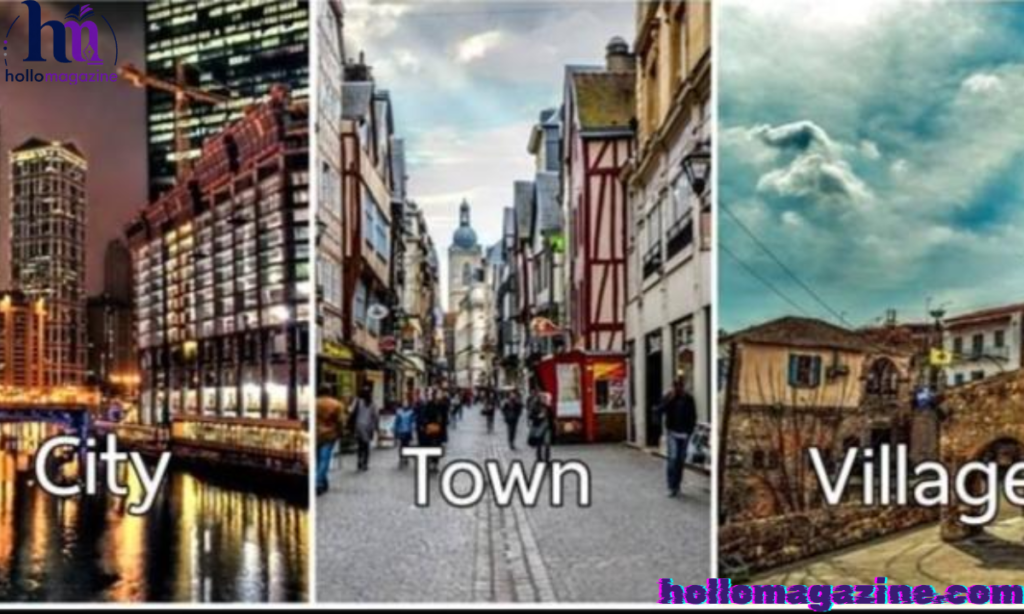
United Kingdom Standards
In the United Kingdom, city status is not automatically tied to population.
Some British cities have relatively small populations, while larger towns may remain officially classified as towns.
Examples include:
- Small cities with historical city status
- Large towns that have never received official designation
United States Framework
In the United States, classification depends largely on state laws.
Many states allow local governments to choose whether they identify as:
- City
- Town
- Village
Population often influences the choice, but legal structures differ significantly from state to state.
International Variations
Different countries apply unique standards.
| Country | Common Classification Method |
| Canada | Provincial rules |
| Germany | Administrative status |
| India | Population and governance |
| Japan | Government criteria |
| Australia | Regional legislation |
Because of these differences, direct comparisons between countries can be challenging.
Contextual Examples Across Settlement Types for City vs Town vs Village
Formal and Administrative Usage
Official documents often use specific classifications.
Examples:
- The city council approved the project.
- The town administration issued new regulations.
- The village committee organized the event.
These titles usually reflect legal status.
Casual and Conversational Contexts
In everyday conversation, people often use broader meanings.
Examples:
- I grew up in a small town.
- They moved to the city for work.
- Her grandparents live in a village.
Here, the focus is more on lifestyle and size than legal definitions.
The Nuance Trap
A common mistake is assuming population alone determines classification.
For example:
- A large town may have more residents than a small city.
- A village may expand significantly but retain its historical classification.
Always consider both administrative status and local usage.
Read This: Deem Fit — What It Means, How To Use It, And Why It Matters
Settlement Classifications in Literature
Classic Literature Analysis
Classic literature frequently uses these terms symbolically.
Common associations include:
| Settlement Type | Literary Symbolism |
| Village | Tradition, simplicity |
| Town | Community, growth |
| City | Opportunity, complexity |
Authors often use these settings to shape themes and character experiences.
Modern Urban Planning Context
Urban planners analyze settlements using factors such as:
- Population density
- Transportation networks
- Economic functions
- Land use patterns
- Public services
Modern planning focuses more on functionality than historical labels.
Synonyms and Regional Terminology
Semantic Neighbors
Related terms include:
- Hamlet
- Borough
- Municipality
- Metropolis
- Community
- Settlement
Each term carries specific meanings depending on local context.
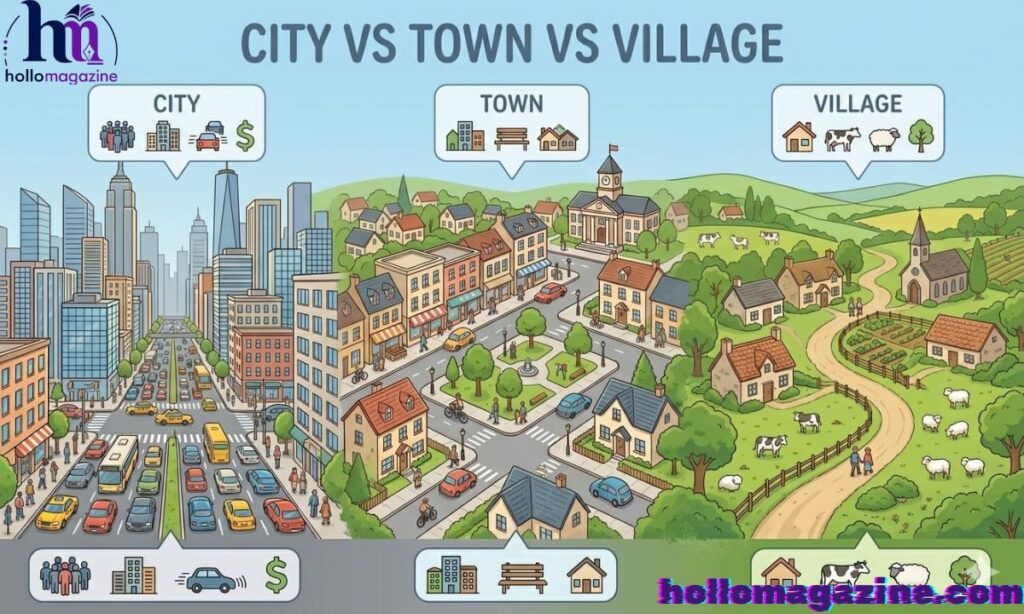
Visualizing Settlement Hierarchy: City vs Town vs Village:
A simple hierarchy looks like this:
- Hamlet
- Village
- Town
- City
- Metropolis
However, actual classifications vary by country.
Regional Variations
Different regions use unique terminology.
Examples:
- Boroughs in parts of the UK and US
- Municipalities in many countries
- Communes in some European nations
Understanding local terminology helps avoid confusion.
Common Mistakes and Classification Errors of City vs Town vs Village
Many people make these common errors:
Mistake 1: Assuming Population Is Everything
Population matters, but legal status also plays a role.
Mistake 2: Treating All Countries the Same
Every nation uses different criteria.
Mistake 3: Ignoring Historical Designations
Historical recognition often affects classification.
Mistake 4: Confusing Rural and Urban Labels
Not every town is highly urbanized, and not every village is isolated.
Quick Comparison Table
| Feature | Village | Town | City |
| Population | Small | Medium | Large |
| Infrastructure | Limited | Moderate | Extensive |
| Government Structure | Basic | More developed | Complex |
| Economic Activity | Primarily local | Mixed | Diverse |
| Services | Fewer services | More services | Extensive services |
Practical Tips and Field Notes
When I Corrected a Journalist’s Settlement Error
A journalist once referred to a legally recognized city as a town simply because its population was relatively small.
The correction highlighted an important lesson: official status often matters more than population when using these terms accurately.
This example demonstrates why checking administrative classifications is important before publishing content.
Memory Aids for Quick Decisions
Use these simple memory tricks:
- Village = Very Small
- Town = Transitional Size
- City = Complex Urban Center
Another easy method:
Think of services.
- Village → Basic services
- Town → More facilities
- City → Extensive infrastructure
These shortcuts help learners remember the hierarchy quickly.
Conclusion
Cities, towns, and villages all serve as places where people live, work, and build communities. Although they may seem similar at first glance, they differ in population size, administrative authority, infrastructure, and historical development.
Understanding these distinctions improves communication, geography knowledge, academic writing, and everyday conversations. Whether you are discussing urban planning, travel destinations, or local government structures, knowing the correct term helps you communicate more precisely and confidently.
Frequently Asked Questions
What is the main difference between a city and a town?
A city typically has larger population centers, more infrastructure, and greater administrative authority than a town.
Is a village always smaller than a town?
Generally yes, although exact definitions vary by country and legal system.
Can a town become a city?
Yes. Many towns eventually gain city status through population growth or official government designation.
Does every country use the same definitions?
No. Definitions differ significantly across countries and regions.
What is smaller than a village?
A hamlet is generally considered smaller than a village.

Rimsha creates simple grammar guides, English writing tips, and word meaning content for readers at Hollo Magazine.