
Many English learners get confused between “what happen” and “what happened.” Since both phrases sound similar, especially in casual conversations, it is easy to assume they are interchangeable. However, only one of them follows standard English grammar rules in most situations.
Understanding the difference is important for speaking, writing, exams, business communication, and everyday conversations. In this guide, you’ll learn why the confusion exists, how English verb tenses work, and exactly when to use the correct form with confidence.
Understanding Why “What Happen” Feels Right
Many people naturally say “what happen” because spoken English often moves quickly. In some regional dialects, informal speech patterns, or among English learners, verb endings may be dropped.
Reasons why it feels correct:
- It sounds similar to the correct phrase.
- Fast speech can make “happened” sound like “happen.”
- Learners often focus on meaning rather than grammar.
- Some social media posts and informal conversations contain grammatical shortcuts.
Even though it may sound acceptable in casual speech, standard English grammar treats it as incorrect when asking about a completed event.
How Verb Tenses Communicate Time
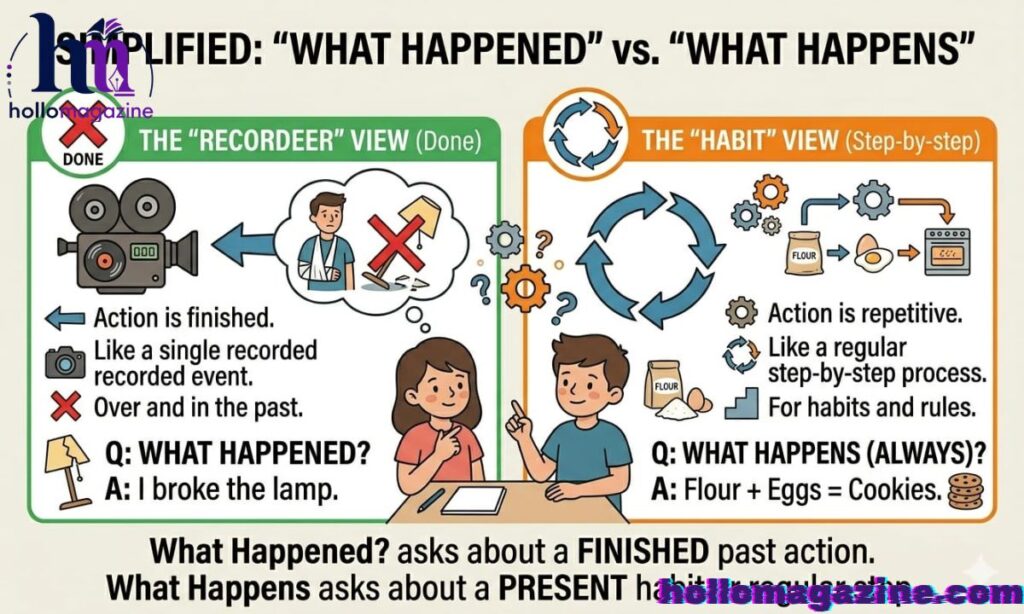
Verb tenses tell us when an action occurs.
| Tense | Example | Meaning |
| Present | What happens every day? | Regular or repeated action |
| Past | What happened yesterday? | Completed action |
| Future | What will happen tomorrow? | Future action |
| Present Continuous | What is happening now? | Action in progress |
The tense of the verb helps listeners understand the time frame being discussed.
Understanding the Verb Happen
The verb happen means:
- To occur
- To take place
- To come about unexpectedly
- To occur by chance
Examples:
- Accidents happen.
- What will happen next?
- Something strange happened last night.
- A lot has happened this year.
Verb forms:
| Form | Example |
| Base Form | happen |
| Present Form | happens |
| Past Form | happened |
| Present Participle | happening |
| Past Participle | happened |
Why “What Happen” Is Grammatically Incorrect
The phrase “what happen” uses the base form of the verb without the grammatical structure needed for a past event.
Incorrect examples:
- What happen yesterday?
- What happen at school?
- What happen to your phone?
These sentences sound incomplete because English requires the correct tense when discussing something that already occurred.
The problem is simple:
- The event happened in the past.
- The verb remains in its base form.
- The sentence lacks proper tense agreement.
As a result, native speakers and grammar experts consider it non-standard English.
Read This: Hola or Ola? The Complete Guide to Meaning, Usage & Confusion
Why “What Happened” Works
“What happened” is the correct way to ask about an event that has already taken place.
Examples:
- What happened yesterday?
- What happened at the meeting?
- What happened to your car?
- What happened after the game?
The word “happened” is already in the past tense, making the sentence grammatically complete and clear.
This structure immediately tells the listener that you’re asking about a completed event.
Subject Questions vs Object Questions
English questions generally fall into two categories.
Subject Questions
The question word acts as the subject.
Examples:
- What happened here?
- Who called you?
Object Questions
The question word receives the action.
Examples:
- What did you buy?
- Who did you call?
Notice something important:
- What happened? does not require the helping verb did because what is functioning as the subject.
- What did happen? is possible but usually used for emphasis.
Examples:
- What happened here? ✅
- What did happen here? ✅ (emphasis)
- What happen here? ❌
When to Use “What Happened”
Use “what happened” whenever you’re asking about a completed event.
Common situations include:
Asking About an Incident
- What happened at work today?
- What happened during the meeting?
Showing Concern
- What happened to your arm?
- What happened to your dog?
Seeking Information
- What happened after the movie ended?
- What happened last night?
Discussing News
- What happened at the event?
- What happened in the city yesterday?
In all these situations, the action occurred in the past, making “what happened” the correct choice.
Why “What Happen” Should Be Avoided
Using “what happen” can create several issues:
- It sounds grammatically incorrect.
- It may confuse readers and listeners.
- It can lower the quality of academic writing.
- It may create a poor impression in professional communication.
- It can result in mistakes during exams and language tests.
For clear and professional English, avoid using “what happen” as a standalone question.
Spoken English vs Written English
Some expressions appear in casual speech that do not follow formal grammar rules.
Spoken English
You may occasionally hear:
- What happen?
- What happen then?
These forms can appear in:
- Informal conversations
- Regional dialects
- Song lyrics
- Social media posts
Written English
In standard writing, always use:
- What happened?
- What happened yesterday?
- What happened next?
Formal writing requires correct verb tense usage.
Common Mistakes Related to “What Happened”
Here are some mistakes learners frequently make.
| Incorrect | Correct |
| What happen yesterday? | What happened yesterday? |
| What happen to him? | What happened to him? |
| What happen after school? | What happened after school? |
| What happen last night? | What happened last night? |
| What happen at the party? | What happened at the party? |
Other related mistakes include:
- Happend ❌
- Hapened ❌
- Happeneded ❌
Correct spelling:
- Happened ✅
Real-Life Examples: Correct vs Incorrect Usage
Let’s compare real examples.
| Incorrect Sentence | Correct Sentence |
| What happen yesterday? | What happened yesterday? |
| What happen to your phone? | What happened to your phone? |
| What happen after class? | What happened after class? |
| What happen at the office? | What happened at the office? |
| What happen to the project? | What happened to the project? |
Conversation Example
Incorrect:
Person A: What happen yesterday?
Person B: We missed the train.
Correct:
Person A: What happened yesterday?
Person B: We missed the train.
The second version sounds natural and grammatically correct.
Quick Rule to Remember
Remember this simple rule:
If the event already occurred, use “what happened.”
Examples:
- Yesterday → What happened?
- Last week → What happened?
- Earlier today → What happened?
Never use “what happen” by itself when asking about a past event.
A helpful shortcut:
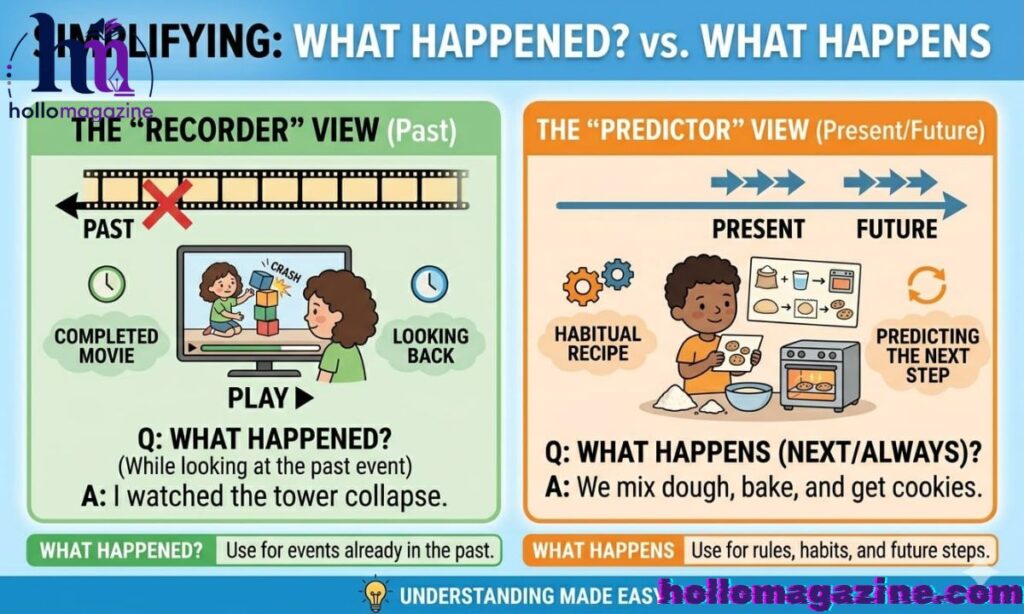
- Present: What happens?
- Past: What happened?
- Future: What will happen?
Conclusion
The difference between “what happen” and “what happened” comes down to verb tense. Since English uses past-tense verbs for completed events, “what happened” is the correct choice whenever you’re asking about something that already took place.
Although you may occasionally hear “what happen” in informal speech or regional dialects, it should generally be avoided in standard English. By remembering that past events require the past-tense form “happened,” you can communicate more clearly and confidently in both speaking and writing.
Frequently Asked Questions
What happened or what happen: which is correct?
“What happened” is correct when asking about a past event. “What happen” is generally considered grammatically incorrect.
Why is “what happen” wrong?
Because it uses the base verb instead of the required past-tense form for a completed event.
Can native speakers say “what happen”?
Some may use it in casual speech or dialects, but it is not standard English grammar.
What is the past tense of happen?
The past tense of happen is happened.
Is “what did happen” correct?
Yes. It is grammatically correct and is usually used for emphasis.
What happens vs what happened?
What happens refers to present or regular events, while what happened refers to events that already occurred.

Rimsha creates simple grammar guides, English writing tips, and word meaning content for readers at Hollo Magazine.