
Spanish words often appear simple, but some create confusion for language learners and English speakers alike. One of the most common examples is Hola vs Ola. These two words look almost identical and even sound very similar, yet they have completely different meanings.
If you’ve ever wondered whether to write Hola or Ola, you’re not alone. This guide explains their meanings, origins, pronunciation, cultural significance, and proper usage. By the end, you’ll know exactly when to use each word and how to avoid common mistakes.
What “Hola” Means and Why It Matters
Hola is the standard Spanish greeting that means “hello.” It is one of the first words most people learn when studying Spanish and is used in both casual and formal situations.
Examples:
- Hola, ¿cómo estás? (Hello, how are you?)
- Hola, buenos días. (Hello, good morning.)
- Hola a todos. (Hello everyone.)
Because it is widely recognized worldwide, many English speakers also use “Hola” playfully or informally when greeting Spanish-speaking friends.
Origins of “Hola”: History, Evolution & Linguistic Roots
Where did “Hola” come from?
Linguists believe that “Hola” developed from older Spanish greeting expressions. While its exact origin remains debated, it has been used as a greeting for centuries throughout the Spanish-speaking world.
Why did the “H” become silent?
Spanish inherited many words containing the letter H from Latin. Over time, the sound disappeared in spoken Spanish, but the letter remained in spelling.
Examples:
- Hombre (man)
- Hablar (to speak)
- Hola (hello)
In modern Spanish, the H is generally silent.
Cultural shift
As Spanish expanded throughout Europe, Latin America, and beyond, “Hola” became the universal greeting recognized across Spanish-speaking cultures.
Pronunciation Essentials: Why the “H” in Hola Is Silent
How to pronounce “Hola”:
Correct pronunciation:
OH-lah
The first syllable sounds like the English word “oh.”
Why the H is silent
Unlike English, modern Spanish usually does not pronounce the letter H. Therefore, “Hola” sounds almost identical to “Ola.”
Common mistakes to avoid
- Pronouncing the H as in English
- Saying “Hoh-la”
- Adding extra emphasis to the first syllable
- Confusing “Hola” with “Ola” in writing
Hola Around the Spanish-Speaking World
Regional Usage Table
| Region | Usage |
| Spain | Common everyday greeting |
| Mexico | Very common |
| Argentina | Frequently used |
| Colombia | Standard greeting |
| Chile | Everyday use |
| Peru | Common greeting |
Important note
The meaning of “Hola” remains consistent throughout the Spanish-speaking world.
Variations
While “Hola” stays the same, it may be combined with other greetings:
- Hola, amigo
- Hola, buenos días
- Hola, ¿qué tal?
- Hola, ¿cómo va?
Read This: Complaint or Complain: The Complete Friendly Guide For 2026
Ola vs Hola: Exact Meaning & Key Differences
“Hola” = Hello
“Hola” is a greeting used when meeting or addressing someone.
Examples:
- Hola, María.
- Hola, amigos.
“Ola” = Wave
“Ola” means a wave in Spanish.
Examples:
- La ola es grande. (The wave is big.)
- Vi una ola enorme. (I saw a huge wave.)
Side-by-side comparison
| Word | Meaning | Usage |
| Hola | Hello | Greeting |
| Ola | Wave | Ocean or water context |
Real examples in sentences
Correct:
- Hola, ¿cómo estás?
- La ola golpeó la playa.
Incorrect:
- Ola, ¿cómo estás?
- La hola golpeó la playa.
Navigating Spanish Homophones (Including Hola & Ola)
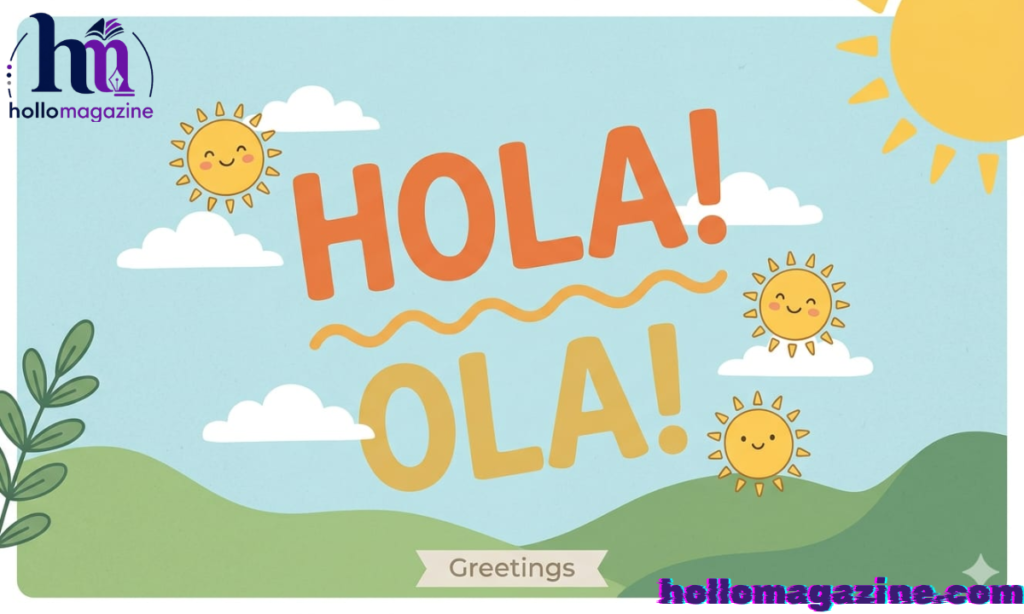
Why homophones exist in Spanish
Homophones occur when different words share similar pronunciation but have different meanings.
Because the H is silent, Hola and Ola sound nearly identical.
Other common Spanish homophone pairs
| Word 1 | Word 2 |
| Hola | Ola |
| Haya | Aya |
| Hasta | Asta |
| Hecho | Echo |
Tips for learners:
- Focus on sentence meaning.
- Read complete contexts.
- Practice spelling separately from pronunciation.
- Learn common vocabulary groups.
Hola in Other Languages & Global Usage
Where “Hola” appears globally
Thanks to globalization and media, “Hola” is recognized far beyond Spanish-speaking countries.
You may hear it in:
- Social media
- Television
- Movies
- Music
- Tourism
- Advertising
Comparison table
| Language | Greeting |
| Spanish | Hola |
| English | Hello |
| French | Bonjour |
| Italian | Ciao |
| German | Hallo |
| Portuguese | Olá |
How English Speakers Can Use “Hola” Naturally
When it feels natural
Using “Hola” can feel natural when:
- Greeting Spanish-speaking friends
- Traveling in Spanish-speaking countries
- Learning Spanish
- Participating in bilingual environments
When it feels forced
Avoid overusing “Hola” if:
- Nobody involved speaks Spanish
- It appears artificial or performative
- It replaces genuine communication
Examples of natural integration:
- Hola, everyone!
- Hola, Carlos.
- Hola! Thanks for joining us today.
Professional use
In bilingual workplaces, customer service, and multicultural environments, “Hola” is often used as a welcoming greeting.
Hola in Pop Culture, Media & the Internet
Key influences
Several factors have increased the global popularity of “Hola”:
- Latin music
- Streaming platforms
- Social media
- International tourism
- Language-learning apps
Today, many non-Spanish speakers recognize the word instantly.
Case Study: Bilingual Social Media
Brands and influencers often use “Hola” to connect with Spanish-speaking audiences. A simple greeting can make content feel more inclusive and culturally aware.
Frequently Asked Questions
What is the correct spelling: Hola or Ola?
Both are correct words, but they have different meanings. Hola means hello, while Ola means wave.
Why does ‘Hola’ have a silent ‘H’?
Spanish pronunciation rules generally treat H as silent in most words.
Can ‘Hola’ be used in formal situations?
Yes. Hola is acceptable in both casual and many formal conversations.
How do you use ‘Hola’ in English conversations?
Many English speakers use it informally when greeting Spanish-speaking friends or audiences.
What does ‘Ola’ mean in Spanish?
Ola means a wave, usually referring to water or ocean waves.
Conclusion
The difference between Hola and Ola is simple but important. Although they sound nearly identical because the Spanish H is silent, their meanings are completely different. Hola is a greeting, while Ola refers to a wave.
Understanding this distinction helps language learners write more accurately and communicate with confidence. Whether you’re studying Spanish, traveling abroad, or simply curious about language, remembering this small difference can prevent a surprisingly common mistake.

Rimsha creates simple grammar guides, English writing tips, and word meaning content for readers at Hollo Magazine.