
English learners often get confused between “myself” and “my self.” At first glance, the difference seems small—just a space between two words. However, that space completely changes the meaning, grammar, and usage of the expression.
Understanding when to use myself as a pronoun and when to use my self as a concept of identity can help you write more naturally and avoid common grammar mistakes. This guide explains everything you need to know with examples, practical tips, and real-world applications.
Myself vs My Self: What’s the Real Difference?
The simplest way to understand the difference is this:
| Term | Meaning | Grammar Role |
| Myself | Reflexive or intensive pronoun | Pronoun |
| My Self | Refers to one’s identity, inner self, or personal being | Noun phrase |
Examples:
- I taught myself Spanish. ✅
- I am trying to understand my self better. ✅
- John and myself attended the meeting. ❌
- John and I attended the meeting. ✅
The difference is not just spelling—it affects sentence structure and meaning.
What “Myself” Really Means in English
The word myself is a pronoun used when the speaker refers back to themselves.
“Myself” as a Reflexive & Intensive Pronoun
“Myself” belongs to a group called reflexive pronouns.
Other reflexive pronouns include:
- Yourself
- Himself
- Herself
- Itself
- Ourselves
- Themselves
It can also act as an intensive pronoun, adding emphasis to a subject.
Two main functions of “myself”:
- Reflexive function
- Intensive function
These are the only standard grammatical uses of “myself.”
Correct Examples in Everyday Sentences
Reflexive Use
A reflexive pronoun is used when the subject and object are the same person.
Examples:
- I blamed myself for the mistake.
- I introduced myself to the new manager.
- I taught myself how to code.
- I reminded myself about the appointment.
In each sentence, the action returns to the person performing it.
Intensive Use
An intensive pronoun adds emphasis.
Examples:
- I myself completed the project.
- I myself witnessed the incident.
- The CEO himself announced the decision.
- She herself approved the proposal.
Removing the intensive pronoun does not change the core meaning.
Incorrect Uses of “Myself” (Very Common!)
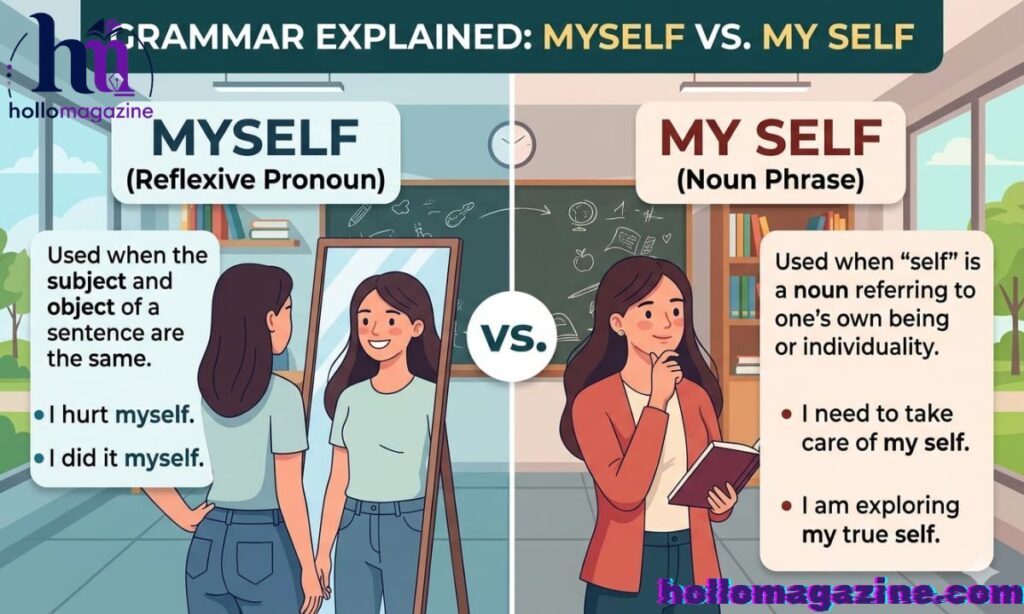
Many speakers incorrectly use “myself” to sound formal or professional.
Incorrect examples:
- Please contact Sarah or myself. ❌
- The report was prepared by John and myself. ❌
- Send the email to myself. ❌
Correct versions:
- Please contact Sarah or me. ✅
- The report was prepared by John and me. ✅
- Send the email to me. ✅
A useful rule:
If you can replace the word with me or I, then “myself” is probably unnecessary.
Read This: Summarize or Summarise: When Should You Use Each?
Understanding “My Self” (Two Separate Words)
Unlike “myself,” my self is not a reflexive pronoun.
Instead:
- “My” is a possessive adjective.
- “Self” is a noun.
Together they refer to a person’s identity, personality, consciousness, or inner being.
This usage appears frequently in discussions about psychology, philosophy, spirituality, and personal growth.
What “My Self” Actually Means
When written as two words, “my self” refers to who you are as a person.
It focuses on identity rather than grammar.
Examples
- I am learning more about my self through meditation.
- My self has changed significantly over the years.
- Understanding my self helped me make better decisions.
- I feel more connected to my self than ever before.
In these examples, “self” refers to personal identity.
Where “My Self” Is Commonly Used
Psychology
Psychologists often discuss concepts such as:
- Self-awareness
- Self-esteem
- Self-image
- Self-concept
Example:
- Therapy helped me better understand my self.
Philosophy
Philosophy frequently explores the nature of the self.
Questions include:
- Who am I?
- What defines my self?
- Does the self remain constant?
Example:
- Philosophers debate the true nature of my self.
Literature
Writers often use “my self” when exploring identity and personal growth.
Example:
- The character struggled to discover her true self.
In literary contexts, “my self” often carries emotional or symbolic meaning.
Why “Myselves” Is Incorrect — Always
Many learners wonder whether myselves exists.
The answer is simple:
No.
There is only one speaker represented by “I.”
Correct:
- I taught myself.
Incorrect:
- I taught myselves.
English does not use a plural form of “myself.”
How “Myself” Functions in Grammar
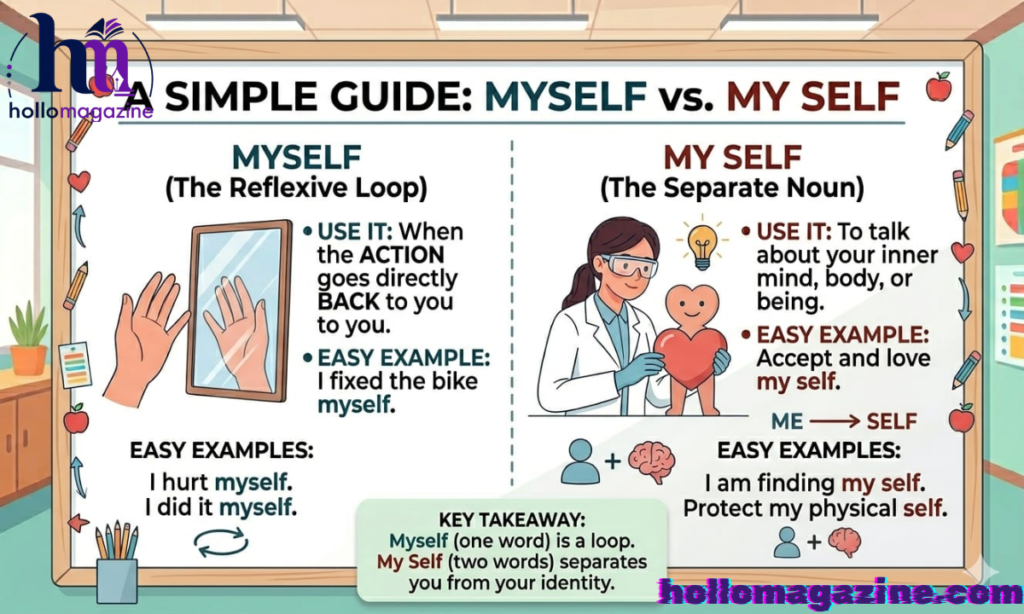
Understanding grammar makes the difference easier to remember.
Reflexive Structure: Subject = Object
Formula:
Subject + Verb + Myself
Examples:
| Subject | Verb | Reflexive Pronoun |
| I | hurt | myself |
| I | introduced | myself |
| I | prepared | myself |
| I | challenged | myself |
The person performing the action is also receiving the action.
Intensive Structure: Adding Emphasis
An intensive pronoun emphasizes the subject.
Examples:
- I myself checked every document.
- I myself solved the problem.
- The manager herself approved the budget.
Key point:
Removing the intensive pronoun keeps the sentence grammatically correct.
Identity & Philosophy: The Non-Reflexive “Self”
The word “self” has a broader meaning beyond grammar.
“Self” as a Concept
In psychology and philosophy, the self refers to:
- Personal identity
- Consciousness
- Character
- Inner awareness
- Individual experience
Examples:
- Knowing your self can improve confidence.
- Personal growth often begins with understanding the self.
- Self-awareness helps people make better decisions.
This use is conceptual rather than grammatical.
How Spacing Changes Meaning
A single space creates a completely different meaning.
| Expression | Meaning |
| Myself | Pronoun |
| My Self | Personal identity |
| Self | Concept of identity |
| Me | Object pronoun |
| I | Subject pronoun |
Always ask yourself whether you’re discussing grammar or identity.
Common Errors and How to Avoid Them
Using “Myself” Instead of “Me” or “I”
Incorrect:
- The manager spoke to myself.
Correct:
- The manager spoke to me.
Using “My Self” When “Myself” Is Correct
Incorrect:
- I introduced my self to the class.
Correct:
- I introduced myself to the class.
Adding “Myself” to Sound Formal
Many people mistakenly believe “myself” sounds more professional.
Incorrect:
- Contact myself for assistance.
Correct:
- Contact me for assistance.
Confusing Identity With Grammar
Remember:
- Grammar → myself
- Identity → my self
Understanding this distinction eliminates most mistakes.
Quick Decision Guide to Remember the Difference

Ask yourself: Is it about grammar or identity?
If the sentence discusses actions returning to the speaker, use myself.
If it discusses personal identity, use my self.
Fast Test
Ask:
“Can I replace this with a reflexive pronoun?”
If yes:
- Use myself.
If no:
- Consider whether “my self” refers to identity.
One-Line Rule
Use “myself” for grammar and “my self” for identity.
Real-Life Examples & Micro Case Studies
Case Study 1: Email at Work
Incorrect:
- Please contact myself regarding scheduling.
Correct:
- Please contact me regarding scheduling.
Professional writing prefers clear pronouns.
Case Study 2: Personal Journal Entry
Example:
- I spent the weekend reconnecting with my self.
Here the writer is discussing identity and personal reflection.
Case Study 3: Classroom Grammar
Sentence:
- I introduced myself to the new students.
This is a standard reflexive structure.
Case Study 4: Meditation Coaching
Example:
- Through meditation, I learned to understand my self better.
The focus is personal awareness rather than grammar.
Conclusion
Although myself and my self differ by only one space, they serve completely different purposes. “Myself” functions as a reflexive or intensive pronoun, while “my self” refers to personal identity, self-awareness, or one’s inner being.
The easiest way to remember the distinction is to ask whether you’re discussing grammar or identity. If the sentence involves an action returning to the speaker, use myself. If it concerns personal growth, consciousness, or self-understanding, my self may be appropriate.
Frequently Asked Questions
Is “myself” one word or two words?
In standard grammar, myself is one word and functions as a reflexive or intensive pronoun.
Is “my self” grammatically correct?
Yes, when referring to personal identity, consciousness, or one’s inner being.
Can I say “John and myself”?
No. In most cases, “John and I” or “John and me” is correct.
Why do professionals misuse “myself”?
Many people mistakenly believe it sounds more formal than “me” or “I.”
Is “myselves” a real word?
No. Standard English has no plural form of “myself.”
How do I know whether to use “myself” or “my self”?
Use myself for grammar and reflexive actions; use my self when discussing identity or self-awareness.

Rimsha creates simple grammar guides, English writing tips, and word meaning content for readers at Hollo Magazine.