
English contains many words that look similar but carry different meanings depending on context. Three commonly confused words are incoming, upcoming, and oncoming. Since all three describe something related to arrival or movement, many learners use them interchangeably, even though they serve different purposes.
Understanding the distinction between these terms can improve your writing, speaking, and professional communication. Whether you’re talking about emails, events, traffic, weather, or emergencies, choosing the right word helps your message sound natural and accurate.
Understanding “Incoming”, “Upcoming”, and “Oncoming”
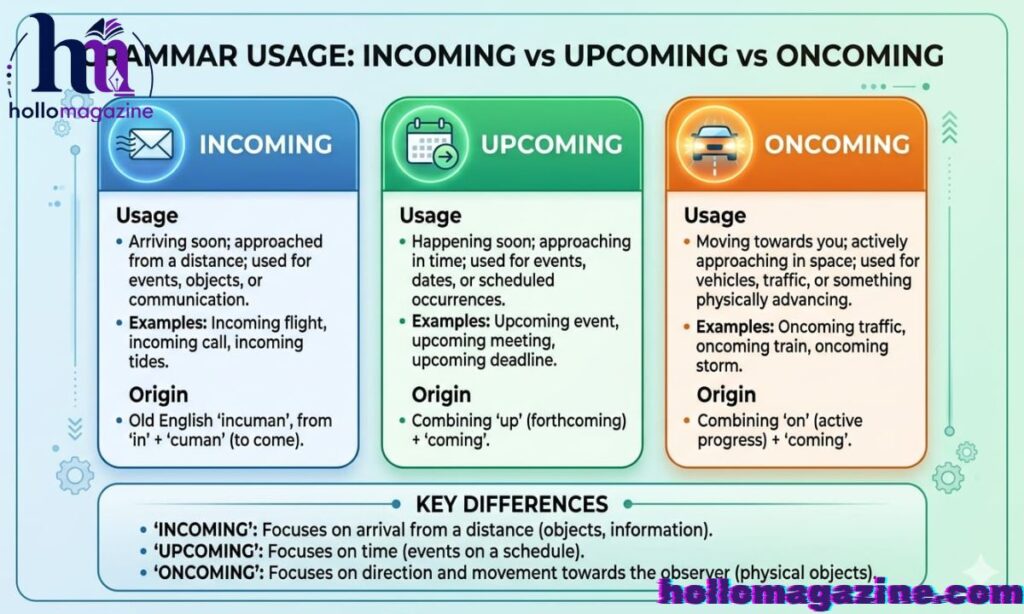
At a glance, these words all suggest something approaching. However, the type of approach differs significantly.
| Word | Basic Meaning | Typical Context |
| Incoming | Arriving or being received | Calls, messages, deliveries, weather alerts |
| Upcoming | Scheduled to happen in the future | Events, meetings, exams, releases |
| Oncoming | Moving directly toward you | Traffic, storms, dangers |
The key difference is whether something is being received, planned for the future, or physically approaching.
What “Incoming” Really Means
Definition of Incoming
Incoming refers to something that is arriving, entering, or being received by a person, device, system, or location.
It often describes things that are currently on their way or about to be received.
When You Use “Incoming”
Use incoming when:
- Something is arriving.
- A system is receiving data.
- A person is receiving communication.
- A location is expecting deliveries.
- A warning indicates something approaching.
Tech & Communication
In technology, incoming is extremely common.
Examples:
- Incoming call
- Incoming email
- Incoming message
- Incoming data
Sentence examples:
- I received an incoming call during the meeting.
- The server detected incoming traffic.
Deliveries & Logistics
Businesses frequently use incoming when discussing shipments.
Examples:
- Incoming package
- Incoming inventory
- Incoming shipment
Sentence:
- The warehouse is processing incoming goods.
Weather & Natural Forces
Meteorologists often refer to incoming weather systems.
Examples:
- Incoming storm
- Incoming rainfall
- Incoming cold front
Sentence:
- An incoming storm is expected tonight.
Emergencies & Warnings
Emergency systems may use incoming to indicate something approaching.
Examples:
- Incoming threat
- Incoming missile
- Incoming danger
Sentence:
- The warning system detected an incoming object.
Examples of Incoming
- We have an incoming customer call.
- The airport is handling incoming flights.
- Incoming emails increased this morning.
- An incoming storm may affect travel.
- The company is processing incoming orders.
Key Insight
Incoming means something is arriving and will soon be received by a person, place, or system.
What “Upcoming” Really Means
Definition of Upcoming
Upcoming refers to something planned, scheduled, or expected to happen in the future.
Unlike incoming, it does not necessarily mean movement. It simply means the event has not happened yet.
Practical Uses of “Upcoming”
Common areas where upcoming appears:
- Events
- Meetings
- Exams
- Product launches
- Holidays
- Appointments
Examples
- The upcoming conference starts next week.
- She is preparing for an upcoming interview.
- Our upcoming project requires additional planning.
- The company announced an upcoming product launch.
Typical Daily Uses
People commonly use upcoming when discussing:
- Upcoming vacations
- Upcoming deadlines
- Upcoming movies
- Upcoming weddings
- Upcoming sporting events
Sentence examples:
- I am excited about the upcoming holiday.
- The upcoming exam covers three chapters.
Key Insight
Upcoming means planned for the future, not necessarily moving toward you physically.
What “Oncoming” Really Means
Definition of Oncoming
Oncoming refers to something physically moving toward a person, vehicle, or location.
It usually involves direct movement in your direction.
Common Uses of “Oncoming”
The word often appears in situations involving movement, danger, or collision risk.
Traffic & Vehicles
This is the most common use.
Examples:
- Oncoming traffic
- Oncoming vehicle
- Oncoming train
Sentence:
- Be careful when turning across oncoming traffic.
Danger & Physical Threats
Oncoming can describe approaching threats.
Examples:
- Oncoming danger
- Oncoming attack
- Oncoming wave
Sentence:
- The hikers noticed an oncoming rockslide.
Weather
Weather conditions can also be described as oncoming.
Examples:
- Oncoming storm
- Oncoming hurricane
- Oncoming fog
Sentence:
- Drivers prepared for the oncoming storm.
Examples
- The driver avoided an oncoming truck.
- Cyclists must watch for oncoming traffic.
- We could see an oncoming storm from miles away.
- The sailors spotted an oncoming wave.
- The pilot warned about oncoming turbulence.
Key Insight
Oncoming means physically approaching your position, often creating awareness or potential danger.
Read This: Dry Snitching: What It Means and How to Spot It
Side-by-Side Comparison
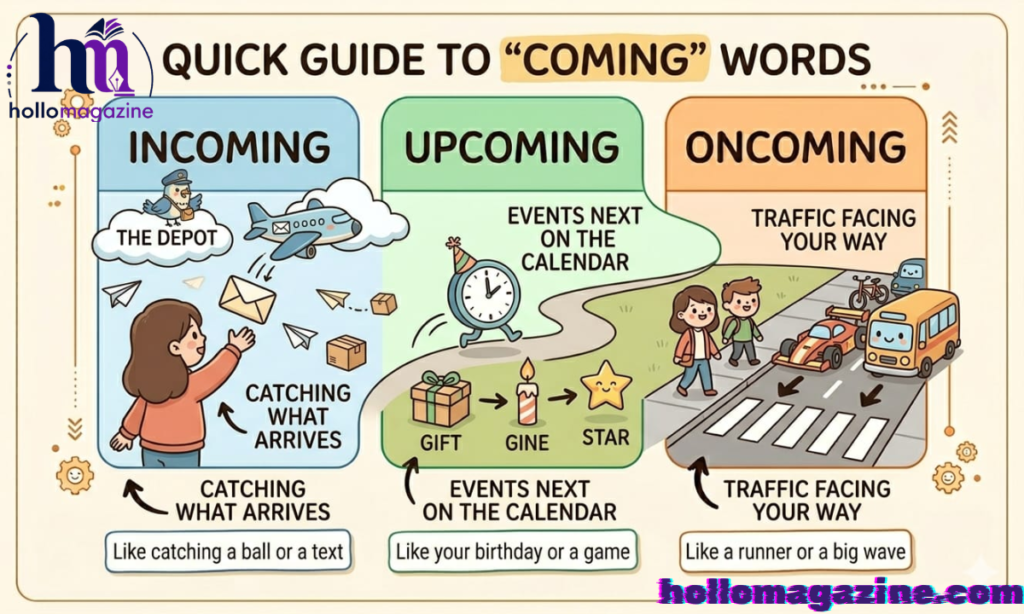
Meaning Differences Table
| Word | Focus | Example |
| Incoming | Being received | Incoming email |
| Upcoming | Future schedule | Upcoming event |
| Oncoming | Physical approach | Oncoming traffic |
Best Word Choice by Scenario
| Scenario | Correct Word |
| A conference next month | Upcoming |
| A new email arrives | Incoming |
| A car driving toward you | Oncoming |
| A package arriving today | Incoming |
| A holiday next week | Upcoming |
| A storm moving toward town | Oncoming or Incoming (depending on context) |
Why Context Matters
Choosing the correct word depends entirely on context.
1. Is it physically moving toward you?
Use oncoming.
Examples:
- Oncoming vehicle
- Oncoming train
- Oncoming storm
2. Is it arriving to your device, system, or location?
Use incoming.
Examples:
- Incoming email
- Incoming shipment
- Incoming call
3. Is it planned for the future?
Use upcoming.
Examples:
- Upcoming meeting
- Upcoming release
- Upcoming event
Examples from Everyday Life
Incoming
- I received an incoming text message.
- The company has incoming inventory.
- The airport reported incoming flights.
Upcoming
- Our upcoming vacation starts next month.
- She is preparing for an upcoming interview.
- The upcoming conference will attract experts worldwide.
Oncoming
- The driver slowed for oncoming traffic.
- We watched an oncoming storm approach.
- The cyclist avoided an oncoming vehicle.
Common Mistakes to Avoid
Using “oncoming” for events
Incorrect:
- The oncoming conference starts next week.
Correct:
- The upcoming conference starts next week.
Using “incoming” for scheduled things
Incorrect:
- Our incoming meeting begins tomorrow.
Correct:
- Our upcoming meeting begins tomorrow.
Using “upcoming” for something happening now
Incorrect:
- An upcoming call is arriving.
Correct:
- An incoming call is arriving.
Using “oncoming” for digital stuff
Incorrect:
- I received an oncoming email.
Correct:
- I received an incoming email.
Using “incoming” for things that don’t move
Incorrect:
- The incoming holiday is exciting.
Correct:
- The upcoming holiday is exciting.
Easy Memory Tricks
1. Incoming = In-coming
Think:
Something is coming in to you.
Examples:
- Incoming call
- Incoming package
2. Upcoming = Up next
Think:
Next on the calendar.
Examples:
- Upcoming event
- Upcoming deadline
3. Oncoming = On the way toward you
Think:
Moving directly toward your position.
Examples:
- Oncoming traffic
- Oncoming storm
4. The Car Rule
If you could crash into it because it is approaching you, use oncoming.
5. The Calendar Rule
If it appears on a future schedule, use upcoming.
Case Studies
Case Study 1: The Weather App
Weather alert:
- Incoming rain expected tonight.
- Oncoming storm approaching the coast.
Both may be correct depending on whether the focus is receiving the weather system or observing its physical approach.
Case Study 2: A Company Announcement
Announcement:
- Our upcoming product launch is scheduled for July.
The event is planned, so upcoming is correct.
Case Study 3: Traffic Incident
Police report:
- The driver crossed into oncoming traffic.
Because vehicles were physically moving toward the driver, oncoming is the correct choice.
Quotes to Help You Remember
- Incoming arrives.
- Upcoming awaits.
- Oncoming approaches.
- Emails are incoming, events are upcoming, cars are oncoming.
- If it’s on your calendar, it’s upcoming.
- If it’s heading toward you, it’s oncoming.
- If you’re receiving it, it’s incoming.
Conclusion
Although incoming, upcoming, and oncoming all involve the idea of arrival or approach, they are not interchangeable. Incoming focuses on something being received, upcoming refers to future plans or scheduled events, and oncoming describes something physically moving toward you.
Learning these distinctions can make your communication clearer and more professional. By paying attention to context—whether something is arriving, scheduled, or approaching—you can confidently choose the correct word every time.
Frequently Asked Questions
What is the difference between incoming and upcoming?
Incoming refers to something arriving or being received, while upcoming refers to something scheduled to happen in the future.
Is an event incoming or upcoming?
An event is usually upcoming because it is planned for a future date.
What does oncoming traffic mean?
Oncoming traffic refers to vehicles moving toward you from the opposite direction.
Can a storm be incoming and oncoming?
Yes. A storm can be incoming when it is expected to arrive and oncoming when it is physically approaching.
Is an incoming call correct?
Yes. An incoming call is a standard expression for a call being received.
Why isn’t an email called upcoming?
Because an email is arriving now or soon, making incoming the correct word.

Rimsha creates simple grammar guides, English writing tips, and word meaning content for readers at Hollo Magazine.