
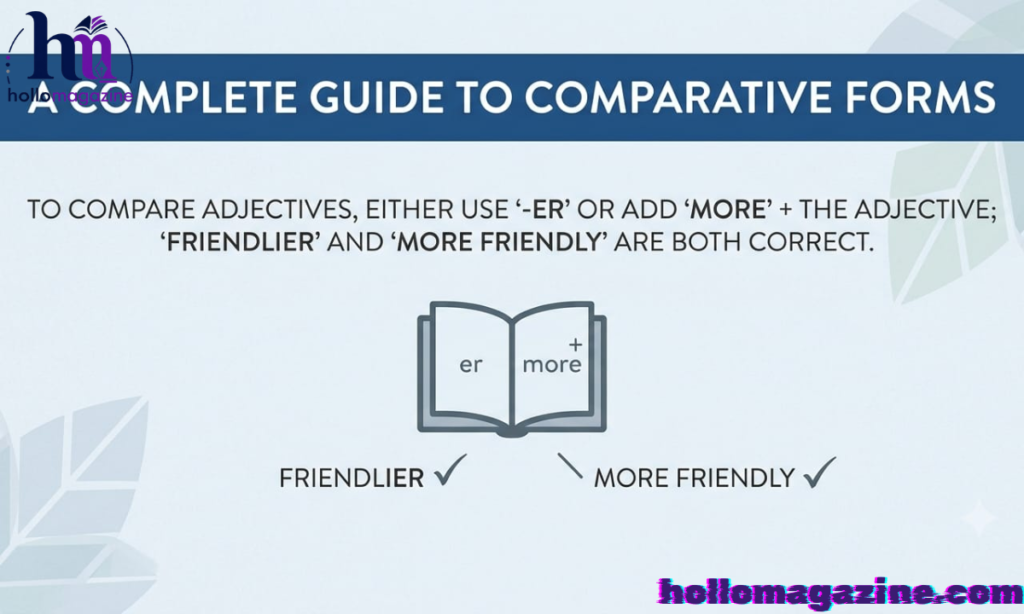
Many English learners and even native speakers wonder whether “more friendly” or “friendlier” is the correct comparative form of friendly. The confusion exists because English usually follows specific rules for forming comparatives, yet some adjectives allow more than one acceptable option.
The good news is that both friendlier and more friendly are grammatically correct in American English. However, they are not always equally natural in every situation. Understanding when to use each form can make your writing smoother, clearer, and more professional.
Understanding Comparative Adjectives in American English
Comparative adjectives help us compare two people, places, things, or ideas.
Examples:
- Tall → Taller
- Small → Smaller
- Happy → Happier
- Friendly → Friendlier
English generally follows these rules:
| Adjective Type | Comparative Form |
| One syllable | Add -er |
| Two syllables ending in -y | Change y to i and add -er |
| Longer adjectives | Use more |
Examples:
- Happy → Happier
- Busy → Busier
- Comfortable → More comfortable
Because friendly ends in -y, many grammar guides naturally prefer friendlier.
Why “Friendly” Allows Both Forms
Unlike many adjectives, friendly has developed usage patterns that make both comparative forms acceptable.
1. “Friendly” Acts Like a Short Adjective
The adjective friendly behaves like other two-syllable adjectives ending in -y.
Examples:
- Happy → Happier
- Easy → Easier
- Friendly → Friendlier
This explains why friendlier sounds natural to most speakers.
2. Its Meaning Is Emotional and Personal
Words describing emotions, attitudes, and personality often sound more natural with -er endings.
Examples:
- Kinder
- Warmer
- Nicer
- Friendlier
The form feels conversational and human.
3. Usage Patterns Over Time Made Both Acceptable
Modern dictionaries and style guides recognize both forms because writers and speakers have used them successfully for decades.
In real-world English:
- Friendlier is more common.
- More friendly remains fully acceptable.
Quick Example
Both are correct:
- This hotel is friendlier than the one downtown.
- This hotel is more friendly than the one downtown.
Most native speakers would naturally choose friendlier.
When You Should Use “Friendlier”
Real-Life Situations
Use friendlier in everyday communication.
Common situations include:
- Conversations
- Emails
- Blog posts
- Reviews
- Customer feedback
- Social media content
Examples:
- The new employee is friendlier than the previous one.
- Our neighborhood has become friendlier over time.
- This café feels friendlier than the chain restaurant.
Why It Works Well
Friendlier offers several advantages:
- Sounds natural
- Flows smoothly
- Matches common speech patterns
- Feels conversational
- Improves readability
Because it is shorter, readers process it quickly.
Examples of “Friendlier” in Action
- The support staff became friendlier after training.
- The redesigned website feels friendlier to users.
- This city is friendlier toward tourists.
- Our new manager is much friendlier.
- The updated policy creates a friendlier workplace.
When “More Friendly” Is the Better Choice
Although friendlier is often preferred, there are situations where more friendly works better.
1. Rhythm or Clarity Needs It
Sometimes sentence rhythm sounds smoother with more friendly.
Example:
- The organization aims to become more friendly toward international partners.
The longer structure can improve flow in certain contexts.
2. You’re Using Compound Adjectives
Compound expressions often sound awkward with an -er ending.
Examples:
- More environmentally friendly
- More family friendly
- More user friendly
These forms are widely accepted.
3. You’re Writing Formally or Technically
Business reports, policy documents, and academic writing may favor more friendly because it sounds slightly more neutral.
Example:
- The initiative seeks a more friendly regulatory environment.
4. You Want to Avoid Emotional Tone
Friendlier can feel personal and conversational.
More friendly sometimes creates a more objective tone.
Example:
- The software now provides a more friendly user experience.
Examples of “More Friendly” Used Correctly
- The company wants a more friendly onboarding process.
- New regulations encourage a more friendly business climate.
- The software offers a more friendly interface.
- The redesign created a more friendly customer journey.
- The policy promotes a more friendly approach to sustainability.
Read This: Myself vs My Self: The Complete Guide to Meaning, Grammar, Identity & Real-World Usage
Special Cases and Exceptions (Important!)
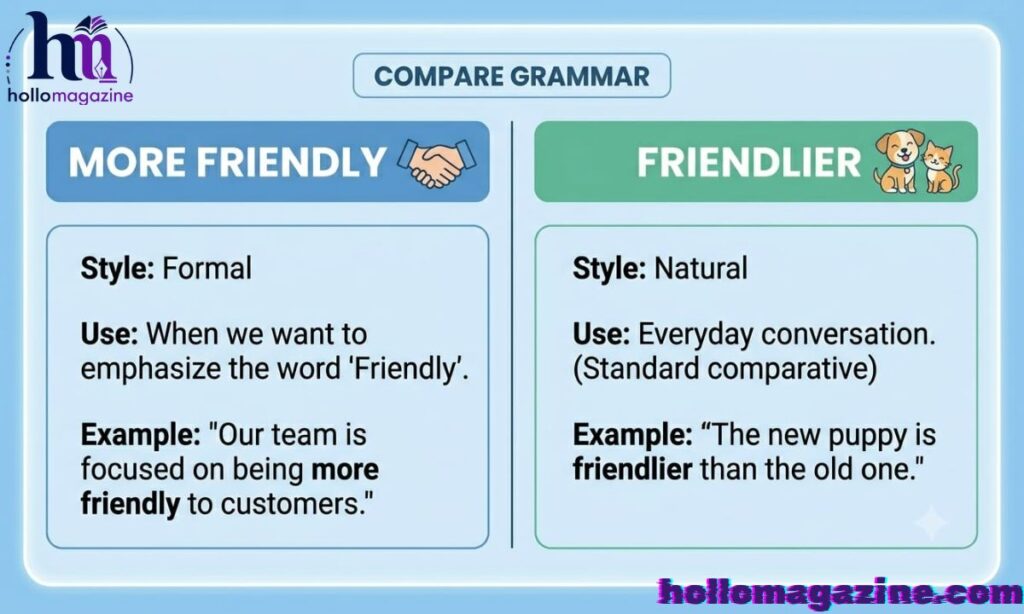
Some situations follow slightly different patterns.
1. Compound Adjectives
Compound adjectives often favor more friendly.
Correct
- More user friendly
- More family friendly
- More environmentally friendly
- More eco-friendly
Incorrect or Odd
- User-friendlier
- Family-friendlier
- Environmentally-friendlier
While some forms may occasionally appear, they often sound awkward to many readers.
2. Technical or Scientific Writing
Technical writing values clarity over conversational style.
Example
- The updated system provides a more friendly user interface.
Technical documents frequently use “more friendly” because it sounds precise and neutral.
3. Advertising and Branding
Marketing professionals use whichever form sounds stronger.
Examples:
- A friendlier banking experience.
- A more friendly customer platform.
Both can be effective depending on branding goals.
4. Formal Tone vs. Casual Tone
Consider your audience.
| Tone | Preferred Form |
| Casual | Friendlier |
| Conversational | Friendlier |
| Marketing | Either |
| Technical | More friendly |
| Academic | More friendly |
| Corporate | Either |
The choice often depends on style rather than grammar.
5. When Emphasis Matters
More friendly can add emphasis because it separates the comparison.
Examples:
- The company is becoming more friendly toward small businesses.
- The organization is more friendly than before.
The extra word can subtly highlight the comparison.
“More Friendly” vs “Friendlier”: Real-World Side-by-Side Comparison
| Situation | Friendlier | More Friendly |
| Casual conversation | ✅ Best choice | Acceptable |
| Customer review | ✅ Common | Acceptable |
| Academic paper | Acceptable | ✅ Often preferred |
| User-interface discussion | Less common | ✅ Common |
| Marketing slogan | ✅ Strong | ✅ Strong |
| Business report | Acceptable | ✅ Often preferred |
In most everyday situations, friendlier remains the more natural choice.
Case Study 1: Customer Service Teams
A company trains its support staff.
Natural wording:
- Our team is now friendlier and more responsive.
This sounds conversational and customer-focused.
Alternative:
- Our team is now more friendly and more responsive.
Grammatically correct but slightly less natural.
Case Study 2: App Redesign
A software company updates its interface.
Best choice:
- The new design is more user friendly.
Because “user friendly” is a fixed compound expression, this version sounds most natural.
Case Study 3: Environmental Policy
A city introduces sustainability measures.
Example:
- The city aims to create a more environmentally friendly transportation system.
This is the standard wording used in government and policy documents.
Practical Guidelines for Choosing the Right Form
Use “friendlier” when:
- Writing naturally
- Speaking casually
- Comparing people
- Comparing attitudes
- Comparing customer experiences
- Improving readability
Examples:
- Friendlier staff
- Friendlier service
- Friendlier atmosphere
Use “more friendly” when:
- Writing formally
- Using compound adjectives
- Creating a technical tone
- Discussing systems or processes
- Referring to user-friendly concepts
Examples:
- More user friendly
- More environmentally friendly
- More family friendly
Quick “Say It Out Loud” Test
When unsure, read the sentence aloud.
If the sentence feels smooth → use friendlier
Examples:
- She is friendlier than her brother.
- The neighborhood is friendlier now.
If it feels choppy or emotional → use more friendly
Examples:
- The software provides a more friendly user experience.
- The platform offers a more friendly interface.
Your ear often identifies the best option.
5 Common Myths About “More Friendly” vs “Friendlier”
Myth 1: Only one form is correct.
False. Both forms are grammatically acceptable.
Myth 2: Friendlier is informal.
False. Friendlier appears in both formal and informal writing.
Myth 3: More friendly is always more formal.
False. Context determines tone, not the phrase alone.
Myth 4: Eco-friendlier is correct.
Generally, writers prefer more environmentally friendly or more eco-friendly.
Myth 5: American English prefers one form.
American English accepts both forms, though friendlier is usually more common in everyday usage.
Conclusion
The debate between more friendly and friendlier is not about right versus wrong. Both forms are accepted in modern American English and appear regularly in professional, academic, and everyday communication.
The key is choosing the form that fits the context. For most conversations and general writing, friendlier sounds smoother and more natural. In formal, technical, or compound-adjective situations, more friendly often provides better clarity and style.
Frequently Asked Questions
Is friendlier a real word?
Yes. Friendlier is the standard comparative form of the adjective friendly.
Is more friendly grammatically correct?
Yes. Modern grammar guides accept both more friendly and friendlier.
Which is more common in everyday English?
Friendlier is generally more common in conversations and everyday writing.
Should I use friendlier in business writing?
Yes, unless a formal or technical context makes more friendly sound clearer.
Is user-friendlier correct?
It is not commonly preferred. Most writers use more user friendly.
Does American English prefer friendlier or more friendly?
American English accepts both, but friendlier is typically the more natural choice.

Rimsha creates simple grammar guides, English writing tips, and word meaning content for readers at Hollo Magazine.