
English contains many words that look almost identical but have completely different meanings. One of the most commonly confused pairs is dieing and dying. At first glance, the difference appears to be just one letter, but that single letter changes both meaning and usage.
Many writers assume that dieing is simply an alternative spelling of dying. In reality, dying is the correct form in most everyday situations, while dieing exists only in a specialized and much less common context. Understanding the distinction can help you avoid embarrassing grammar mistakes and improve your writing accuracy.
One Letter That Changes Everything
The confusion between dieing and dying comes from English spelling patterns. Since the base verb is die, many people naturally expect the present participle to be dieing.
However, English follows a special spelling rule here. The result is that dying becomes the correct form when referring to death, decline, or the process of coming to an end. Meanwhile, dieing survives as a technical term related to manufacturing.
The Root Verb: What “Die” Really Means
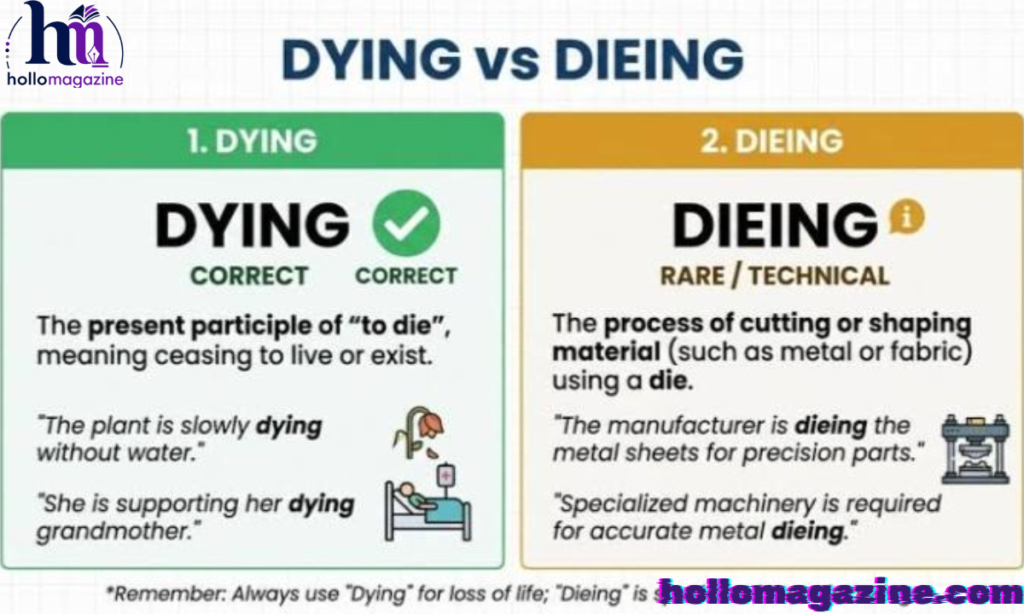
The verb die generally means to stop living. However, its usage extends far beyond biological death.
Examples:
- Plants die without water.
- Batteries die when they lose power.
- Traditions can die over time.
- Interest in a trend may die out.
The word is highly versatile in both literal and figurative language.
How “Die” Expands in Meaning
Over centuries, the verb developed several extended meanings.
Common uses include:
- Physical death
- Gradual disappearance
- Loss of energy
- Fading popularity
- Emotional longing
Examples:
- The phone battery died.
- The movement eventually died out.
- I’m dying to know the answer.
These broader meanings explain why dying appears so frequently in modern English.
Why “Dying” Is the Correct Present Participle
The standard present participle and gerund form of die is dying.
Examples:
- The flowers are dying.
- He is dying of curiosity.
- The battery is dying.
This spelling is accepted in modern dictionaries, style guides, educational materials, and professional writing.
The Rule That Governs It
English avoids the awkward sequence ie + ing in certain verbs.
Instead of:
❌ Dieing
The spelling changes to:
✔ Dying
This modification improves readability and pronunciation.
Clear Examples of the Same Pattern
Several English words undergo spelling adjustments before adding suffixes.
Examples:
| Base Word | Modified Form |
| Die | Dying |
| Lie | Lying |
| Tie | Tying |
Notice that the ie changes to y before adding -ing.
This pattern helps explain why dying is correct.
Why “Dieing” Looks Right to So Many People
The mistake is understandable because it appears logical.
Writers often think:
- Move → Moving
- Bake → Baking
- Smile → Smiling
Therefore:
- Die → Dieing
The assumption seems reasonable, but English treats die differently.
Sound-Based Assumptions
Most people learn spelling by sound.
Because both forms sound similar when read mentally, writers often choose the spelling that appears most consistent with other verbs.
This explains why dieing remains a common misspelling despite being incorrect in most contexts.
Read This: Nonresponsive Vs Unresponsive Which One Is The Correct One?
Is “Dieing” Ever a Real Word? Yes But Rarely
Surprisingly, dieing is a legitimate English word in specialized industries.
Is dieing a word?
Yes.
However, it does not refer to death.
Instead, it relates to the use of a die, which is a tool used in manufacturing, cutting, stamping, or shaping materials.
Die as a Noun, Not a Verb
In industrial settings, a die is a machine tool.
Examples include:
- Cutting dies
- Stamping dies
- Forming dies
- Metalworking dies
When these tools are being used, adjusted, or operated, the process may be described as dieing.
Where You’ll See This Usage
You may encounter dieing in:
- Manufacturing manuals
- Engineering documents
- Metalworking industries
- Packaging production
- Industrial machinery instructions
Outside these technical environments, dying is almost always the intended word.
Side by Side Comparison: Dieing vs Dying
Comparison Table
| Feature | Dying | Dieing |
| Related to Death | Yes | No |
| Standard Everyday English | Yes | No |
| Present Participle of Die | Yes | No |
| Industrial Meaning | No | Yes |
| Common Usage | Very Common | Rare |
| Accepted in Academic Writing | Yes | Only in Technical Contexts |
Real Examples That Clarify the Difference Instantly
Seeing both words in context makes the distinction easier.
Correct Everyday Uses of “Dying”
Examples:
- The flowers are dying.
- His phone is dying.
- The tradition is slowly dying.
- She was dying of laughter.
- The fire is dying out.
All these examples involve the standard verb die.
Correct Industrial Uses of “Dieing”
Examples:
- The factory completed the dieing process.
- Workers monitored the dieing equipment.
- The dieing operation improved production speed.
These examples involve manufacturing tools called dies.
Figurative and Emotional Power of “Dying”
One reason dying appears so often is its figurative strength.
English speakers use it to express strong emotions and experiences.
Common Figurative Uses
Examples:
- Dying to know
- Dying to see you
- Dying of embarrassment
- Dying of laughter
- Dying for a vacation
These expressions rarely involve literal death.
Instead, they communicate intensity and emotion.
Dying vs Dead: Understanding the Difference
Many learners also confuse dying and dead.
Key Distinction
| Word | Meaning |
| Dying | In the process of ending or losing life |
| Dead | No longer alive |
Examples:
- The plant is dying.
- The plant is dead.
The first describes an ongoing process.
The second describes a completed state.
Why This Mistake Persists in Modern Writing
Despite grammar resources and spell-check tools, confusion continues.
Common Causes
Reasons include:
- Similar appearance
- Sound-based spelling assumptions
- Limited exposure to grammar rules
- Autocorrect inconsistencies
- Fast digital communication
Many people simply have never been taught the special spelling rule.
Simple Ways to Never Get This Wrong Again
Fortunately, the distinction is easy to remember.
The One Question Test
Ask yourself:
“Am I talking about death, decline, or ending?”
If yes, use:
✔ Dying
If you’re discussing industrial machinery and dies:
✔ Dieing
The Substitution Trick
Replace the word mentally with:
- Lying
- Tying
If the pattern fits, dying is probably correct.
Examples:
- The battery is dying.
- The flowers are dying.
The spelling immediately looks natural.
Editing Checklist for Writers and Editors
A quick review can prevent mistakes.
High Risk Areas
Pay extra attention to:
- Blog posts
- Academic essays
- News articles
- Social media captions
- Marketing content
These are common places where the error appears.
Final Check
Before publishing:
- Verify whether death or decline is being discussed.
- Replace dieing with dying when appropriate.
- Confirm technical manufacturing contexts carefully.
A simple proofread catches most errors.
Dieing vs Dying in Professional and Academic Writing
Professional writing values precision.
Using the wrong spelling may distract readers and reduce credibility.
Why This Error Hurts Credibility
Readers often view spelling mistakes as indicators of poor editing.
Potential consequences include:
- Reduced trust
- Lower perceived expertise
- Weaker academic performance
- Less professional communication
Using the correct form demonstrates attention to detail.
Quick Recap: Dieing vs Dying
Here is the simplest summary:
- Dying = correct form of the verb die.
- Dieing = rare industrial term related to manufacturing dies.
- Most writers should use dying.
- Dieing appears mainly in technical documents.
Remember:
If life, decline, fading, or endings are involved, the answer is almost always dying.
Reference: Cambridge Dictionary Definitions
Cambridge Dictionary recognizes dying as the present participle of the verb die and uses it to describe the process of losing life or gradually ending.
The dictionary treatment confirms that dying is the standard spelling for everyday English. Dieing remains a specialized technical term used primarily in manufacturing and industrial settings.
Conclusion
The difference between dieing and dying is a classic example of how a small spelling change can create a completely different meaning. In nearly all everyday situations, dying is the correct choice because it serves as the present participle of the verb die.
Although dieing is a legitimate word, its usage is limited to manufacturing contexts involving industrial dies. For most writers, students, and professionals, remembering that dying relates to life, death, decline, and figurative expressions will eliminate this common mistake.
Frequently Asked Questions
Is dying or dieing correct?
Dying is correct in almost all everyday situations.
Is dieing a real word?
Yes, but it is a rare technical term related to manufacturing dies.
Why is dying spelled with a y?
English changes the ending from ie to y before adding -ing.
What does dying mean?
It means losing life, fading away, ending, or declining.
What does dieing mean in manufacturing?
It refers to processes involving industrial dies used for shaping or cutting materials.
Is dieing a spelling mistake?
Usually yes, unless you’re discussing manufacturing equipment.
What is the difference between dying and dead?
Dying describes a process, while dead describes a completed state.
Why do people confuse dieing and dying?
The confusion comes from normal English spelling patterns and sound-based assumptions.

Rimsha creates simple grammar guides, English writing tips, and word meaning content for readers at Hollo Magazine.