
English learners often struggle with small spelling differences that can completely change whether a phrase is correct or incorrect. One of the most common examples is too many vs to many. Because both phrases sound nearly identical when spoken, many writers accidentally use the wrong form.
Understanding the difference is important for exams, professional writing, emails, and everyday communication. This guide explains the grammar rules, common mistakes, practical examples, and easy memory tricks so you can confidently choose the correct phrase every time.
Too Many vs To Many
The quick answer is simple:
| Phrase | Correct? | Meaning |
| Too Many | ✔ Correct | More than needed or desired |
| To Many | ✘ Usually Incorrect | Often a spelling mistake |
Too many is the standard English expression used before countable nouns.
Examples:
- There are too many cars on the road.
- We have too many assignments this week.
- She bought too many books.
In most situations, to many is incorrect because the writer intended to use too many.
Grammar Rule Behind “Too Many”
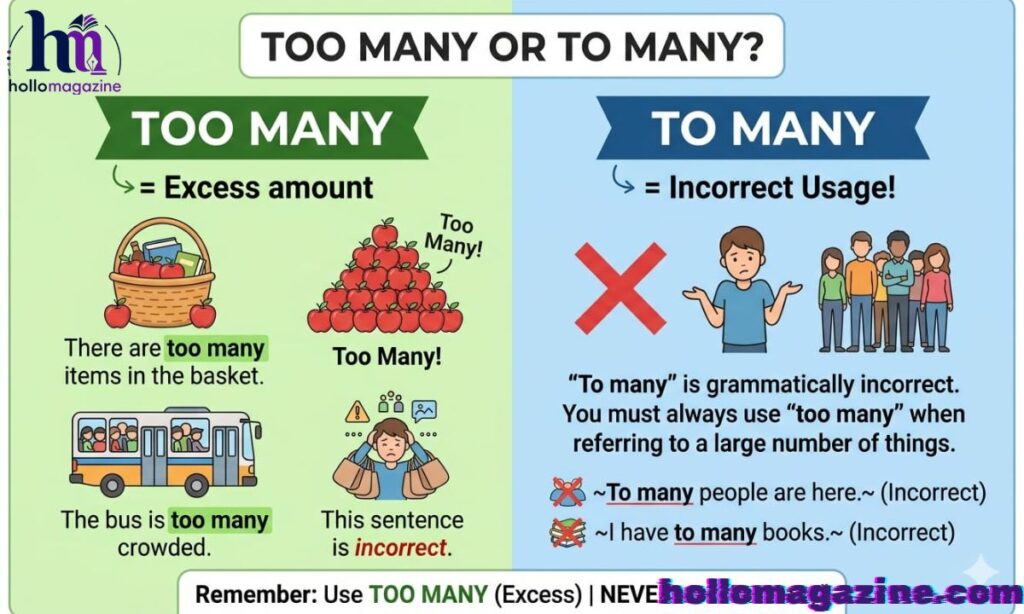
The word too means more than enough, excessively, or more than desired.
When combined with many, it describes an excessive number of countable items.
Formula:
Too + Many + Countable Noun
Examples:
- Too many students
- Too many emails
- Too many mistakes
- Too many questions
Notice that every noun above can be counted individually.
Difference Between Too Many, Too Much, and Too Few
Many learners confuse these expressions.
| Expression | Used With | Example |
| Too Many | Countable nouns | Too many chairs |
| Too Much | Uncountable nouns | Too much water |
| Too Few | Countable nouns | Too few chairs |
Examples:
- There are too many people in the room.
- There is too much noise outside.
- There are too few seats available.
Learning this distinction improves grammar accuracy significantly.
How to Identify Countable and Uncountable Nouns
Before using too many, determine whether the noun is countable.
Countable Nouns
These can be counted individually:
- Books
- Pens
- Students
- Cars
- Houses
Examples:
- Too many books
- Too many students
Uncountable Nouns
These cannot usually be counted individually:
- Water
- Information
- Advice
- Furniture
- Money
Examples:
- Too much water
- Too much information
A useful tip is to ask yourself, “Can I count it one by one?”
Common Real-Life Usage of Too Many
You will hear too many frequently in daily conversations.
Examples:
At School
- There are too many tests this month.
- We have too many assignments.
At Work
- I received too many emails today.
- There are too many meetings scheduled.
At Home
- We bought too many groceries.
- There are too many shoes near the door.
While Traveling
- There were too many tourists at the attraction.
- We packed too many bags.
Read This: Shown vs Showed: What’s the Difference? Easy Examples
Tips to Avoid Confusing Too Many and To Many
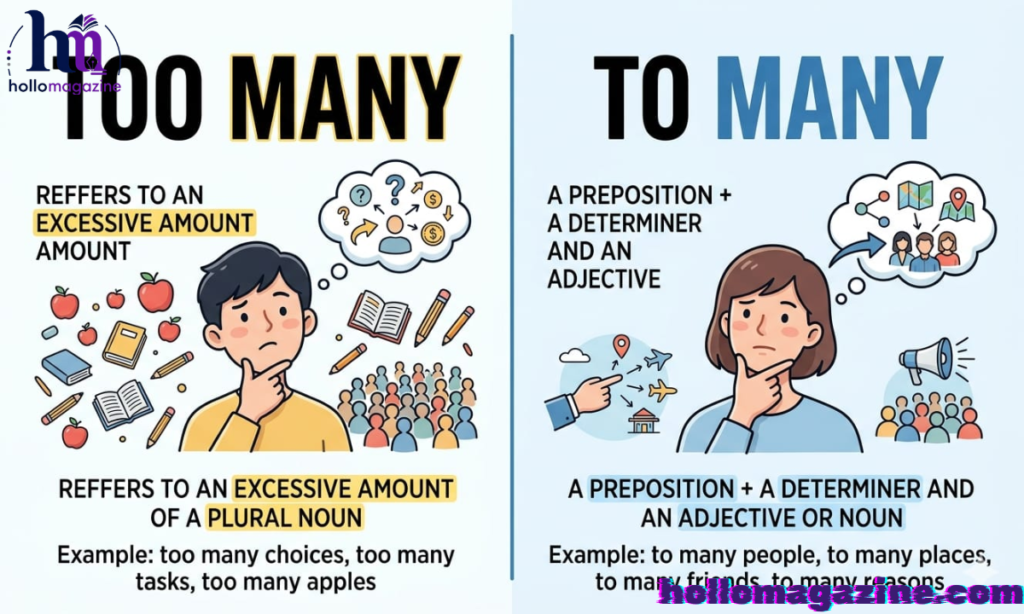
Use these practical strategies:
- Remember that too means excess.
- Check whether you are expressing a large quantity.
- Read the sentence aloud.
- Replace too with excessively. If the sentence still makes sense, use too.
Example:
- There are excessively many people here.
Since the meaning works, too many is correct.
What Does Too Many Mean?
Too many means a quantity that exceeds what is wanted, expected, or necessary.
Examples:
- Too many mistakes were found.
- Too many guests arrived unexpectedly.
- Too many notifications can be distracting.
The phrase often expresses annoyance, concern, or inconvenience.
Should I Write To Many or Too Many?
In almost all cases, you should write too many.
Incorrect:
- There are to many cars outside.
Correct:
- There are too many cars outside.
The word to is normally a preposition or part of an infinitive verb.
Examples:
- I want to learn.
- She went to school.
Neither of these examples expresses excess.
Too Many Sentence Examples
Here are additional examples:
- We have too many deadlines this week.
- There are too many people waiting.
- She owns too many jackets.
- Too many distractions reduce productivity.
- They asked too many questions.
These examples demonstrate natural and correct usage.
To Many Sentence Examples (Why They’re Wrong)
Common errors include:
❌ There are to many errors.
✔ There are too many errors.
❌ We bought to many tickets.
✔ We bought too many tickets.
❌ She has to many responsibilities.
✔ She has too many responsibilities.
The mistake occurs because writers confuse to and too.
Comparison Table: Too Many vs To Many
| Feature | Too Many | To Many |
| Grammatically Correct | Yes | Usually No |
| Expresses Excess | Yes | No |
| Common in English | Very Common | Usually an Error |
| Used Before Countable Nouns | Yes | No |
| Accepted in Formal Writing | Yes | No |
Common Grammar Mistakes Learners Make
Some frequent mistakes include:
- Writing to many instead of too many
- Using too many with uncountable nouns
- Confusing too much and too many
- Forgetting that too means excess
Examples:
❌ Too many water
✔ Too much water
❌ To many books
✔ Too many books
Linguistic Insight: Why This Confusion Happens
The confusion exists because to, too, and two sound exactly alike in most English accents.
These words are known as homophones.
Examples:
- To = preposition
- Too = excessively or also
- Two = number 2
Because pronunciation is similar, spelling mistakes frequently occur during writing.
Expert Opinion on Correct Usage
Grammar experts consistently agree that too many is the correct phrase when discussing an excessive number of countable items.
Style guides, dictionaries, educational institutions, and grammar references all recognize too many as the standard form.
Professional writers, editors, and teachers strongly recommend proofreading for this common mistake.
Wrapping Up: Should I Use Too Many or To Many?
The answer is straightforward: use too many whenever you mean an excessive number of countable things.
Write Better Perfectly
Good grammar improves clarity, professionalism, and credibility. Learning small distinctions like too many versus to many helps eliminate common writing errors.
Product
Think of grammar as a tool that improves the final product of your communication. Correct word choice creates stronger and clearer messages.
Resources
Practice exercises, reading materials, and grammar guides can help reinforce correct usage over time.
Blog
Many grammar blogs identify to many as one of the most common spelling errors among English learners.
Company
Businesses often expect polished communication. Using correct grammar leaves a positive impression on colleagues and clients.
Self Assessment
Choose the correct answer.
- There are ___ people in the room.
- A) to many
- B) too many
- We received ___ emails today.
- A) too many
- B) to many
- There is ___ water in the bucket.
- A) too many
- B) too much
Answers:
- B) too many
- A) too many
- B) too much
Conclusion
Understanding the difference between too many and to many is one of the easiest ways to improve your English writing. While the phrases sound alike, only too many correctly expresses an excessive quantity of countable nouns.
The next time you write an email, essay, report, or social media post, remember that too means more than enough. If you are talking about an excessive number of things, too many is almost always the correct choice.
Frequently Asked Questions
Is “to many” ever correct?
It can appear in rare sentence structures involving the preposition to, but it is usually a spelling mistake for too many.
What does “too many” mean?
It means more people, objects, or items than needed, wanted, or expected.
Can I use “too many” with uncountable nouns?
No. Use too much with uncountable nouns instead.
Why do people confuse “too” and “to”?
They are homophones, meaning they sound the same but have different meanings and spellings.
Is “too many” formal or informal?
It works in both formal and informal English.

Rimsha creates simple grammar guides, English writing tips, and word meaning content for readers at Hollo Magazine.