
Writing clearly often means making small but important choices. One of the most common spelling questions writers face is whether to use summarize or summarise. At first glance, the difference seems minor, but choosing the right form can help your writing appear more professional and consistent.
The good news is that both spellings are correct. The choice depends mainly on whether you are writing in American English or British English. Understanding this distinction will help students, professionals, bloggers, and researchers avoid confusion and maintain credibility in their work.
Summarize or Summarise: What’s the Actual Difference?
The difference between summarize and summarise is purely a spelling variation.
| Word | English Variety | Meaning |
| Summarize | American English | To give the main points briefly |
| Summarise | British English | To give the main points briefly |
Both verbs mean to present information in a shorter form while keeping the key ideas intact.
Why American and British English Spell It Differently
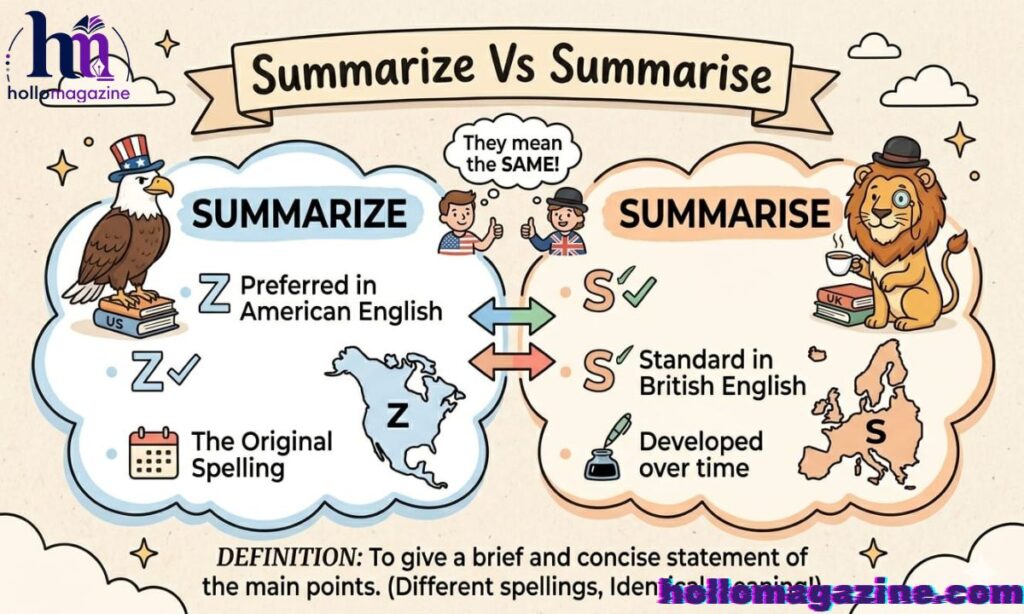
Many English words ending in -ize and -ise follow regional spelling conventions.
Examples include:
- Organize / Organise
- Realize / Realise
- Recognize / Recognise
- Summarize / Summarise
American English generally favors -ize, while British English commonly uses -ise, although some British publishers also accept -ize.
Summarize or Summarise: Which One Is Correct?
The simple answer is that both are correct.
Choose summarize when writing for:
- American readers
- US universities
- American businesses
- US-based publications
Choose summarise when writing for:
- British readers
- UK universities
- British businesses
- Publications using British English standards
The most important rule is consistency. Do not switch between both spellings in the same document.
Summarize vs Summarise in Academic Writing
Academic institutions usually follow specific language standards.
US Academic Standards
American academic writing typically prefers summarize.
Examples:
- Summarize the article in 200 words.
- Students must summarize the chapter before class.
- The report summarizes the main findings.
Common style systems that favor this spelling include APA, MLA, and Chicago-style publications.
UK Academic Standards
British academic writing commonly uses summarise.
Examples:
- Summarise the author’s argument.
- Please summarise the research findings.
- The essay summarises previous studies.
Many UK universities and publications prefer this form.
Read This: Dry Snitching: What It Means and How to Spot It
Summarize or Summarise in Professional Writing
Professional communication should match the audience’s language expectations.
Use summarize in:
- American business reports
- US marketing content
- Corporate presentations
- Technical documentation for US audiences
Example:
“The manager will summarize the project results during the meeting.”
Use summarise in:
- UK business reports
- British government documents
- UK corporate communication
- Commonwealth English publications
Example:
“The director will summarise the quarterly performance.”
Examples: Summarize vs Summarise in Real Sentences
American English Examples
- Can you summarize the article for me?
- The teacher asked students to summarize the chapter.
- I will summarize the meeting notes tomorrow.
- The report summarizes key customer feedback.
British English Examples
- Could you summarise the article?
- The lecturer asked students to summarise the findings.
- Please summarise your conclusions briefly.
- The report summarises recent developments.
Verb Forms and Grammar Rules
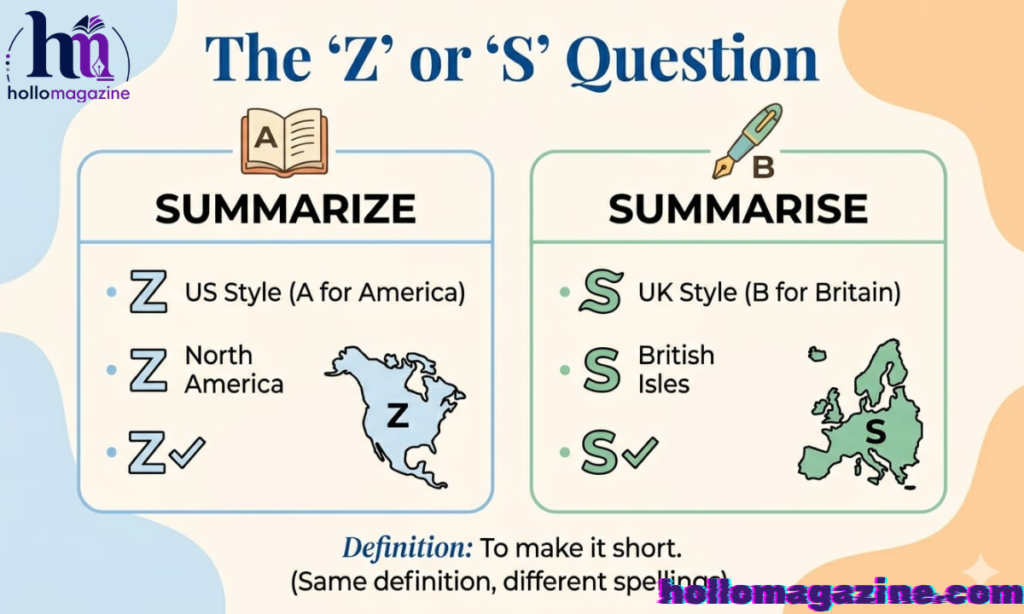
Both spellings follow the same grammar rules.
Base Forms
| American | British |
| Summarize | Summarise |
Past Tense
| American | British |
| Summarized | Summarised |
Examples:
- She summarized the report.
- She summarised the report.
Present Participle
| American | British |
| Summarizing | Summarising |
Examples:
- He is summarizing the discussion.
- He is summarising the discussion.
Noun Form
| American | British |
| Summary | Summary |
Interestingly, the noun remains the same in both varieties of English.
Why Writers Still Get Confused
Several factors contribute to confusion:
- Spellcheck settings may use a different language variety.
- Online content mixes American and British English.
- Global audiences encounter both spellings frequently.
- Pronunciation remains identical.
Because both words sound exactly the same, many writers assume one must be incorrect. In reality, both are accepted depending on the audience.
How to Choose the Right Spelling Every Time
Use these simple rules:
- Identify your audience.
- Follow your organization’s style guide.
- Stay consistent throughout the document.
- Check spellcheck language settings.
- Match existing content on your website or publication.
If your audience is international, consistency is more important than the specific spelling you choose.
Common Mistakes to Avoid
Avoid these errors:
Mixing Spellings
❌ The report summarizes the findings and later summarises the recommendations.
✅ The report summarizes the findings and summarizes the recommendations.
Using Different Language Standards
❌ Organise, recognise, summarize
✅ Organise, recognise, summarise
OR
✅ Organize, recognize, summarize
Ignoring Style Guidelines
Always check whether your school, employer, or publisher prefers American or British English.
Summarize or Summarise in Education and Technology
Modern technology exposes users to both spellings daily.
Examples include:
- AI writing assistants
- Educational platforms
- Online learning systems
- Search engines
- Grammar-checking software
Many applications automatically adjust spelling recommendations based on the language setting selected by the user. This is why American users often see summarize, while British users commonly see summarise.
Quick Reference Guide

| Question | Answer |
| Is summarize correct? | Yes, in American English |
| Is summarise correct? | Yes, in British English |
| Do they mean the same thing? | Yes |
| Is one more formal? | No |
| Should both appear in one document? | No |
| Which spelling is used in US schools? | Summarize |
| Which spelling is used in UK schools? | Summarise |
Conclusion
Choosing between summarize and summarise is not about right versus wrong. Both spellings are accepted and carry the exact same meaning. The real difference lies in the variety of English you are using and the expectations of your audience.
For American English, use summarize. For British English, use summarise. Once you choose one form, remain consistent throughout your writing. This simple habit improves readability, professionalism, and overall writing quality.
Frequently Asked Questions
Is summarize correct in American English?
Yes. Summarize is the standard American English spelling.
Is summarise correct in British English?
Yes. Summarise is widely used in British English.
Do summarize and summarise have different meanings?
No. Both words mean to present the main points briefly.
Which spelling should students use?
Students should follow the language standard required by their institution.
Can I use both spellings in one article?
No. Consistency is recommended throughout any document.
Is one spelling more formal than the other?
No. Both are equally formal within their respective language varieties.

Rimsha creates simple grammar guides, English writing tips, and word meaning content for readers at Hollo Magazine.