
Understanding the difference between complaint and complain is one of the most common grammar challenges for English learners. Because both words come from the same root and relate to expressing dissatisfaction, many people accidentally use one in place of the other.
The good news is that the distinction is simple. Once you understand that one word is a noun and the other is a verb, choosing the correct form becomes much easier. This guide explains the meaning, grammar, usage, common mistakes, and practical examples of complaint vs complain.
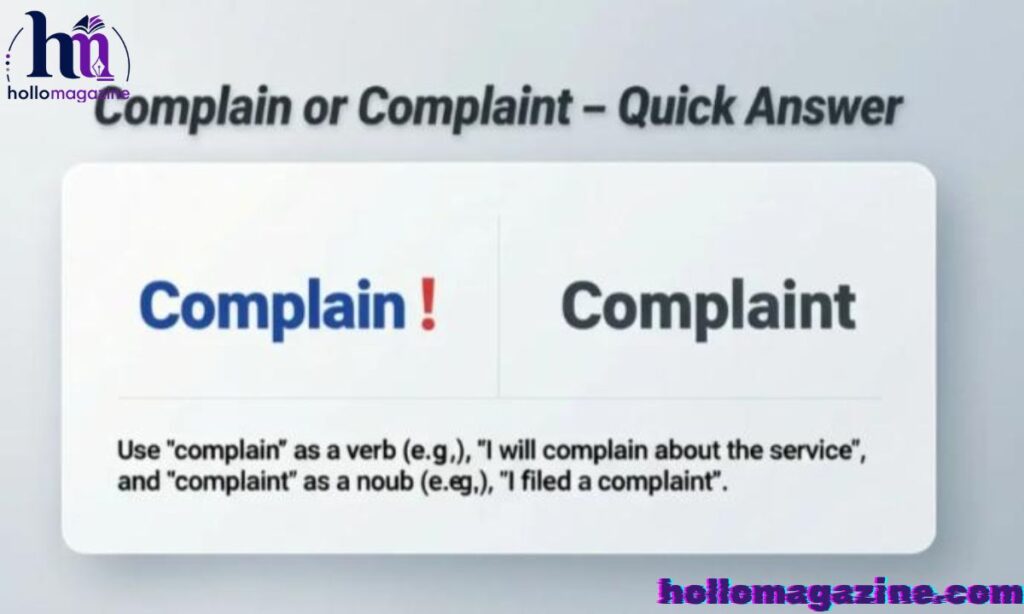
Complaint or Complain – Quick Answer
The quick answer is simple:
- Complaint = a noun (a thing)
- Complain = a verb (an action)
Examples:
- I filed a complaint about the service.
- I want to complain about the service.
If you are talking about the action, use complain. If you are talking about the issue or report itself, use complaint.
Complaint vs Complain Meaning Explained in Simple English
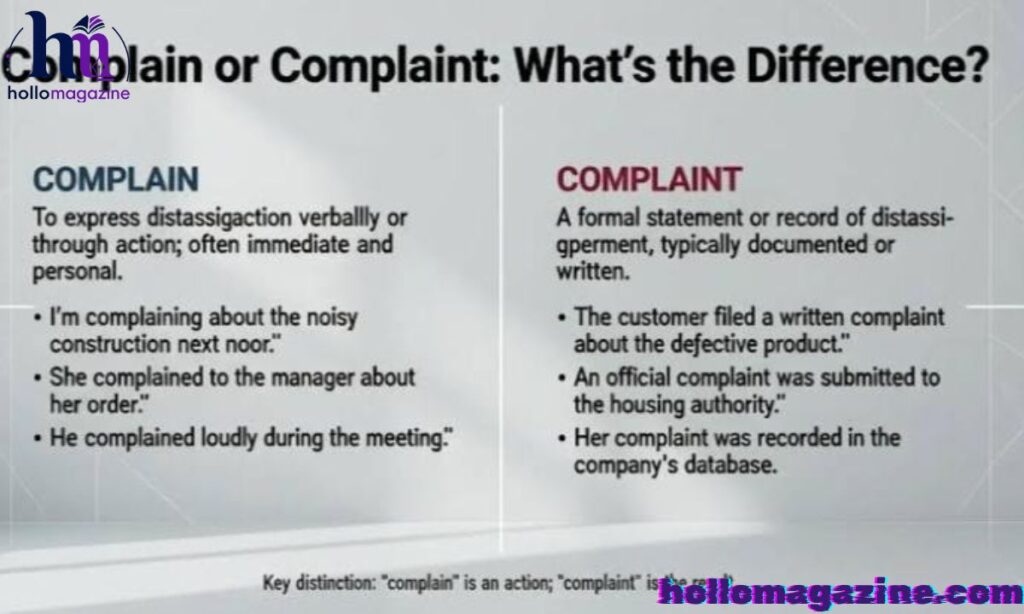
Meaning of “Complaint” (Noun)
A complaint is a statement, report, or expression of dissatisfaction.
Examples:
- The customer submitted a complaint.
- We received several complaints this week.
- Her complaint was investigated quickly.
Meaning of “Complain” (Verb)
Complain means to express dissatisfaction or annoyance about something.
Examples:
- Customers often complain about delays.
- He likes to complain about the weather.
- They complained to the manager yesterday.
Complaint or Complain Grammar Difference
Complaint vs Complain – Part of Speech Table
| Word | Part of Speech | Meaning |
| Complaint | Noun | A statement of dissatisfaction |
| Complain | Verb | To express dissatisfaction |
Sentence Structure Guide
Use complaint after articles and adjectives:
- A complaint
- The complaint
- Formal complaint
Use complain after subjects:
- I complain
- They complain
- Customers complain
Formula:
- Subject + Complain + About + Problem
- Subject + File/Submit + Complaint
Complaint vs Complain in Real Life Contexts
Everyday English Examples
Daily conversations often include both words.
Examples:
- My neighbor always complains about noise.
- We received a complaint from a neighbor.
- Don’t complain without offering solutions.
- The complaint was resolved quickly.
Professional & Business Usage
Using “Complaint” in Business
Businesses frequently use the noun form.
Examples:
- Customer complaint
- Formal complaint
- Complaint department
- Complaint resolution process
Using “Complain” in Business
The verb is used when discussing customer actions.
Examples:
- Customers complain about slow delivery.
- Employees may complain about working conditions.
- Clients complained about communication delays.
Healthcare and Legal Usage
Healthcare
Healthcare organizations track complaints carefully.
Examples:
- Patient complaint forms
- Complaint investigation procedures
- Patients may complain about waiting times.
Legal
Legal systems often distinguish between making a complaint and filing one.
Examples:
- The witness complained about harassment.
- The victim filed a formal complaint.
Read This: Deem Fit — What It Means, How To Use It, And Why It Matters
Common Mistakes with Complaint and Complain
Wrong
I want to make a complain.
Correct
I want to make a complaint.
Wrong
She submitted a complain.
Correct
She submitted a complaint.
Wrong
The customer complainted about the service.
Correct
The customer complained about the service.
Wrong
We received many complain.
Correct
We received many complaints.
Simple Memory Tricks to Never Forget the Difference
Memory Trick 1
Complaint = Thing
The ending -t can remind you that it is a thing you can submit or receive.
Memory Trick 2
Complain = Action
If someone is actively expressing dissatisfaction, they are performing an action.
Memory Trick 3
Think:
- I complain.
- I file a complaint.
This sentence pair helps reinforce the difference.
Complaint vs Complain in Tenses and Forms
Forms of Complain (Verb)
| Form | Example |
| Complain | I complain often |
| Complains | She complains daily |
| Complained | They complained yesterday |
| Complaining | He is complaining now |
Forms Related to Complaint (Noun)
| Form | Example |
| Complaint | A complaint was filed |
| Complaints | Several complaints were received |
| Complaint-related | Complaint-related procedures |
Complaint or Complain – Usage in Different Situations
In Casual Conversation
Examples:
- Stop complaining about everything.
- What’s your complaint?
In Text Messages
Examples:
- Why are you complaining?
- What’s the complaint this time?
In Professional Emails
Examples:
- I would like to submit a complaint.
- I am writing to complain about a billing issue.
In Official Complaints
Examples:
- Formal complaint letter
- Consumer complaint report
- Written complaint submission
Complaint vs Complain – Mini Learning Table
| Situation | Correct Word |
| Expressing dissatisfaction | Complain |
| Filing a report | Complaint |
| Customer action | Complain |
| Customer report | Complaint |
| Verb needed | Complain |
| Noun needed | Complaint |
Real World Case Study: Complaint vs Complain in Business
Imagine a customer receives a damaged product.
Step 1:
The customer contacts support and complains about the issue.
Step 2:
The company records the issue as a complaint.
Step 3:
The complaint is reviewed and resolved.
This example shows how both words often appear in the same situation but perform different grammatical roles.
Engaging Mini Quiz – Test Yourself
Choose the correct word.
- I want to ______ about poor service.
- The manager received a ______.
- Customers often ______ about long waits.
- The company investigated the ______.
Answers:
- Complain
- Complaint
- Complain
- Complaint
Simple Visual Explanation
Think of the difference this way:
| Action | Result |
| Complain | Complaint |
| Speak up | Report |
| Express dissatisfaction | Written record |
A complaint is often the result of someone complaining.
Powerful Usage Tips
- Use complain when an action is happening.
- Use complaint when referring to a report or issue.
- Check whether the sentence needs a noun or verb.
- Remember that complaints can be counted, while complain is an action.
- Read the sentence aloud to identify the correct form.
Helpful Examples You Can Use Anytime
- Customers complain about delays.
- The airline received a complaint.
- Parents complained about the policy.
- A formal complaint was submitted.
- Employees sometimes complain about workload.
- The complaint was addressed immediately.
- She complained politely.
- His complaint was taken seriously.
Expert Quote
Grammar experts often emphasize that understanding parts of speech is the fastest way to avoid confusion between similar words. Since complaint is a noun and complain is a verb, identifying the role each word plays in a sentence usually reveals the correct choice immediately.
Conclusion
Complaint and complain are closely related words, but they serve different grammatical purposes. Complain is the verb used when someone expresses dissatisfaction, while complaint is the noun used for the statement, report, or issue itself.
Mastering this difference can improve your writing, speaking, professional communication, and grammar accuracy. By remembering the noun-versus-verb distinction and practicing with real-life examples, you can confidently choose the correct word every time.
Frequently Asked Questions
What is the difference between complaint and complain?
Complaint is a noun, while complain is a verb.
Can I say “make a complain”?
No. The correct phrase is “make a complaint.”
Is complain a verb?
Yes. Complain means to express dissatisfaction.
What is the plural of complaint?
The plural form is complaints.
Which is used in formal business writing?
Both are used, but complaint is common in reports and documentation, while complain is used to describe actions.

Rimsha creates simple grammar guides, English writing tips, and word meaning content for readers at Hollo Magazine.