
English grammar can sometimes feel confusing, especially when indefinite pronouns enter the picture. One of the most common questions learners ask is whether they should write “anyone has” or “anyone have.” Since both forms appear online and in everyday conversations, it’s easy to become unsure.
The good news is that the answer follows a simple grammar rule. Once you understand how subject-verb agreement and auxiliary verbs work, you’ll never struggle with this question again. This guide explains everything with examples, comparisons, and real-world usage.
Quick Answer First: Anyone Has vs Anyone Have
Here’s the short answer:
| Phrase | Correct? | Usage |
| Anyone has | ✅ Yes | Statements and clauses |
| Anyone have | ✅ Yes | Questions, negatives, and conditionals with auxiliary verbs |
| Anyone have a pen? | ❌ Usually incorrect in formal English | Missing auxiliary verb |
| Does anyone have a pen? | ✅ Correct | Standard question |
The key is understanding why each form appears.
The Core Grammar Rule You Must Know
The entire issue comes down to one grammar concept:
Subject-verb agreement.
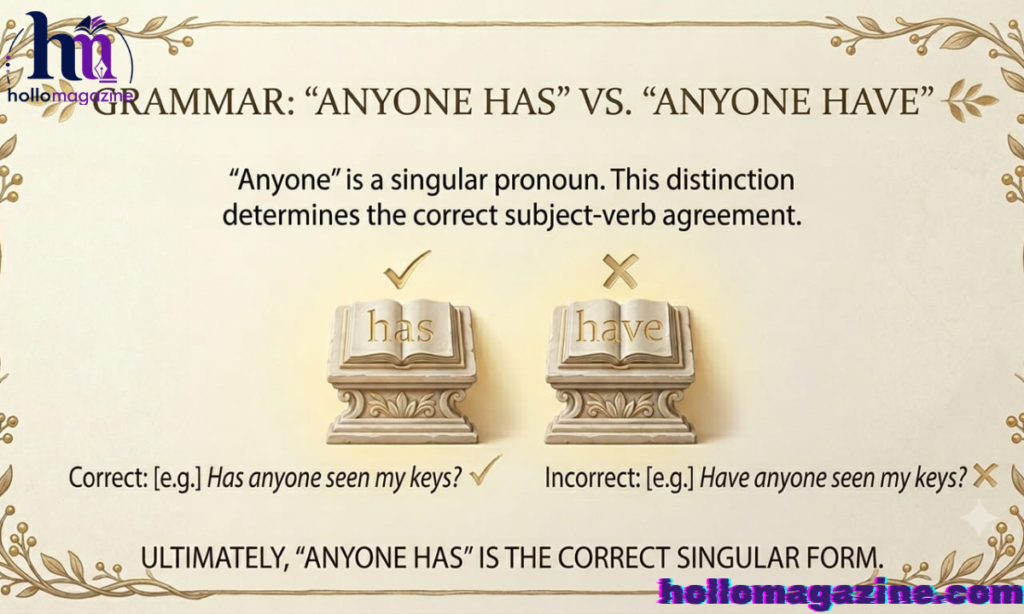
Anyone Is Always Singular
In standard English, anyone is treated as a singular indefinite pronoun.
Examples:
- Anyone is welcome.
- Anyone knows the answer. ❌
- Anyone knows? ❌
- Anyone has access. ✅
Because it is singular, it normally takes singular verbs.
Think of anyone as similar to:
- Someone
- Everyone
- Nobody
- Anybody
Common Singular Indefinite Pronouns
The following pronouns are singular:
- Anyone
- Anybody
- Someone
- Somebody
- Everyone
- Everybody
- No one
- Nobody
- Each one
Examples:
- Everyone has a ticket.
- Somebody has called.
- Nobody knows the answer.
- Anyone has the right to apply.
The singular nature of these words is the foundation of the rule.
When “Anyone Has” Is Correct
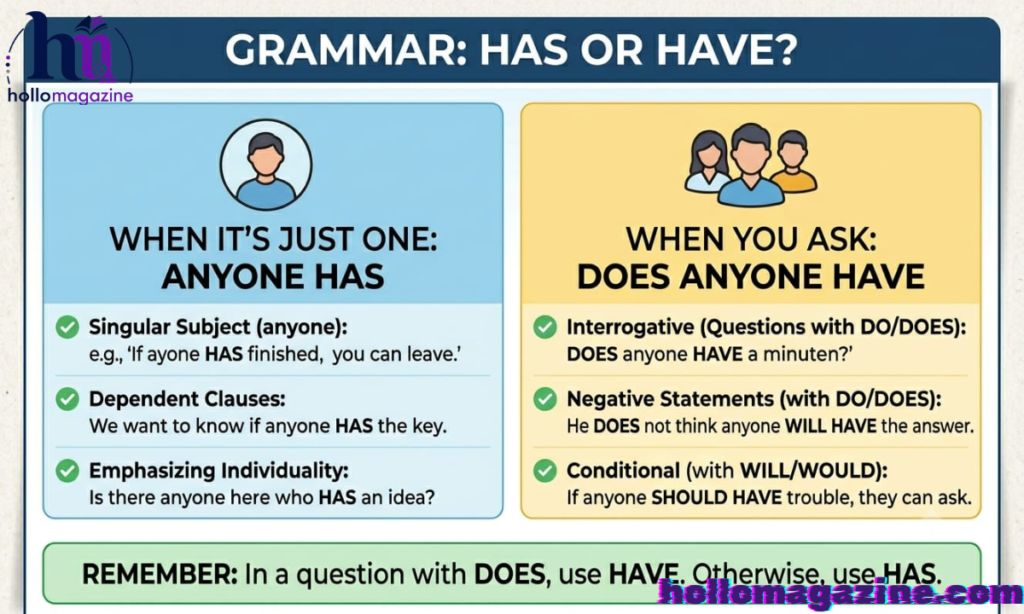
Anyone has is correct when has functions as the main verb in a statement or clause.
Declarative Statements
Declarative sentences simply make statements.
Examples:
- If anyone has questions, please ask.
- Anyone who has experience may apply.
- Anyone has the opportunity to succeed. *
- Let me know if anyone has concerns.
- Tell me whether anyone has seen my keys.
The most common pattern is:
Anyone + has + noun
Examples:
- Anyone has access to the handbook.
- Anyone has permission to participate.
- Anyone has the ability to improve.
In natural English, you’ll often see this structure inside longer clauses.
Embedded Clauses and Indirect Speech
Embedded clauses frequently use anyone has.
Examples:
- I wonder whether anyone has called.
- We need to know if anyone has reported the issue.
- The manager asked whether anyone has suggestions.
- Tell me if anyone has completed the assignment.
Notice that has agrees with the singular subject anyone.
These structures appear frequently in business emails and professional communication.
Formal and Written English
Formal writing strongly follows subject-verb agreement rules.
Examples:
- If anyone has additional comments, they should submit them before Friday.
- The committee would like to know whether anyone has objections.
- Please notify us if anyone has relevant experience.
In academic and professional contexts, anyone has is completely standard.
Read This: Incoming vs Upcoming vs Oncoming: Clear Differences Explained
When “Anyone Have” Is Correct
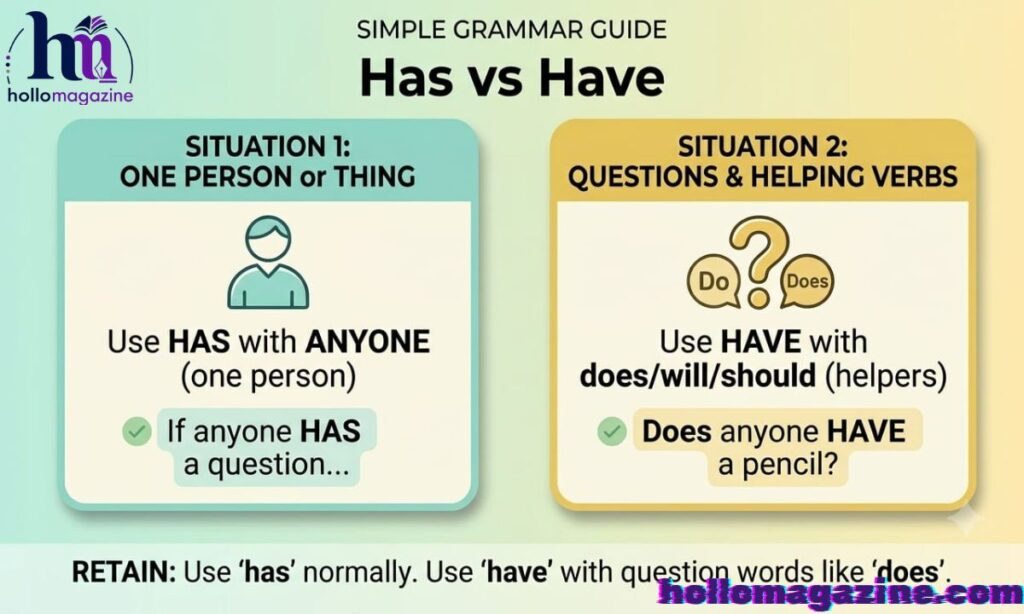
Many learners think anyone have is always wrong. That’s not true.
It becomes correct when an auxiliary verb controls the sentence.
Direct Questions
In questions, English often uses do, does, or did.
Examples:
- Does anyone have a charger?
- Does anyone have an answer?
- Does anyone have experience with this software?
Notice what happens:
| Subject | Auxiliary | Main Verb |
| Anyone | Does | Have |
The auxiliary verb carries the agreement, so the main verb remains have.
Correct:
- Does anyone have a pen?
Incorrect:
- Does anyone has a pen?
Negative Constructions
Negative sentences also require the base form have.
Examples:
- Anyone does not have access. ❌
- Does anyone not have access? ✅
- Anyone doesn’t have permission. ❌
- Does anyone not have permission? ✅
Because an auxiliary verb is present, the main verb stays in its base form.
Conditional and Hypothetical Sentences
Conditional structures frequently use have.
Examples:
- If anyone should have questions, contact support.
- If anyone were to have concerns, we would listen.
- Should anyone have objections, please speak now.
These sentences are grammatically correct because auxiliary or modal verbs govern the verb form.
Why People Keep Getting This Wrong
Several factors contribute to the confusion.
Spoken English vs Written English
In fast speech, people often shorten phrases.
Examples:
- Anyone have a pen?
- Anybody got a charger?
These expressions are common conversational shortcuts.
However, formal writing requires:
- Does anyone have a pen?
- Does anybody have a charger?
Spoken English often ignores grammar rules that writing preserves.
Word Order Illusions
Many learners focus on the word closest to the verb.
Example:
- Does anyone have questions?
Because have follows anyone, some people mistakenly think has should appear.
But the auxiliary does already handles singular agreement.
Subject-Verb Agreement Made Simple
Use this quick formula:
| Sentence Type | Correct Form |
| Statement | Anyone has |
| Question with does | Anyone have |
| Negative with does | Anyone have |
| Conditional with should | Anyone have |
| Conditional with would | Anyone have |
Simple rule:
- No auxiliary → has
- Auxiliary present → have
This guideline solves most confusion instantly.
Anyone Has vs Anyone Have: Side-by-Side Comparison
| Incorrect | Correct |
| Does anyone has a pen? | Does anyone have a pen? |
| If anyone have questions | If anyone has questions |
| Anyone have the answer | Anyone has the answer |
| Does anyone has experience | Does anyone have experience |
| Tell me if anyone have concerns | Tell me if anyone has concerns |
Comparing examples side by side helps reinforce the pattern.
Anyone vs Anybody: Is There a Difference?
In most situations, anyone and anybody mean the same thing.
Examples:
- Does anyone have a question?
- Does anybody have a question?
Both are correct.
Differences are minimal:
| Word | Tone |
| Anyone | Slightly more formal |
| Anybody | Slightly more conversational |
Grammar rules remain identical.
Common Mistakes (And How to Fix Them)
Mistake 1: Matching Meaning Instead of Grammar
Many learners think “anyone” refers to many possible people.
Therefore they incorrectly write:
- Anyone have questions. ❌
Correct:
- Anyone has questions. ✅
- Does anyone have questions? ✅
Mistake 2: Forgetting the Auxiliary Verb Rule
Incorrect:
- Does anyone has experience? ❌
Correct:
- Does anyone have experience? ✅
Remember: after does, use the base verb.
Mistake 3: Copying Spoken English Into Writing
Informal speech:
- Anyone have a charger?
Formal writing:
- Does anyone have a charger?
Written English requires complete grammatical structure.
Pronunciation Traps That Cause Confusion
Native speakers often reduce sounds during conversation.
Examples:
- Does anyone have → “duz anyone have”
- Anyone has → “anyone’z”
These pronunciation shortcuts can make learners hear incorrect patterns.
The solution is to rely on grammar rules rather than spoken shortcuts.
Real-World Usage Examples
Everyday Conversation
- Does anyone have a phone charger?
- Does anyone have plans tonight?
- If anyone has ideas, let me know.
Workplace Communication
- Please notify me if anyone has concerns.
- Does anyone have experience with this platform?
- Let us know whether anyone has questions.
Academic and Exam Writing
- If anyone has evidence supporting the claim, it should be cited.
- Researchers wanted to know whether anyone has observed similar results.
- Does anyone have a different interpretation of the text?
These examples reflect standard English usage.
Quick Grammar Checklist (Bookmark This)
Before choosing has or have, ask:
- Is “anyone” the subject? ✅
- Is there an auxiliary verb? ✅
- Am I writing a statement or a question? ✅
Quick reminders:
- Anyone has → statements
- Does anyone have → questions
- If anyone has → conditions
- Should anyone have → hypothetical situations
Following these checkpoints prevents almost every mistake.
Conclusion
The difference between anyone has and anyone have becomes easy once you understand subject-verb agreement. Since anyone is always singular, it naturally pairs with has when no auxiliary verb is present.
However, when words such as does, should, would, or other auxiliaries appear, the main verb returns to its base form have. This is why both expressions can be correct depending on sentence structure.
Frequently Asked Questions
Is anyone singular or plural?
Anyone is always treated as a singular indefinite pronoun in standard English.
Is “anyone has” grammatically correct?
Yes. It is correct when used in statements and clauses without auxiliary verbs.
Is “anyone have” ever correct?
Yes. It is correct after auxiliary verbs such as does, should, would, and could.
Why is “Does anyone has” incorrect?
Because after does, the main verb must remain in its base form: have.
Is there a difference between anyone and anybody?
The meanings are nearly identical, though anyone may sound slightly more formal.
Which is correct: “If anyone has questions” or “If anyone have questions”?
“If anyone has questions” is correct because anyone is singular.

Rimsha creates simple grammar guides, English writing tips, and word meaning content for readers at Hollo Magazine.