
English spelling can be surprisingly complex, especially when verbs change form. One spelling debate that frequently appears in writing, editing, and online discussions is combatting vs combating. Because both versions are seen in books, articles, and websites, many writers wonder whether one is wrong or whether both are acceptable.
The answer depends largely on spelling conventions and regional preferences. Understanding the difference between combatting and combating can help writers maintain consistency, improve professionalism, and follow the style standards expected by their audience.
Quick Answer: Combatting or Combating
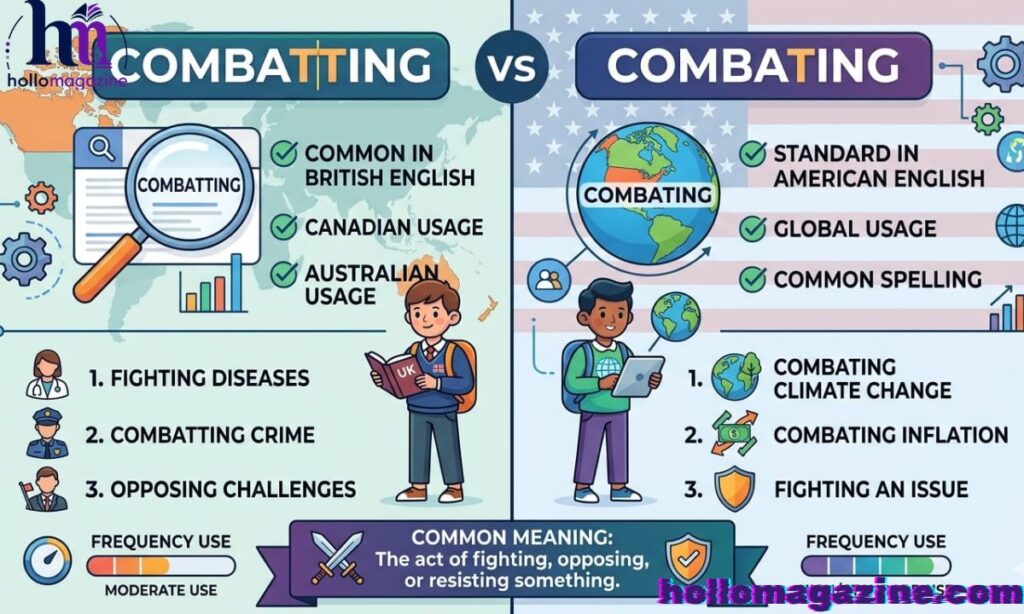
Both combatting and combating are accepted spellings of the present participle and gerund form of the verb combat.
However, usage differs by region and style guide.
| Spelling | Status | Common Usage |
| Combating | ✅ Correct | More common worldwide, especially in American English |
| Combatting | ✅ Correct | Accepted, often seen in British English and some formal contexts |
In modern publishing, combating is generally the preferred and more widely used spelling.
Origins: The Roots of Combatting and Combating
The word combat comes from the Old French word combatre, which itself originated from the Late Latin combattere, meaning “to fight together.”
Over time, the term entered Middle English and developed into the modern verb and noun forms.
Examples:
- To combat disease
- To combat poverty
- To combat misinformation
As English evolved, questions arose about how the word should change when adding endings such as -ing and -ed, leading to the coexistence of combating and combatting.
English Spelling Rule: Consonant Doubling Explained
Much of the confusion comes from English consonant-doubling rules.
A common spelling rule says that when a one-syllable word ends in:
- One vowel
- Followed by one consonant
The final consonant is often doubled before adding -ing.
Examples:
| Base Word | -ing Form |
| Run | Running |
| Sit | Sitting |
| Stop | Stopping |
| Hit | Hitting |
Some writers apply this rule to combat, producing combatting.
However, English spelling conventions have gradually favored combating, particularly in American English.
This is why both forms appear in modern writing.
British English vs American English Spelling

Regional spelling preferences play a major role.
American English
American publications overwhelmingly favor:
✅ Combating
Examples:
- Combating climate change
- Combating cybercrime
- Combating inflation
Many American style guides recommend this spelling because it aligns with simplified spelling conventions.
British English
British English is more flexible.
Both forms appear, although combating remains increasingly common.
Examples:
- Combating poverty
- Combatting crime
Because British English often preserves doubled consonants in certain words, some organizations still prefer combatting.
Comparison Table
| Region | Preferred Form |
| United States | Combating |
| Canada | Combating |
| Australia | Usually Combating |
| United Kingdom | Combating or Combatting |
| International Organizations | Usually Combating |
Dictionaries Speak: The Official Take
Major dictionaries generally recognize both spellings.
Most dictionary entries:
- List combating as the primary form.
- Recognize combatting as a variant spelling.
- Treat both as grammatically acceptable.
The key takeaway is that neither form is technically wrong.
The more important issue is consistency throughout a document.
Read This: Learn the Difference Between Oversight vs Oversite
Style Guides & Usage Recommendations
Many professional writing organizations recommend choosing one form and using it consistently.
Common recommendations include:
Preferred by Many Modern Publications
✅ Combating
Reasons:
- Simpler spelling
- More common globally
- Easier readability
- Stronger search visibility
Acceptable Alternative
✅ Combatting
Reasons:
- Historical usage
- Some British preferences
- Certain organizational style guides
For most business, academic, and online writing, combating is generally the safer choice.
Common Mistakes Writers Make
Writers often make several errors when dealing with these spellings.
Mistake 1: Assuming Combatting Is Wrong
Many people incorrectly believe combatting is a spelling error.
In reality, it is an accepted variant.
Mistake 2: Mixing Both Forms
Incorrect:
- The organization is combating poverty and combatting hunger.
Correct:
- The organization is combating poverty and combating hunger.
Consistency is essential.
Mistake 3: Applying Rules Inconsistently
Writers sometimes double consonants in some words but not others without following a specific style guide.
Mistake 4: Ignoring Audience Expectations
A document intended for an American audience should generally use combating.
Examples in Everyday Sentences
Here are practical examples.
Health
- Governments are combating infectious diseases.
- Researchers are combating antibiotic resistance.
Business
- Companies are combating cybersecurity threats.
- The team is combating declining sales.
Education
- Schools are combating bullying.
- Teachers are combating misinformation online.
Environment
- Nations are combating climate change.
- Scientists are combating habitat loss.
Social Issues
- Communities are combating poverty.
- Organizations are combating discrimination.
These examples work equally well with combatting if consistent style rules are followed.
Data Insights: Real Usage Trends 2026
Modern publishing trends show a clear preference for combating.
Several factors explain this:
- International business communication
- Global journalism standards
- Digital publishing practices
- Search engine optimization preferences
- American English influence
Current usage patterns indicate:
- Combating appears significantly more frequently in online publications.
- Combatting remains present but less common.
- Most international organizations prefer combating.
As a result, combating has become the dominant spelling in many professional contexts.
How to Choose Which Form to Use
The best choice depends on your audience and style requirements.
Use Combating When:
- Writing for international readers
- Following American English conventions
- Creating SEO content
- Publishing online articles
- Writing business documents
Use Combatting When:
- Following a specific British style guide
- Matching organizational preferences
- Maintaining consistency with existing documents
Quick Rule
If you’re unsure, choose:
✅ Combating
It is the most widely accepted modern option.
Case Study: Standardizing Spelling in a Global NGO
A multinational nonprofit organization publishes reports for audiences in North America, Europe, Asia, and Africa.
Initially, different departments used different spellings:
- Some wrote combating.
- Others wrote combatting.
This inconsistency created editorial challenges and reduced style uniformity.
The organization eventually standardized all publications to combating because:
- It was more widely recognized.
- It improved consistency.
- It aligned with international publishing standards.
- It simplified editing workflows.
As a result, documents became easier to manage and maintain.
Reference Cambridge Dictionary Definitions

According to Cambridge Dictionary, combat means:
- To fight against something.
- To take action to reduce or prevent a problem.
Common examples include:
- Combat disease
- Combat crime
- Combat corruption
- Combat climate change
Cambridge Dictionary recognizes the verb combat and its derived forms in modern English usage. In practical publishing and contemporary writing, combating is generally the most frequently encountered form.
Conclusion
The debate between combatting and combating is unusual because both spellings are accepted. However, modern usage trends, style guides, and international publishing standards strongly favor combating, particularly in American English and global communication.
The most important rule is consistency. Whether you choose combating or combatting, use the same form throughout your document. For most writers, businesses, educators, and content creators, combating remains the clearest and most widely accepted choice.
Frequently Asked Questions
Is combating or combatting correct?
Both are correct, but combating is more commonly used.
Which spelling is preferred in American English?
American English strongly favors combating.
Is combatting a spelling mistake?
No. It is an accepted variant spelling.
Which form is better for SEO content?
Combating is generally preferred because it is more widely searched and recognized.
Do dictionaries recognize both spellings?
Yes. Most major dictionaries accept both forms.
Which spelling is more common worldwide?
Combating is considerably more common in modern global publishing.
Should I use both forms in one document?
No. Choose one spelling and remain consistent.
What does combat mean?
Combat means to fight against, oppose, or take action to reduce a problem or threat.

Rimsha creates simple grammar guides, English writing tips, and word meaning content for readers at Hollo Magazine.