
English grammar can be confusing when singular, plural, and possessive forms look almost identical. One common example is the confusion between coachs and coaches. Many writers are unsure whether they need an apostrophe, an extra “es,” or both.
The good news is that once you understand the grammar rules behind the word coach, choosing the correct form becomes simple. This guide explains the differences between coach’s, coaches, and coaches’ with clear examples and practical writing tips.
The Basics Singular vs Plural in Coach Grammar
Before comparing coachs and coaches, it’s important to understand three different grammar concepts:
- Singular possessive
- Plural noun
- Plural possessive
The word coach is a singular noun.
Examples:
- The coach gave instructions.
- The coach planned practice.
When ownership or possession is involved, the spelling changes. When referring to more than one coach, the plural form changes as well.
Understanding these distinctions prevents common grammar mistakes.
Coachs The Singular Possessive
Technically, coachs without an apostrophe is not considered standard English.
When people write “coachs,” they are usually trying to write the singular possessive form:
coach’s
The apostrophe shows ownership.
Examples:
- The coach’s whistle was loud.
- The coach’s strategy worked perfectly.
- The coach’s office is upstairs.
In each example, something belongs to one coach.
Examples of Singular Possessive Coach
Examples include:
- The coach’s notes were detailed.
- The coach’s decision changed the game.
- The coach’s training methods improved performance.
- The coach’s speech inspired the team.
- The coach’s schedule was packed.
Notice that ownership belongs to one person.
Tips for Using Coach’s
Remember these simple rules:
- One coach owns something → coach’s
- Use an apostrophe before the final s.
- Read the sentence as “belonging to the coach.”
Quick check:
“The coach’s clipboard”
Ask yourself:
“Whose clipboard?”
Answer:
“The coach’s clipboard.”
Coaches The Plural Form (No Apostrophe)
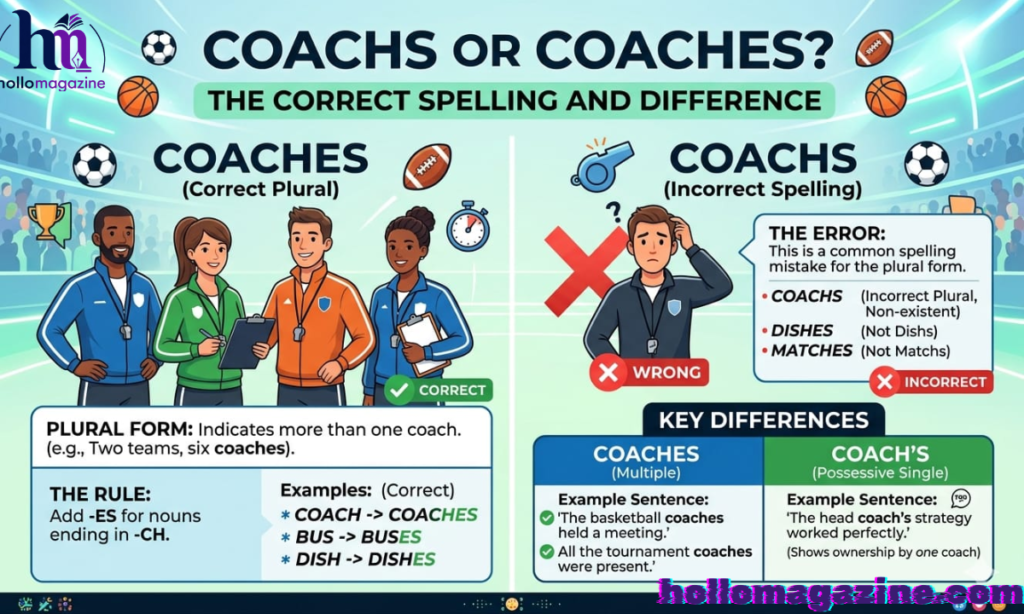
The plural form of coach is coaches.
This simply means more than one coach.
Examples:
- The coaches attended the meeting.
- Several coaches shared their ideas.
- The coaches traveled together.
No ownership is involved.
Examples of Plural Form of Coach
Examples:
- The coaches discussed strategy.
- The coaches met after practice.
- Experienced coaches often mentor younger staff.
- The coaches reviewed game footage.
- Local coaches attended the conference.
Each sentence refers to multiple coaches.
Key Reminder
If you can replace the word with:
- one coach → coach
- multiple coaches → coaches
then no apostrophe is needed.
Plural does not automatically mean possessive.
Coaches The Plural Possessive
When multiple coaches own something together, use:
coaches’
The apostrophe comes after the final s.
Examples:
- The coaches’ meeting lasted two hours.
- The coaches’ recommendations were adopted.
- The coaches’ office was renovated.
This indicates ownership by more than one coach.
Examples of Plural Possessive Coaches
Examples:
- The coaches’ schedules overlapped.
- The coaches’ training plan was approved.
- The coaches’ opinions influenced the decision.
- The coaches’ equipment was stored safely.
- The coaches’ leadership improved team morale.
Ownership belongs to several coaches.
Sentence Tips
Use this quick test:
- One coach owns it → coach’s
- Multiple coaches own it → coaches’
Examples:
- Coach’s notebook = one coach
- Coaches’ notebook = multiple coaches
The apostrophe position changes the meaning.
Read This: Reevaluation or Re-evaluation: Hyphen Rules in American English
Side by Side Comparison Coachs or Coaches
| Form | Correct? | Meaning |
| Coachs | No | Common spelling mistake |
| Coach’s | Yes | Singular possessive |
| Coaches | Yes | Plural noun |
| Coaches’ | Yes | Plural possessive |
This table summarizes the most important differences.
Common Mistakes and How to Avoid Them
Many grammar mistakes happen because apostrophes and plural endings look similar.
Mistakes to Avoid
Common errors include:
- Writing coachs instead of coach’s
- Using coaches when possession is intended
- Placing the apostrophe incorrectly
- Adding apostrophes to simple plurals
- Confusing singular and plural ownership
Examples:
❌ The coachs office
✔ The coach’s office
❌ The coaches strategy
✔ The coach’s strategy
Quick Tips
Helpful reminders:
- Apostrophes show possession.
- Plurals usually do not need apostrophes.
- Read the sentence carefully.
- Ask who owns the object.
- Check whether one coach or several coaches are involved.
Real Life Usage in Sentences

Practical examples make grammar easier to understand.
Singular Possessive Examples
Examples:
- The coach’s advice helped the players.
- The coach’s clipboard was missing.
- The coach’s contract was renewed.
Ownership belongs to one coach.
Plural Possessive Examples
Examples:
- The coaches’ conference attracted hundreds of attendees.
- The coaches’ decisions shaped the season.
- The coaches’ reports were submitted on time.
Ownership belongs to multiple coaches.
Simple Plural Examples
Examples:
- The coaches gathered in the auditorium.
- New coaches joined the organization.
- The coaches exchanged ideas.
No ownership exists in these examples.
When to Use Coachs or Coaches
The answer depends on meaning.
Use:
- Coach’s = one coach owns something.
- Coaches = more than one coach.
- Coaches’ = several coaches own something.
Avoid coachs because it is generally considered incorrect.
Emails & Reports
Professional writing requires accuracy.
Examples:
- The coach’s recommendations are attached.
- The coaches reviewed the proposal.
Correct grammar improves professionalism.
Sports Articles
Sports journalism frequently uses these forms.
Examples:
- The coach’s comments were widely discussed.
- The coaches met before the tournament.
- The coaches’ strategy proved successful.
Sports writers rely heavily on proper apostrophe placement.
Team Communication
Internal team communication also benefits from clarity.
Examples:
- Please review the coach’s schedule.
- The coaches will arrive at 8 a.m.
- The coaches’ meeting begins at noon.
Proper grammar prevents misunderstandings.
Quick Reference Cheat Sheet
| Meaning | Correct Form |
| One coach | Coach |
| More than one coach | Coaches |
| Belonging to one coach | Coach’s |
| Belonging to multiple coaches | Coaches’ |
Coaching Tip Apostrophes in Action
Think of apostrophes as ownership markers.
Examples:
- Coach’s whistle
- Coach’s office
- Coaches’ conference room
- Coaches’ strategy session
Whenever ownership appears, an apostrophe is usually needed.
Fun Facts About Apostrophes in English
Apostrophes are among the most frequently misused punctuation marks in English.
Interesting facts:
- They indicate possession.
- They show contractions.
- They do not normally create plurals.
- Many grammar mistakes involve apostrophe placement.
Learning apostrophe rules significantly improves writing accuracy.
Quick Examples in Sports
Examples:
- The player’s jersey
- The team’s locker room
- The coach’s playbook
- The coaches’ meeting
Sports writing provides excellent examples of possessive grammar.
Case Study Coaching Seminars
Imagine a coaching seminar attended by ten coaches.
Correct sentences:
- The coaches attended the seminar.
- The coaches’ materials were distributed at registration.
- The keynote speaker praised the coaches’ dedication.
- One coach lost the coach’s notebook assigned to him.
Each sentence demonstrates a different grammatical use.
Understanding these distinctions helps writers avoid ambiguity and communicate clearly.
Reference Cambridge Dictionary Definitions

According to Cambridge Dictionary, coach is a noun that commonly refers to a person who trains, teaches, or directs athletes, teams, or individuals. The dictionary recognizes coaches as the standard plural form.
Possessive forms such as coach’s and coaches’ follow standard English grammar rules and indicate ownership by one coach or multiple coaches respectively.
Conclusion
The confusion between coachs and coaches usually comes down to understanding plurals and possessives. While coachs is generally considered incorrect, coach’s, coaches, and coaches’ each serve a specific grammatical purpose.
By identifying whether you’re referring to one coach, multiple coaches, or ownership, you can quickly choose the correct form. Mastering this simple rule will make your writing clearer, more professional, and grammatically accurate.
Frequently Asked Questions
Is coachs a correct word?
No. Standard English uses coach’s, coaches, or coaches’ depending on the context.
What is the plural of coach?
The plural form is coaches.
What does coach’s mean?
Coach’s is the singular possessive form, meaning something belongs to one coach.
What does coaches’ mean?
Coaches’ is the plural possessive form, meaning something belongs to multiple coaches.
How do I know where to place the apostrophe?
Determine who owns the item. One owner uses coach’s, while multiple owners use coaches’.
Is coaches a possessive word?
Not by itself. Coaches is simply the plural noun form.
Why do people write coachs?
Most often it is a spelling mistake caused by confusion about apostrophes.
Is coach’s used in professional writing?
Yes. It is the correct possessive form when referring to one coach.

Rimsha creates simple grammar guides, English writing tips, and word meaning content for readers at Hollo Magazine.