
Many English learners struggle with the question: Should I say “she has” or “she have”? The confusion is understandable because English verb forms change depending on the subject. While native speakers often use the correct form automatically, learners frequently hesitate when writing emails, assignments, business documents, or everyday messages.
The good news is that the rule is actually simple. Once you understand how subject-verb agreement works, you’ll be able to choose between has and have instantly. This guide explains the grammar rule, common exceptions, practical examples, and quick tricks that will help you avoid mistakes forever.
Why “She Has or She Have” Creates Confusion
English learners often encounter both has and have in different sentences:
- She has a car.
- They have a car.
- I have a car.
Because both words come from the verb have, many people assume they can be used interchangeably.
The confusion becomes even greater when learners see examples such as:
- Does she have a car?
- She doesn’t have a car.
In these cases, have appears after she, making some people wonder whether she have is sometimes correct.
She Has Is Always Correct: The Core Rule Explained
In standard English grammar:
✅ She has
❌ She have
The pronoun she is third-person singular, and third-person singular subjects require has in the present tense.
Quick Reference Table
| Subject | Correct Form |
| I | Have |
| You | Have |
| We | Have |
| They | Have |
| He | Has |
| She | Has |
| It | Has |
Examples:
- She has a new laptop.
- She has an appointment tomorrow.
- She has excellent communication skills.
Whenever she is the subject in a present-tense statement, has is the correct choice.
Understanding “Has” vs “Have” in a Clear, Practical Way
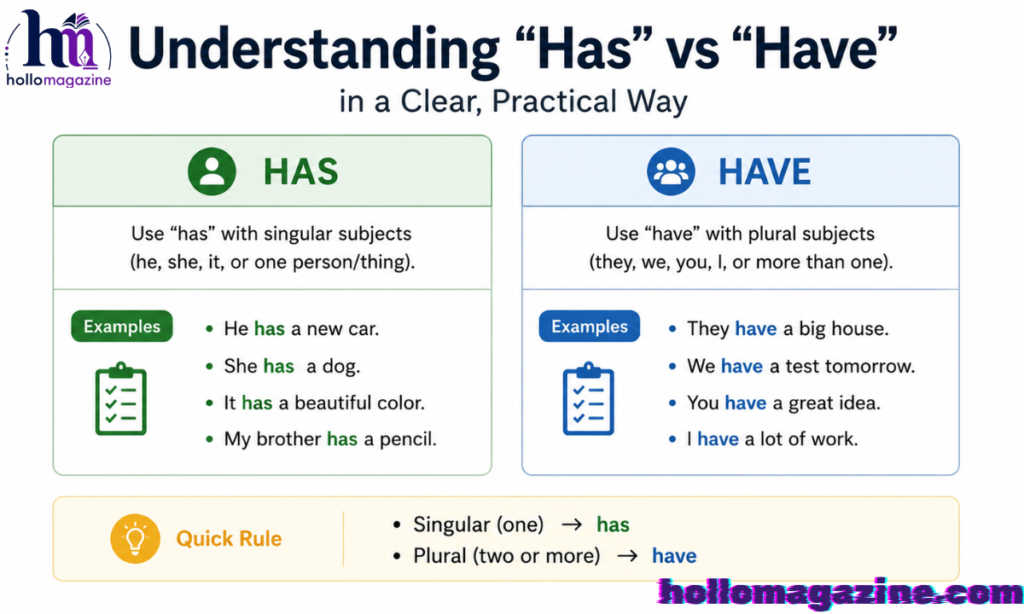
The difference comes down to subject-verb agreement.
Use has with:
- He
- She
- It
- Singular nouns
Use have with:
- I
- You
- We
- They
- Plural nouns
Examples
| Correct Sentence | Reason |
| She has a meeting. | Singular subject |
| He has a bicycle. | Singular subject |
| They have a meeting. | Plural subject |
| We have a bicycle. | Plural subject |
The verb must always match the subject.
Subject–Verb Agreement Essentials for “She Has or She Have”
Subject-verb agreement means the verb changes depending on the subject.
Key Rule
Third-person singular subjects use has.
Examples:
- Sarah has a dog.
- The teacher has a lesson plan.
- My sister has a new job.
- She has a solution.
This rule applies in formal writing, business communication, academic work, and everyday speech.
Using “She Has” Correctly: Practical Examples
She has + noun
One common structure is:
She has + noun
Examples:
- She has a car.
- She has a headache.
- She has a great idea.
- She has several responsibilities.
This structure expresses possession or ownership.
She has + past participle
This structure forms the present perfect tense.
Examples:
- She has finished the project.
- She has completed the assignment.
- She has arrived safely.
- She has written the report.
The action occurred in the past but remains relevant now.
She has + to + verb
This structure expresses necessity or obligation.
Examples:
- She has to attend the meeting.
- She has to finish her homework.
- She has to submit the application.
- She has to leave early.
This pattern is extremely common in spoken and written English.
Frequent Mistakes with “She Has”
Incorrect:
- She have a car.
- She have completed the task.
- She have to work today.
Correct:
- She has a car.
- She has completed the task.
- She has to work today.
Read This: Modeling vs Modelling: The Real Difference
Using “Have” Correctly (and Why “She Have” Does Not Work)
The present-tense statement she have is grammatically incorrect.
Incorrect:
- She have a laptop.
- She have experience.
- She have a question.
Correct:
- She has a laptop.
- She has experience.
- She has a question.
The only time have follows she is when another helping verb controls the sentence, which we’ll discuss later.
Special Cases: Collective Nouns, Names, and Indefinite Pronouns
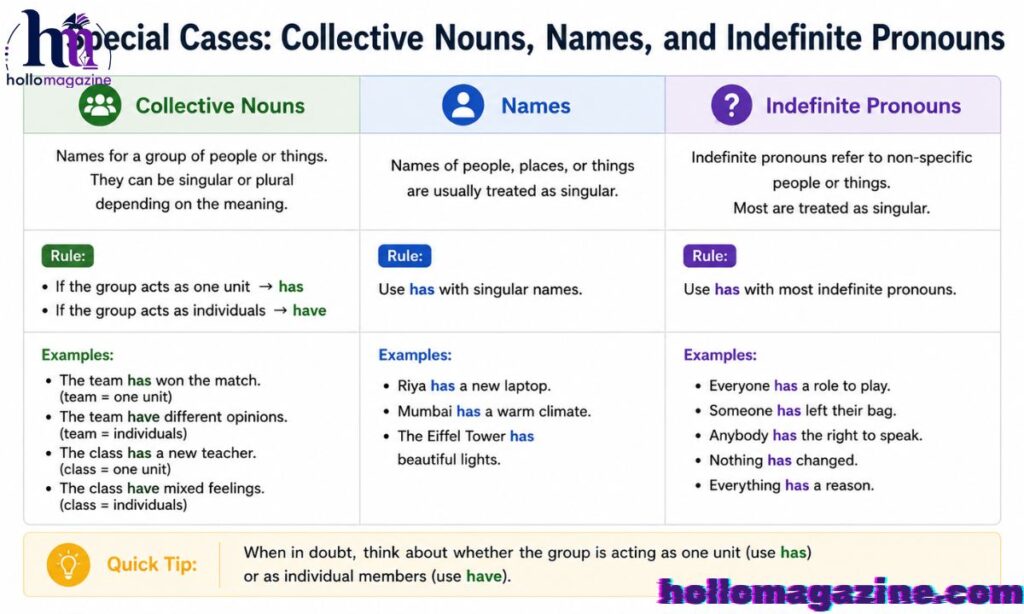
Collective Nouns
Collective nouns are singular in many situations.
Examples:
- The team has a strategy.
- The committee has reached a decision.
Because the group acts as one unit, has is used.
Names That Look Plural
Some names may appear plural but are treated as singular.
Examples:
- Mathematics has many branches.
- The United States has a large economy.
The grammatical subject is singular, so has is correct.
Indefinite Pronouns
Many indefinite pronouns are singular.
Examples:
- Everyone has a ticket.
- Somebody has the answer.
- Nobody has complained.
These pronouns take has, not have.
When “Have” Appears After “She”: The Exception Zone
Questions
In questions, the helping verb does takes responsibility for the tense.
Examples:
- Does she have a car?
- Does she have time?
- Does she have experience?
Notice that have appears after she, but the sentence remains correct because does carries the grammatical agreement.
Negative Sentences
The same principle applies to negatives.
Examples:
- She does not have a car.
- She doesn’t have time.
- She doesn’t have enough information.
The helping verb controls the structure, so have remains unchanged.
Modal Verbs With “She”: A Different Grammar Rule Entirely
After modal verbs, use the base form have.
Examples:
- She can have another chance.
- She may have a question.
- She will have more opportunities.
- She should have enough time.
The modal verb controls the grammar, making have correct.
Perfect Tenses: Navigating “Has” and “Have” With Ease
Present Perfect
Structure:
She has + past participle
Examples:
- She has finished the report.
- She has completed the project.
- She has submitted the application.
Present Perfect Continuous
Structure:
She has been + verb-ing
Examples:
- She has been working all day.
- She has been studying English.
- She has been preparing for the presentation.
Common Errors in Perfect Tenses
Incorrect:
- She have completed the task.
- She have been working.
Correct:
- She has completed the task.
- She has been working
Frequent Missteps
Many learners make these mistakes:
- Using have with she
- Forgetting subject-verb agreement
- Confusing questions and statements
- Misusing perfect tenses
Quick Fix
Ask yourself:
Is “she” the main subject?
If yes, the answer is usually has.
Quick Diagnostics: How to Instantly Choose Between Has and Have
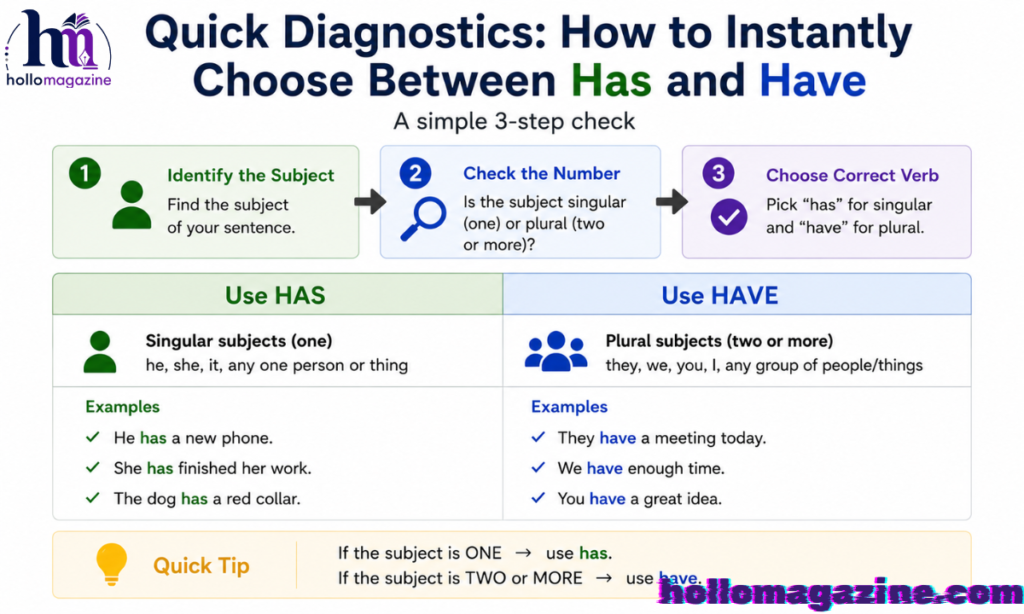
Step-by-Step Test
- Identify the subject.
- Determine whether it is singular or plural.
- Check whether a helping verb is present.
- Apply the agreement rule.
Decision Chart
| Situation | Correct Form |
| She + present tense statement | Has |
| He + present tense statement | Has |
| It + present tense statement | Has |
| They + present tense statement | Have |
| We + present tense statement | Have |
| Does she + question | Have |
| She doesn’t + negative | Have |
| She can + modal verb | Have |
Practical Tips to Master “She Has or She Have”
Use Memory Triggers
Remember this simple phrase:
He, she, it = has
This rule solves most situations instantly.
Read Sentences Out Loud
Incorrect forms often sound unnatural when spoken.
Compare:
- She have a dog. ❌
- She has a dog. ✅
Reading aloud helps catch mistakes.
Compare Pronoun Sets
| Pronoun | Verb |
| I | Have |
| You | Have |
| We | Have |
| They | Have |
| He | Has |
| She | Has |
| It | Has |
Practice these pairs regularly.
Rewrite Sentences for Practice
Transform sentences:
- They have a plan. → She has a plan.
- We have an idea. → She has an idea.
- I have a solution. → She has a solution.
This strengthens subject-verb agreement skills.
Table of Sample Practice Sentences
| Incorrect | Correct |
| She have a meeting. | She has a meeting. |
| She have completed the task. | She has completed the task. |
| She have a question. | She has a question. |
| She have been working. | She has been working. |
| She have to leave. | She has to leave. |
Conclusion
The answer to “she has or she have?” is straightforward: she has is the correct form in standard English. Because she is a third-person singular subject, it requires has in present-tense statements. Understanding this core rule eliminates one of the most common grammar mistakes English learners make.
Although have sometimes appears after she in questions, negatives, and sentences with modal verbs, the main rule never changes. If she is the subject of a simple present-tense statement, use has. Mastering this pattern will make your writing clearer, more professional, and grammatically correct.
Frequently Asked Questions
Is “she have” ever correct?
Not in standard present-tense statements. Use she has instead.
Why do we say “Does she have”?
Because does acts as the helping verb, allowing have to stay in its base form.
Is “she has” grammatically correct?
Yes, it is the correct present-tense form for the pronoun she.
What is the rule for has and have?
Use has with he, she, and it; use have with I, you, we, and they.
Can I say “she has completed the task”?
Yes. This is a correct present perfect sentence.
Why is “she have a car” incorrect?
Because she is singular and requires has, not have.
How can I remember the rule easily?
Use the memory trigger: He, she, it = has.

Rimsha creates simple grammar guides, English writing tips, and word meaning content for readers at Hollo Magazine.