
Choosing between “I sent,” “I have sent,” and “I had sent” is one of the most common challenges in business communication and email writing. While all three phrases refer to sending something, they belong to different verb tenses and communicate different meanings. Using the wrong one can make your message sound awkward, unclear, or even grammatically incorrect.
In professional emails, tense choice affects tone, clarity, and timing. Understanding when to use each phrase helps you communicate more confidently with colleagues, clients, managers, and customers. This guide breaks down the differences in a simple and practical way.
Understanding “I Sent” vs “I Have Sent” vs “I Had Sent” in Email Writing
Before diving into details, here is a quick comparison:
| Phrase | Tense | Main Purpose |
| I sent | Simple Past | Describes a completed action in the past |
| I have sent | Present Perfect | Connects a past action to the present |
| I had sent | Past Perfect | Shows an action happened before another past action |
Quick Examples
- I sent the report yesterday.
- I have sent the report for your review.
- I had sent the report before the meeting started.
The timing relationship changes with each tense.
“I Sent” — The Past Simple Tense in Emails
What “I Sent” Actually Means
“I sent” is the simple past tense of the verb send.
It tells the reader that the action happened and is completed.
Examples:
- I sent the invoice yesterday.
- I sent the attachment this morning.
- I sent the updated file last week.
The focus is on a finished action in the past.
When to Use “I Sent” in Professional Emails
Use I sent when referring to a specific completed time.
Examples:
- I sent the proposal on Monday.
- I sent the contract at 10 a.m.
- I sent the documents last week.
This tense works well when the timing matters.
Why “I Sent” Feels Direct
The simple past sounds straightforward because it focuses only on the completed action.
Benefits include:
- Clear communication
- Simple wording
- Direct reporting
- Easy readability
Many business professionals prefer it when discussing completed tasks.
Common Mistakes with “I Sent”
Avoid combining simple past with unnecessary present-perfect structures.
Incorrect:
- I have sent the file yesterday.
Correct:
- I sent the file yesterday.
Specific past times generally require the simple past tense.
Case Study: The Blunt Email
Consider this message:
I sent the report.
This statement is correct but can feel abrupt depending on context.
A softer alternative might be:
I have sent the report for your review.
The second version often sounds more collaborative.
“I Have Sent” — The Present Perfect Tense
What “I Have Sent” Really Signals
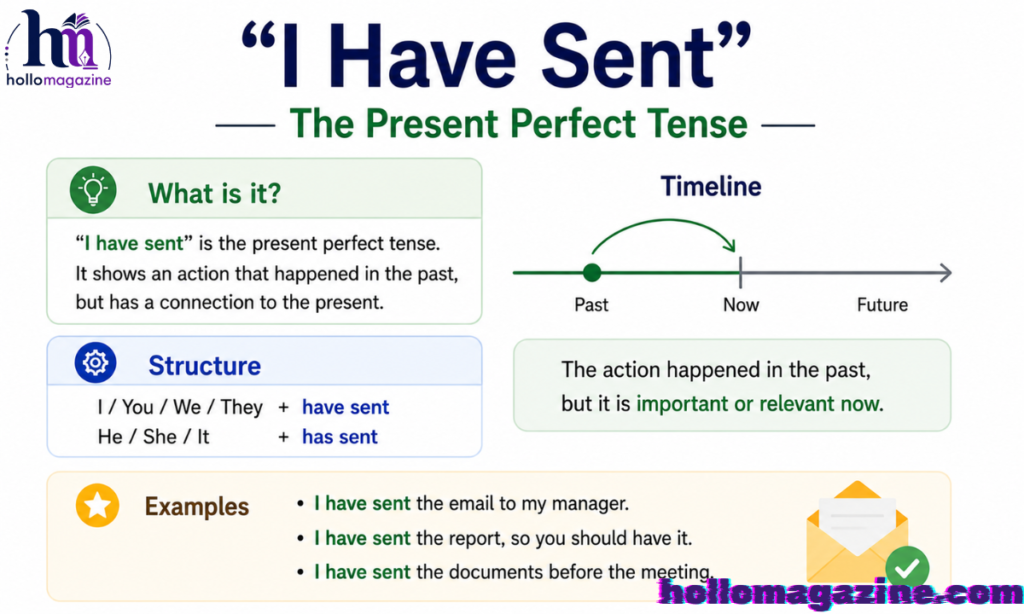
“I have sent” uses the present perfect tense.
Structure:
Have + past participle
Example:
- I have sent the document.
This structure emphasizes that the action has relevance now.
When to Use “I Have Sent” in Emails
Use present perfect when:
- The exact time is not important.
- The result matters now.
- The recipient may need to check something.
Examples:
- I have sent the updated proposal.
- I have sent the requested files.
- I have sent the information you asked for.
The focus is on the current result.
Why “I Have Sent” Sounds More Professional
Many professionals prefer present perfect because it sounds:
- Polite
- Cooperative
- Professional
- Less abrupt
It subtly highlights that the task has been completed and is available for action.
The Time Rule You Must Remember
Do not use present perfect with a finished time expression.
Incorrect:
- I have sent the email yesterday.
- I have sent it last week.
Correct:
- I sent the email yesterday.
- I sent it last week.
Present perfect works best when no specific completed time is mentioned.
Tone Comparison Table
| Sentence | Tone |
| I sent the report. | Direct |
| I have sent the report. | Professional |
| I have sent the report for your review. | Polite and collaborative |
“I Had Sent” — The Past Perfect Tense Explained
What “I Had Sent” Actually Means
“I had sent” uses the past perfect tense.
Structure:
Had + past participle
Example:
- I had sent the report before the meeting.
This tense shows that one action happened before another action in the past.
The Rule Most People Ignore
Past perfect should usually compare two past events.
Example:
- I had sent the email before the client called.
Timeline:
- Email sent
- Client called
Without a second past event, past perfect often sounds unnecessary.
When to Use “I Had Sent” in Email Communication
Use it when explaining sequences.
Examples:
- I had sent the attachment before receiving your message.
- I had sent the payment before the deadline expired.
- I had sent the revised document before the meeting started.
The tense establishes chronological order.
Example of Real Miscommunication
Incorrect:
I had sent the proposal.
Readers may wonder:
Before what?
Better:
I had sent the proposal before the contract discussion began.
The comparison makes the meaning clear.
Side-by-Side Comparison of “I Sent” vs “I Have Sent” vs “I Had Sent”
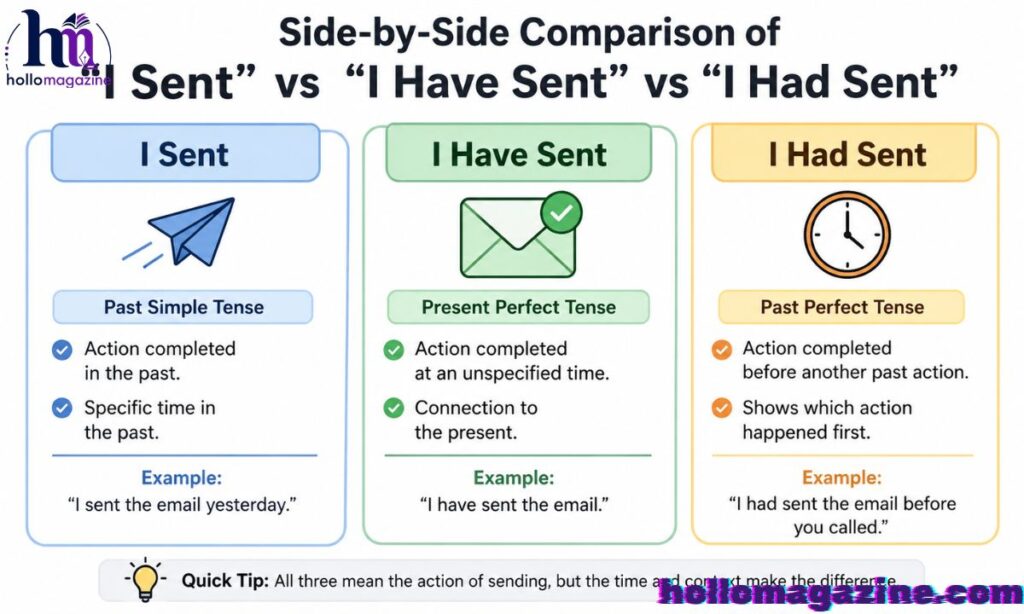
| Phrase | Time Focus | Typical Use |
| I sent | Completed past action | Specific past time |
| I have sent | Past action with present relevance | Current status |
| I had sent | Earlier past action | Comparison between past events |
Example
- I sent the report yesterday.
- I have sent the report for review.
- I had sent the report before the meeting.
Each sentence communicates a different timeline.
Read This: Modeling vs Modelling: The Real Difference
Practical Usage in Business Email Writing
Scenario One: Following Up on a Proposal
Correct:
I sent the proposal on Tuesday.
Correct:
I have sent the proposal for your review.
Incorrect:
I had sent the proposal.
The last example lacks a second past event.
Scenario Two: Explaining a Missed Attachment
Correct:
I had sent the file before noticing the attachment was missing.
The past perfect clearly explains the sequence.
Scenario Three: Reporting Work Completion
Correct:
I have sent the completed report.
This highlights that the report is available now.
Common Mistakes Learners Make with These Tenses
Mistake One: Mixing Present Perfect with Specific Time
Incorrect:
- I have sent it yesterday.
- I have sent it last Friday.
Correct:
- I sent it yesterday.
- I sent it last Friday.
Mistake Two: Using Past Perfect Without Context
Incorrect:
- I had sent the invoice.
Correct:
- I had sent the invoice before the client requested another copy.
Past perfect typically requires another past reference point.
Mistake Three: Overusing “I Had Sent”
Many learners believe past perfect sounds more formal.
It does not.
Using it unnecessarily often creates confusion.
The Decision Framework — Choose the Right One Instantly
Did it happen at a specific time?
Use:
I sent
Examples:
- I sent it yesterday.
- I sent it last week.
Does it matter right now?
Use:
I have sent
Examples:
- I have sent the file.
- I have sent the report.
Am I comparing two past actions?
Use:
I had sent
Examples:
- I had sent the report before the meeting.
- I had sent the email before receiving your response.
Tone Psychology in “I Sent” vs “I Have Sent” vs “I Had Sent”
The tense you choose affects how readers perceive your message.
| Phrase | Reader Perception |
| I sent | Direct and factual |
| I have sent | Professional and helpful |
| I had sent | Explanatory and contextual |
Business communication often favors clarity over complexity.
For that reason, I sent and I have sent appear more frequently than I had sent.
Quick Grammar Check Before Sending Any Email
Before clicking send, ask yourself:
- Did I mention a specific past time?
- Does the action affect the present?
- Am I comparing two past events?
- Is the tense helping clarity?
- Would a simpler tense work better?
These questions prevent most tense mistakes.
Advanced Insight: US vs UK Usage Patterns
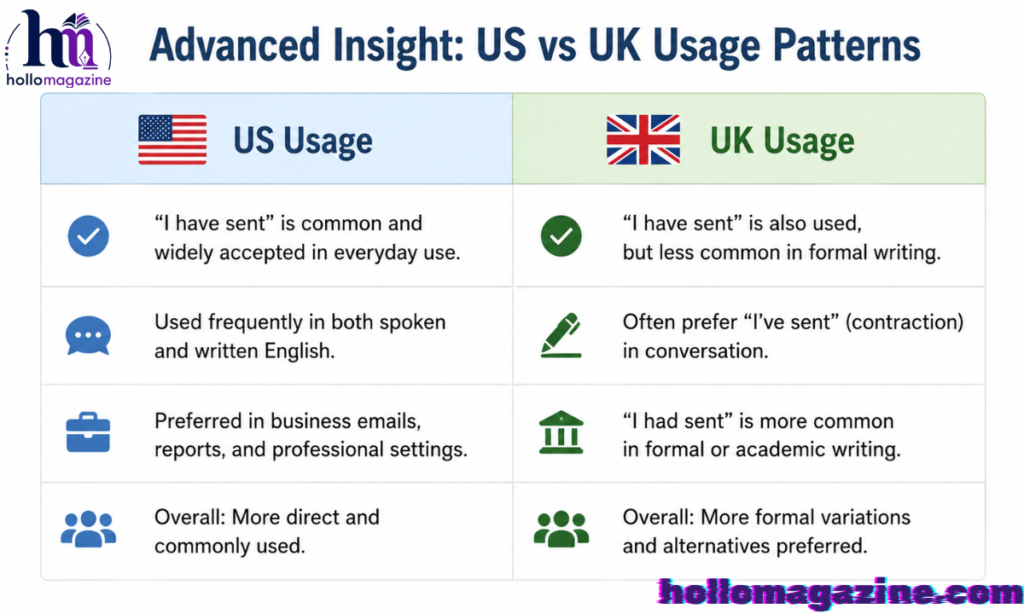
Both American and British English use all three tenses.
However, British English tends to use the present perfect more frequently.
Examples:
British English:
- I have sent the documents.
American English:
- I sent the documents.
Both are often acceptable depending on context, though British speakers generally prefer present perfect in situations connected to the present.
Conclusion
Understanding the difference between “I sent,” “I have sent,” and “I had sent” can dramatically improve your email writing. Each tense serves a specific purpose: I sent reports a completed action in the past, I have sent connects a completed action to the present, and I had sent shows that one past action happened before another.
When writing professional emails, focus on the timeline you want to communicate. If you’re referring to a specific past time, choose I sent. If the action matters right now, use I have sent. If you’re comparing two past events, use I had sent. Making the right choice will improve clarity, professionalism, and reader understanding.
Frequently Asked Questions
Is “I have sent” more professional than “I sent”?
Often yes, because it emphasizes the current result and sounds slightly more polished.
Can I say “I have sent the email yesterday”?
No. Use I sent the email yesterday because a specific past time is mentioned.
When should I use “I had sent”?
Use it when one past action happened before another past action.
Is “I sent” rude in emails?
No. It is grammatically correct and commonly used, though it may sound more direct.
Why is present perfect common in business emails?
It highlights completed actions that remain relevant to the current situation.
Do Americans and British speakers use these tenses differently?
British English generally uses present perfect more often than American English.
Which tense should I use when sending a report?
Use I have sent the report if the report is relevant now, or I sent the report yesterday if you mention a specific time.

Rimsha creates simple grammar guides, English writing tips, and word meaning content for readers at Hollo Magazine.