
English contains many word pairs that appear similar but are used differently depending on context. One example is unenroll and disenroll. Both words relate to ending enrollment in a program, service, school, or membership, yet they are not always interchangeable.
The confusion often arises because different organizations, government agencies, schools, and insurance providers use their own preferred terminology. Understanding the distinction between unenroll and disenroll can help you communicate more accurately and avoid misunderstandings in formal situations.
What Does Unenroll Mean
The word unenroll generally means to remove oneself or another person from an educational program, course, class, or membership.
In most cases, unenroll suggests that someone who was previously enrolled is no longer participating.
Examples:
- A student may unenroll from a university course.
- A parent may unenroll a child from a private school.
- A learner may unenroll from an online training program.
Common situations involving unenrollment include:
- Dropping a class
- Leaving a course
- Cancelling educational participation
- Ending membership in a learning platform
The term is widely used in educational settings and online learning systems.
What Does Disenroll Mean
Disenroll means to remove a person from enrollment in a program, service, benefit plan, or institution.
While the meaning is similar to unenroll, disenroll is often used in more formal administrative environments.
Examples:
- A health insurance provider may disenroll a member.
- A government program may disenroll participants who no longer qualify.
- A benefits administrator may disenroll inactive members.
Disenrollment often appears in:
- Healthcare programs
- Insurance plans
- Government assistance programs
- Administrative records
- Membership systems
Because of its formal tone, many organizations prefer this term in official documents.
The Key Difference Between Unenroll and Disenroll
Although both words involve ending enrollment, the distinction usually comes down to context and who initiates the action.
| Feature | Unenroll | Disenroll |
| Common in education | Yes | Sometimes |
| Common in insurance | Rarely | Yes |
| Common in government programs | Rarely | Yes |
| Often initiated by participant | Yes | Often |
| Frequently used in administrative documents | Less often | Yes |
| Formality level | Moderate | Higher |
A simple way to think about it:
- Unenroll often appears when someone chooses to leave.
- Disenroll often appears in formal systems, regardless of who initiates the removal.
However, actual usage varies by organization.
How These Words Appear in Education
Educational institutions frequently use enrollment-related terminology.
Examples include:
- Enroll in a class
- Unenroll from a course
- Cancel registration
- Withdraw from a program
Many online learning platforms use buttons labeled:
- Enroll
- Unenroll
Examples:
- Students can unenroll before the semester begins.
- Users may unenroll from online training courses.
Universities may also use terms such as:
- Withdraw
- Drop
- Deregister
Depending on institutional policies.
Read This: Tweek vs Tweak Clarifying the Difference and Usage
How These Words Appear in Insurance and Government Programs
Disenroll is especially common in administrative systems.
Insurance Examples
- Disenroll from a health plan.
- Disenroll from coverage.
- Automatic disenrollment due to non-payment.
Government Program Examples
- Medicare disenrollment
- Medicaid disenrollment
- Benefits disenrollment
- Program eligibility reviews
Administrative agencies often prefer disenroll because it clearly describes membership removal within a formal system.
Examples:
- Participants were disenrolled after eligibility changes.
- Members may request voluntary disenrollment.
Examples of Unenroll vs Disenroll in Everyday Sentences
Unenroll in Education
Examples:
- She decided to unenroll from the course.
- Students may unenroll before the registration deadline.
- I unenrolled from the online certification program.
These examples involve education and personal choice.
Disenroll in Administrative Contexts
Examples:
- The insurer disenrolled inactive members.
- Participants were automatically disenrolled after policy changes.
- Members may request to disenroll from the program.
These examples involve structured administrative systems.
Quick Reference Table
| Sentence | Correct Word |
| Leaving a college course | Unenroll |
| Exiting an online class | Unenroll |
| Leaving a government benefit plan | Disenroll |
| Removing a health insurance member | Disenroll |
| Cancelling a training course | Unenroll |
| Administrative membership removal | Disenroll |
Common Mistakes People Make

Using Unenroll and Disenroll Interchangeably
Many writers assume both words are identical.
Although their meanings overlap, the surrounding context often determines which sounds more natural.
Confusing Voluntary and Administrative Actions
Some people think:
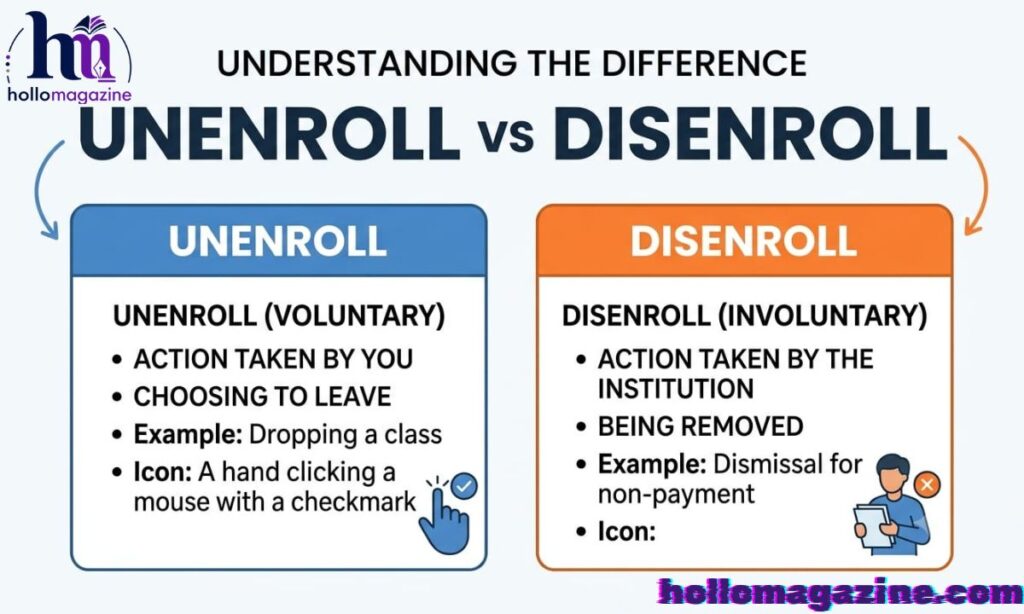
- Unenroll = voluntary
- Disenroll = involuntary
While this can sometimes be true, it is not a strict rule.
Many organizations use disenroll even when the member requests removal.
Ignoring Context and System Terminology
Organizations often establish official terminology.
For example:
- Schools may use unenroll.
- Insurance providers may use disenroll.
Using the organization’s preferred language improves clarity.
Overlooking Deadlines and Policies
Enrollment systems often include:
- Withdrawal deadlines
- Cancellation windows
- Administrative review periods
Understanding these rules prevents confusion when ending participation.
Spelling and Pronunciation Errors
Common mistakes include:
❌ Un-inroll
❌ Dis-enrol
❌ Disinroll
✅ Unenroll
✅ Disenroll
Accurate spelling is particularly important in official documentation.
Why Context Matters So Much
Context determines which term sounds most natural and professional.
Consider these examples:
Education:
- The student unenrolled from Biology 101.
Insurance:
- The member was disenrolled from the healthcare plan.
Government Program:
- Participants were disenrolled after eligibility verification.
The meaning remains similar, but professional expectations differ.
Using the correct term for the setting improves communication and credibility.
Quick Way to Remember the Difference
Focus on Who Initiates the Action
Ask:
- Is a student leaving a course?
- Is an administrator processing enrollment removal?
This often points toward the most appropriate term.
Think About Formality
Disenroll generally sounds more formal and administrative.
Unenroll often sounds more educational and user-focused.
Use a Memory Trick
Remember:
“Un” often means undoing a personal action.
“Dis” often appears in formal administrative processes.
This isn’t a perfect rule, but it helps in many situations.
Visualize the Scenario
Imagine two different situations:
Scenario A:
A student clicks a button to leave an online class.
→ Unenroll
Scenario B:
An insurance company updates member records.
→ Disenroll
Visualizing the context makes the distinction easier to remember.
Reference Cambridge Dictionary Definitions
Cambridge Dictionary recognizes enroll (or enrol in British English) as the act of officially registering to participate in a course, organization, or program.
While unenroll and disenroll are derived forms used in modern English, organizations often adopt specific terminology based on industry practices.
In practical usage:
- Unenroll commonly appears in educational systems and online learning platforms.
- Disenroll commonly appears in healthcare, insurance, government, and administrative programs.
The most important consideration is selecting the term that matches the context and official terminology of the organization involved.
Conclusion
The debate over unenroll vs disenroll is not really about right versus wrong. Both words are valid and widely used in modern English. The difference lies primarily in context. Unenroll is most commonly associated with education, courses, and learning platforms, while disenroll frequently appears in insurance, healthcare, government programs, and administrative systems.
When choosing between the two, consider the setting, the organization’s preferred terminology, and the audience. Using the correct term helps ensure clarity, professionalism, and effective communication in both formal and everyday situations.
Frequently Asked Questions
Is unenroll a real word?
Yes. Unenroll is a recognized term commonly used in education and online learning.
Is disenroll a real word?
Yes. Disenroll is widely used in healthcare, insurance, and government administration.
Which is more common, unenroll or disenroll?
It depends on the industry. Education often uses unenroll, while insurance and government systems often use disenroll.
Do unenroll and disenroll mean the same thing?
They have similar meanings but are typically used in different contexts.
Can a student disenroll from a class?
Some institutions use the term, but unenroll or withdraw is usually more common.
Why do insurance companies use disenroll?
The term fits formal administrative processes and membership management systems.
Is disenrollment always involuntary?
No. A person may voluntarily request disenrollment from a program or plan.
How can I remember the difference?
Think of unenroll for courses and education, and disenroll for formal administrative programs.

Rimsha creates simple grammar guides, English writing tips, and word meaning content for readers at Hollo Magazine.