
English spelling rules can sometimes feel inconsistent, especially when words ending in -e change form. One common question that confuses writers, students, DIY enthusiasts, and professionals alike is whether the correct spelling is gluing or glueing. Since the base word is glue, many people naturally assume that adding -ing should create glueing.
However, standard English follows a different rule. Understanding why gluing is correct and glueing is generally considered incorrect can help improve your writing, avoid spelling mistakes, and ensure consistency in academic, professional, and everyday communication.
Gluing vs Glueing — The Only Correct Spelling You Need to Know
The standard and accepted spelling is:
✅ Gluing
The nonstandard spelling is:
❌ Glueing
Whether you’re writing in American English, British English, Canadian English, or Australian English, dictionaries and style guides overwhelmingly prefer gluing.
Quick Answer Table
| Word | Correct? |
| Gluing | ✅ Yes |
| Glueing | ❌ No |
| Glued | ✅ Yes |
| Glue | ✅ Yes |
In modern English, gluing is the spelling you should use.
Why the Spelling Confusion Still Happens Today
Many people are surprised to learn that glueing isn’t the standard form.
The Brain Wants Symmetry
Writers often think:
- Glue → Glueing
- Blue → Blueing
- Cue → Cueing
Because the base word ends in e, it seems logical to keep that letter when adding -ing.
This natural assumption explains why the misspelling remains common.
The Rule That Actually Applies
Most English verbs ending in silent e drop the e before adding -ing.
Examples:
| Base Verb | -ing Form |
| Make | Making |
| Write | Writing |
| Use | Using |
| Move | Moving |
| Glue | Gluing |
This is known as the e-dropping rule.
But What About “Cueing” or “Queueing”?
Some English words keep the e before adding -ing.
Examples:
- Cueing
- Queueing
- Ageing (British variant)
These are exceptions rather than the rule.
Because such exceptions exist, many writers mistakenly assume glueing follows the same pattern.
Gluing vs Glueing in American and British English
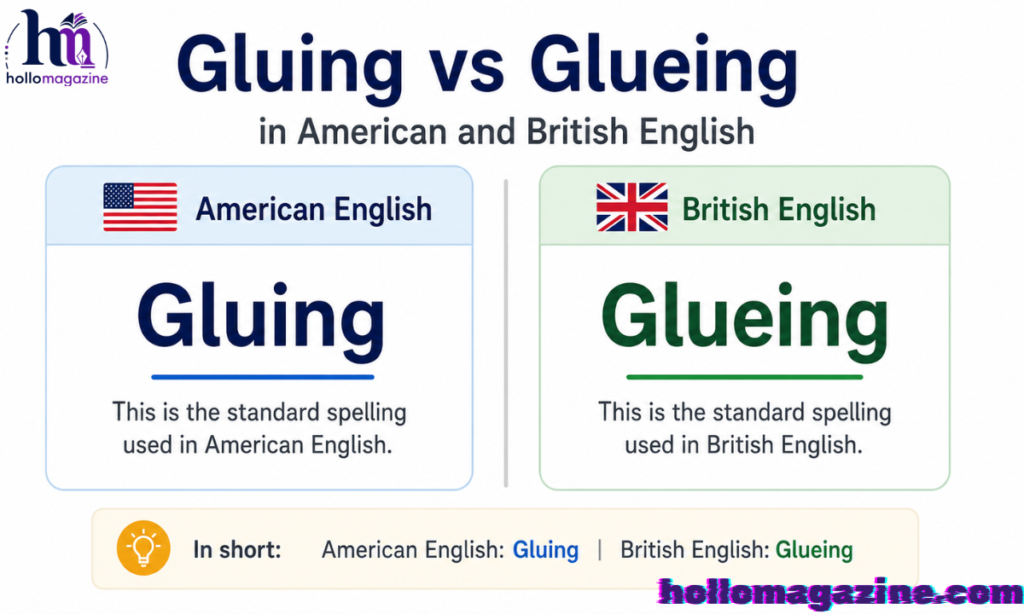
Unlike many spelling debates, this one is not divided by region.
Regional Usage Table
| Region | Preferred Spelling |
| United States | Gluing |
| United Kingdom | Gluing |
| Canada | Gluing |
| Australia | Gluing |
| New Zealand | Gluing |
All major English-speaking regions favor gluing.
What Dictionaries Say
Leading dictionaries consistently list:
- Gluing ✅
- Glueing ❌ or nonstandard
Modern dictionaries, educational resources, and style guides recognize gluing as the accepted form.
Where the Rule Comes From: A Short Etymology of “Gluing”
The history of the word helps explain its spelling.
Old French Roots
The word glue entered English through Old French and ultimately traces back to Latin roots associated with adhesive substances.
For centuries, glue referred to materials used for bonding surfaces together.
E-Dropping During Inflection
As English spelling evolved, verbs ending in silent e typically dropped that letter before adding -ing.
Examples include:
- Use → Using
- Live → Living
- Move → Moving
- Glue → Gluing
The same principle applies here.
Why Some Old Texts Use “Glueing”
Historical documents occasionally contain glueing.
Reasons include:
- Older spelling conventions
- Inconsistent publishing standards
- Regional printing practices
Today, these older spellings are rarely used outside historical references.
What “Gluing” Actually Means in Real-Life Language
The word appears in both literal and figurative contexts.
General Definition
Gluing means attaching two or more objects using adhesive material.
Examples:
- Gluing paper together
- Gluing wood panels
- Gluing ceramic pieces
Technical Meaning in Specific Fields
Many industries use the term regularly.
Examples include:
- Manufacturing
- Construction
- Engineering
- Product design
- Packaging
In technical settings, gluing refers to specific bonding processes.
Expanded Uses in Everyday Language
The word can also be figurative.
Examples:
- A leader gluing the team together.
- Shared goals gluing a community together.
- Technology gluing systems together.
These metaphorical uses are common in modern communication.
Where You’ll See “Gluing” in Real Life
Home Repairs
DIY projects often involve:
- Gluing furniture
- Gluing broken decorations
- Gluing plastic parts
The term appears frequently in repair guides.
School Projects
Students commonly use glue for:
- Posters
- Art projects
- Craft activities
Teachers regularly refer to the process as gluing.
Professional Workshops
Tradespeople use gluing techniques in:
- Carpentry
- Construction
- Manufacturing
- Product assembly
The term is standard industry vocabulary.
Digital Usage
In technology and software discussions, gluing can describe connecting systems or processes.
Examples:
- Gluing applications together
- Gluing databases and services
- Gluing workflows together
Read This: Which One Is You vs Which One Are You — The Complete Guide to Choosing Correctly
Examples of Correct Usage of “Gluing”
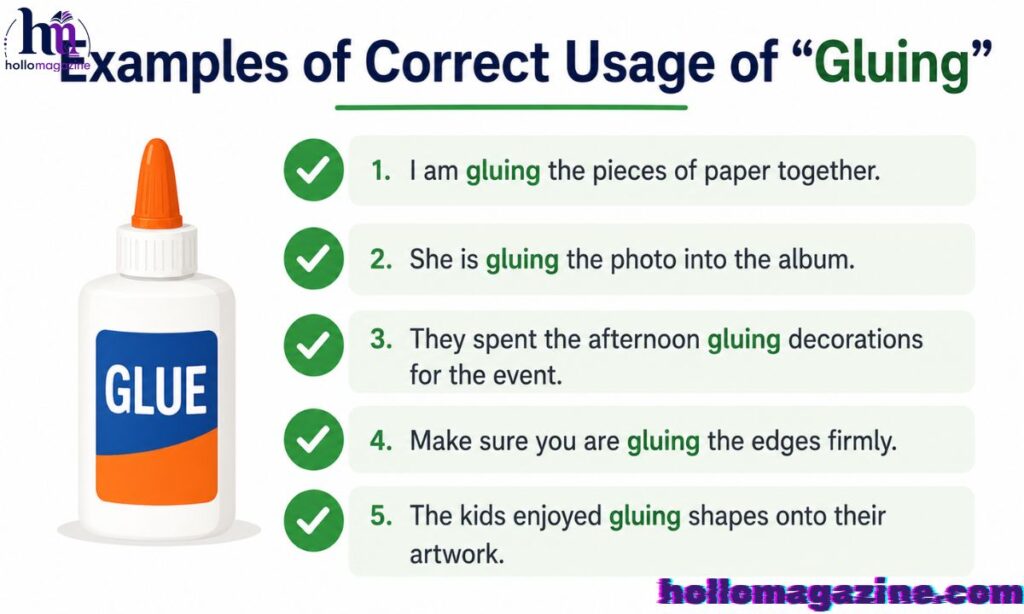
Physical Usage
Examples:
- She is gluing the photographs into a scrapbook.
- We spent the afternoon gluing wooden pieces together.
- The child is gluing paper shapes onto the poster.
Industrial Usage
Examples:
- Workers are gluing components during assembly.
- The factory uses automated gluing equipment.
- Proper gluing techniques improve product durability.
Figurative Usage
Examples:
- Strong leadership is gluing the organization together.
- Trust is gluing the team into a unified group.
- Shared values are gluing the community together.
Past Tense and Other Forms
| Form | Correct Spelling |
| Base Verb | Glue |
| Present Participle | Gluing |
| Past Tense | Glued |
| Past Participle | Glued |
| Noun | Glue |
Why “Glueing” Is Not Standard — And Why Using It Hurts Your Writing
Academic and Professional Issues
Using glueing may create problems in:
- Research papers
- Business reports
- Educational assignments
Readers may view it as a spelling mistake.
Business Writing Problems
Professional communication benefits from standardized spelling.
Using nonstandard forms can:
- Reduce credibility
- Distract readers
- Create inconsistency
Consistency improves professionalism.
Software and Grammar Tools Flag It
Most modern tools identify glueing as incorrect.
Examples include:
- Grammar checkers
- Spellcheck software
- Editing platforms
- Publishing systems
This reinforces the accepted spelling standard.
Memory Tricks to Always Spell “Gluing” Correctly
The “Drop the E” Rule
Remember:
Glue → Gluing
Just like:
Use → Using
The “U Does the Work” Trick
The letter u already preserves the pronunciation.
The extra e is unnecessary.
The Visual Shortcut
Compare:
- Gluing ✅
- Glueing ❌
The shorter version is usually correct.
The Finger Test
Cover the ending:
- Glue
- Gluing
The spelling still looks natural and complete.
Phrase Association
Memorize this sentence:
“When adding -ing to glue, drop the e and keep moving.”
It helps reinforce the rule.
Common Misspellings Related to Gluing
Words People Often Get Wrong
Examples include:
- Glueing
- Useing
- Moveing
- Writeing
- Hopeing
These errors all result from misunderstanding the e-dropping rule.
Why These Mistakes Occur
Common causes include:
- Pronunciation confusion
- Overgeneralizing spelling patterns
- Lack of proofreading
- Exposure to incorrect online spellings
Understanding the rule eliminates these mistakes.
Quick Reference Table: Gluing vs Glueing
| Feature | Gluing | Glueing |
| Standard English | ✅ Yes | ❌ No |
| American English | ✅ Yes | ❌ No |
| British English | ✅ Yes | ❌ No |
| Academic Writing | ✅ Yes | ❌ No |
| Professional Writing | ✅ Yes | ❌ No |
| Dictionary Preferred | ✅ Yes | ❌ No |
Conclusion
The debate between gluing and glueing has a clear answer: gluing is the standard and widely accepted spelling in modern English. It follows the common e-dropping rule that applies to many verbs ending in a silent e, such as use → using and move → moving. While glueing occasionally appears in older texts or informal writing, it is generally considered nonstandard today.
For academic, professional, and everyday communication, using gluing ensures clarity and correctness. Remember the simple rule: when adding -ing to glue, drop the final e. Following this guideline will help you avoid a common spelling mistake and strengthen your writing.
Frequently Asked Questions
Is gluing or glueing correct?
Gluing is the correct and standard spelling in modern English.
Why is glueing considered incorrect?
Because English normally drops the silent e before adding -ing.
Do British and American English use different spellings?
No. Both varieties prefer gluing.
Is glueing ever acceptable?
It may appear in older texts, but modern style guides generally discourage it.
What is the past tense of glue?
The correct past tense is glued.
Why do people write glueing?
Many writers mistakenly keep the e from the base word glue.
How can I remember the correct spelling?
Use the e-dropping rule: glue → gluing, just like use → using.

Rimsha creates simple grammar guides, English writing tips, and word meaning content for readers at Hollo Magazine.