
Spelling mistakes often happen when we type quickly, especially with words that appear frequently in work, education, and technology. One common example is the confusion between input and imput. At first glance, these words look similar, but only one is considered correct in standard English.
Whether you are writing an email, filling out a form, preparing a report, or discussing technology, knowing the correct spelling helps improve clarity and professionalism. This guide explains why input is correct, why imput appears so often, and how to avoid this common mistake.
Why Does Your Brain Keep Typing “Imput”?
Many people accidentally type imput because of how the letters m and n are positioned on a keyboard. Fast typing, muscle memory, and simple typing errors can easily cause the substitution.
Other reasons include:
- Typing too quickly
- Autocorrect failures
- Lack of proofreading
- Visual similarity between the letters
In modern digital communication, such errors are common, but they should still be corrected in formal writing.
| Word | Status | Meaning |
| Input | Correct | Information, contribution, or data entered into a system |
| Imput | Incorrect | Misspelling of input |
Historical Evolution and Core Concepts
The word input has been used for decades in both general English and technical fields. Today, it appears in education, business, engineering, computing, and everyday conversation.
Etymology and Compound Word Formation
The word input is a compound word formed from:
- In = into
- Put = place or insert
Together, they create the idea of putting something into a system, process, or discussion.
Examples:
- Input data into the spreadsheet.
- The manager requested employee input.
- Scientists rely on accurate input measurements.
Grammatical Mechanics and Zero Derivation
One interesting feature of input is that it can function as both a noun and a verb without changing form.
As a noun:
- Your input was helpful.
As a verb:
- Please input your password.
This process is known as zero derivation, where a word changes grammatical function without changing spelling.
How Input Functions in Real Contexts
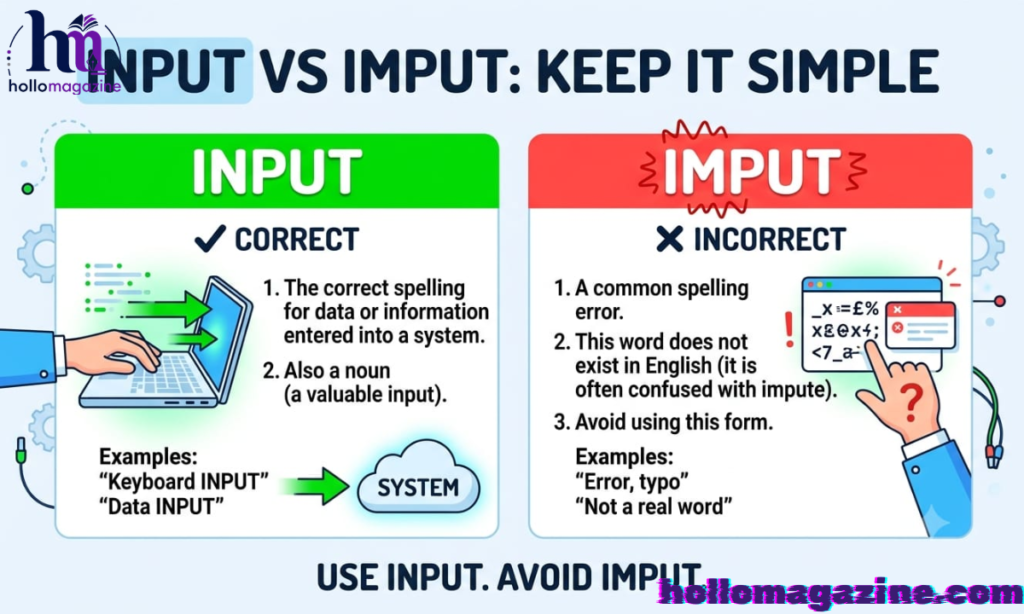
The word appears across many communication settings.
Formal Academic and Professional Usage
In academic and workplace writing, input often refers to information, advice, feedback, or data.
Examples:
- Researchers collected input from participants.
- Employee input improved the proposal.
- Customer input guided product development.
Common collocations include:
- Valuable input
- User input
- Data input
- Expert input
- Community input
Casual Conversational Contexts
The word also appears naturally in everyday conversation.
Examples:
- Can I get your input on this idea?
- Thanks for your input.
- I need some input before making a decision.
These uses make the term flexible and widely understood.
The Nuance Trap: When Autocorrect Fails
Many writers assume spellcheck will catch every error. However, software does not always identify mistyped words immediately.
Problems arise when:
- Typing on mobile devices
- Using specialized software
- Working with disabled spellcheck settings
- Relying solely on autocorrect
A quick proofreading review remains the best defense against errors.
Input and Imput in Literary and Technical History
Although input is now strongly associated with technology, its broader meaning extends beyond computers.
Classic Literature and Early Usage
Historically, writers used concepts similar to input when discussing contributions, information exchange, and participation.
While the exact technical meaning evolved later, the underlying idea of contributing information has long existed in English communication.
Examples include discussions involving:
- Public opinion
- Expert advice
- Intellectual contribution
- Educational participation
Modern Stylistic and Technical Usage
Today, input is heavily used in technology.
Examples include:
- Keyboard input
- User input
- Data input
- Audio input
- Digital input
Technology has made the word even more common than before.
Read This: To Fast Or Too Fast: Beginner Grammar Guide Made Easy
Synonyms and Distinguishing Input from Similar Terms

Understanding related words helps prevent misuse.
Semantic Neighbors and Functional Alternatives
Depending on context, possible alternatives include:
| Input | Alternative |
| Feedback | Opinion |
| Contribution | Participation |
| Advice | Recommendation |
| Data | Information |
| Suggestion | Proposal |
However, these words are not always interchangeable because each carries a slightly different meaning.
Visualizing the Articulatory Difference
When spoken aloud, input is pronounced:
IN-put
The incorrect form imput usually results from typing rather than pronunciation.
Many speakers never intentionally say or write “imput”; it simply appears due to keyboard habits.
Regional Variations: US vs UK
Both American and British English use input.
Examples:
- American English: Input the information.
- British English: Input the information.
There is no regional spelling difference.
Unlike words such as color/colour or behavior/behaviour, input remains identical in both varieties of English.
Common Mistakes People Make
Several recurring mistakes appear in writing.
- Writing imput instead of input
- Assuming imput is an accepted variant
- Ignoring spellcheck warnings
- Using incorrect technical terminology
- Failing to proofread important documents
Examples:
❌ Please imput your password.
✅ Please input your password.
❌ We need your imput before making a decision.
✅ We need your input before making a decision.
Practical Tips and Field Notes
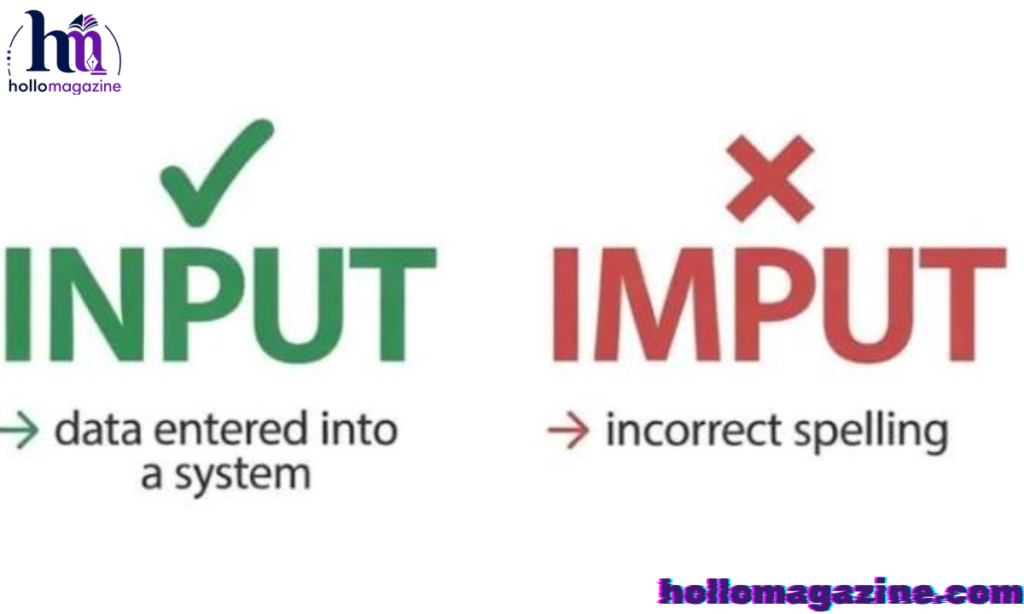
Small habits can dramatically reduce spelling errors.
Useful strategies include:
- Read important documents twice.
- Use grammar-checking tools.
- Slow down when typing quickly.
- Learn commonly misspelled words.
- Review professional documents before submission.
The Editor’s Field Note
Professional editors frequently encounter imput in drafts, emails, reports, and online content. The mistake is usually accidental rather than a misunderstanding of meaning.
Editors recommend focusing on common typo patterns because repeated errors can reduce credibility and professionalism.
Mnemonics and Memory Aids
Try these memory tricks:
- Input = In + Put
- Think of putting information into a system.
- Remember that dictionaries only recognize input.
- Associate input with entering data.
Quick memory phrase:
“You put information in, so the word is input.”
Conclusion
The answer is simple: input is the correct spelling, while imput is merely a typing mistake. Although the error is common, especially on digital keyboards, it should always be corrected in professional, academic, and everyday writing.
Understanding the origin, meaning, and grammatical function of input makes it easier to remember. With careful proofreading and a few simple memory tricks, you can avoid this mistake and communicate more confidently.
Frequently Asked Questions
Is “imput” a real English word?
No. It is considered a misspelling of input.
Why do people type “imput”?
Usually because of fast typing, keyboard position, or simple typing errors.
Can input be both a noun and a verb?
Yes. It can function as either a noun or a verb.
Is input used in both British and American English?
Yes. The spelling remains input in both forms of English.
What is the most common use of input?
It commonly refers to information, feedback, data, or contributions provided to a process or system.

Rimsha creates simple grammar guides, English writing tips, and word meaning content for readers at Hollo Magazine.