
Many English learners struggle with the difference between to fast and too fast because the words sound almost identical when spoken. This confusion is common in emails, school assignments, social media posts, and everyday conversations. However, choosing the correct form is important because each phrase has a completely different meaning.
The good news is that the rule is simple once you understand how to, too, and fast function in English grammar. In this guide, you’ll learn the difference, see practical examples, discover common mistakes, and gain easy memory tricks to avoid errors forever.
Definition
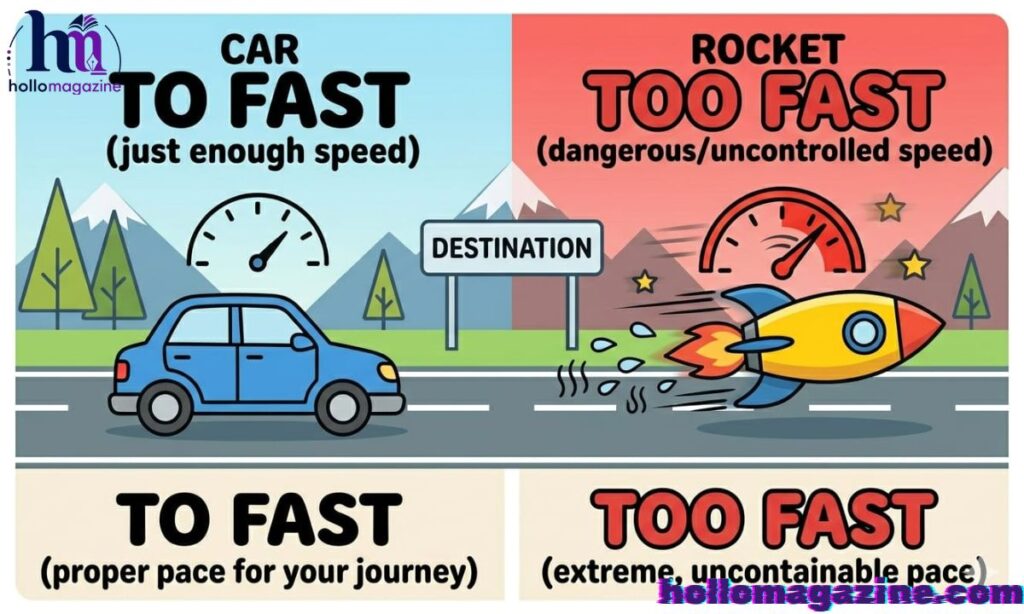
Too fast means excessively fast or faster than desired.
To fast means to abstain from food because fast is functioning as a verb.
| Phrase | Meaning | Correct Example |
| Too fast | Excessively fast | The car was moving too fast. |
| To fast | To avoid eating for a period | She plans to fast tomorrow. |
The Real Difference Between “To” and “Too”
The confusion comes from the words to and too, which are pronounced similarly but serve different grammatical purposes.
| Word | Function | Example |
| To | Preposition or infinitive marker | I want to learn. |
| Too | Means excessively or also | The music is too loud. |
When talking about excessive speed, too fast is always correct.
Examples:
- The train is moving too fast.
- You are speaking too fast.
- The project progressed too fast.
What “To” Really Means
The word to performs several important grammatical functions.
It can indicate:
- Direction
- Purpose
- Relationship
- An infinitive verb
Examples:
- We walked to the store.
- She gave the gift to her friend.
- I want to improve my writing.
- They decided to fast for health reasons.
As a Preposition
When used as a preposition, to connects one thing to another.
Examples:
- He drove to the office.
- The package was sent to Canada.
- We went to school together.
In these examples, to indicates direction or destination.
As an Infinitive Marker
An infinitive consists of to + base verb.
Examples:
- To run
- To study
- To write
- To fast
Sentence examples:
- She wants to fast before the medical test.
- They plan to fast during the event.
- He hopes to fast successfully.
What “Too” Really Means
The word too generally means:
- More than necessary
- More than desired
- Excessively
- Also
Examples:
- The room is too hot.
- The coffee is too cold.
- The speaker talked too fast.
- I would like to come too.
Notice that too often suggests that something has exceeded an acceptable limit.
Read This: Sweet vs Sweat: Differences and Never Confuse Them Again
What “Fast” Means in Grammar
The word fast is interesting because it can function in multiple ways.
| Part of Speech | Example |
| Adjective | A fast car |
| Adverb | She runs fast |
| Verb | They fast during Ramadan |
Examples:
- The athlete is fast. (adjective)
- The athlete runs fast. (adverb)
- Many people fast for religious reasons. (verb)
Understanding these roles helps explain why to fast and too fast have completely different meanings.
When “To Fast” Is Correct
Use to fast only when talking about voluntarily avoiding food.
Common contexts include:
- Religious observances
- Medical procedures
- Health practices
- Personal discipline
Examples:
- He plans to fast for twelve hours.
- Patients must fast before surgery.
- She chose to fast during the retreat.
- They agreed to fast together.
Examples (To Fast)
Here are practical examples:
- I need to fast before my blood test.
- Many people choose to fast during religious holidays.
- The doctor advised him to fast overnight.
- She intends to fast once a week.
In all these cases, fast means not eating.
Case Study: Intermittent Fasting
Intermittent fasting has become a popular health practice.
Common approaches include:
- 16-hour fasting windows
- Alternate-day fasting
- Time-restricted eating
Examples:
- She prefers to fast for sixteen hours daily.
- He learned to fast safely under medical guidance.
- Many beginners start by learning how to fast gradually.
Notice that to fast is completely correct because it refers to abstaining from food.
When “Too Fast” Is Correct
Use too fast whenever something moves, happens, develops, or occurs at an excessive speed.
Examples:
- You’re driving too fast.
- The lesson moved too fast.
- He speaks too fast for beginners.
- Time passed too fast during vacation.
Examples (Too Fast)
Common everyday examples include:
- The movie ended too fast.
- The athlete started too fast.
- You typed too fast and made mistakes.
- The children grew up too fast.
- The car was going too fast for the road conditions.
In each example, the speed exceeds what is comfortable, safe, or desirable.
Real-Life Context: “Too Fast” and Everyday Rules
The phrase too fast appears frequently in daily life.
Common situations include:
Traffic Safety
- Driving too fast can cause accidents.
- Police often issue tickets for driving too fast.
Education
- Students sometimes learn too fast and miss important details.
- Teachers may move too fast through difficult topics.
Communication
- Speakers who talk too fast may confuse listeners.
- Presentations can feel rushed when delivered too fast.
Technology
- Software updates may happen too fast for users to adapt.
- Rapid changes can occur too fast for organizations to manage effectively.
In Traffic Laws
Traffic laws frequently use concepts related to excessive speed.
Examples:
- The driver was fined for going too fast.
- Weather conditions made the vehicle travel too fast for safety.
- Speed limits help prevent drivers from moving too fast.
In Sports
Sports commentators often discuss excessive speed.
Examples:
- The runner started too fast and became exhausted.
- The team played too fast and lost control.
- The athlete accelerated too fast during the opening lap.
In Life Situations
Many everyday situations involve the phrase too fast.
Examples:
- The relationship moved too fast.
- Technology changes too fast sometimes.
- The meeting ended too fast.
- The weekend passed too fast.
Common Mistakes and Why They Happen
Many learners make the same errors repeatedly.
Common Errors
❌ He drives to fast.
✅ He drives too fast.
❌ She talks to fast.
✅ She talks too fast.
❌ The lesson moved to fast.
✅ The lesson moved too fast.
Why It Happens
The confusion occurs because:
- To and too sound alike.
- People type quickly.
- Autocorrect does not always catch mistakes.
- Learners memorize pronunciation instead of spelling.
Quick Fixes: How to Catch and Prevent These Errors
Use these strategies:
- Replace too with excessively.
- Ask whether you’re discussing speed.
- Check whether fast means “not eating.”
- Proofread carefully.
Example:
- The car moved excessively fast.
Since the sentence works, too fast is correct.
Simple Trick to Remember
A simple memory rule:
- Too contains an extra O.
- That extra O represents something extra.
Therefore:
- Too fast = extra speed
- Too loud = extra noise
- Too hot = extra heat
Quick Reference Table
| Situation | Correct Form |
| Excessive speed | Too fast |
| Speaking rapidly | Too fast |
| Driving rapidly | Too fast |
| Not eating | To fast |
| Religious fasting | To fast |
| Medical fasting | To fast |
Mini Quiz: Test Your Understanding
Choose the correct option.
- The driver was moving (to fast / too fast).
- Patients must (to fast / too fast) before surgery.
- She spoke (to fast / too fast) during the presentation.
- Many people choose (to fast / too fast) for health reasons.
Answers
- Too fast
- To fast
- Too fast
- To fast
Advanced Usage: When Both Appear in the Same Sentence
Sometimes both phrases can appear together.
Examples:
- If you choose to fast, avoid exercising too fast afterward.
- People who fast should not return to intense activity too fast.
- She decided to fast but resumed training too fast.
These examples show how the meanings remain completely different.
Related Confusing Word Pairs
English contains many commonly confused words:
- To vs Too
- Their vs There vs They’re
- Your vs You’re
- Then vs Than
- Affect vs Effect
Learning these pairs improves overall writing accuracy.
Linguistic Insight
English contains many homophones—words that sound the same but have different meanings and spellings. To and too belong to this category. Because pronunciation provides little guidance, writers must rely on grammar and context to determine the correct spelling.
Expert Opinion
Grammar experts consistently agree on one rule:
- Use too fast when describing excessive speed.
- Use to fast only when discussing abstaining from food.
Remembering this distinction instantly eliminates one of the most common spelling mistakes in English.
Conclusion
Understanding the difference between to fast and too fast is easier than it first appears. The phrase too fast refers to excessive speed and is the correct choice in most everyday situations involving movement, speaking, driving, or progress. In contrast, to fast only applies when someone chooses not to eat for a period of time.
Once you remember that too contains an extra O for something extra, the distinction becomes simple. A quick grammar check before publishing or sending your writing can help ensure you always choose the correct form.
Frequently Asked Questions
Is “to fast” ever correct?
Yes. It is correct when fast is used as a verb meaning to abstain from food.
Which is correct: “driving too fast” or “driving to fast”?
Driving too fast is correct because it refers to excessive speed.
Why do people confuse “to” and “too”?
They sound almost identical in speech, making spelling mistakes common.
Can “too” mean something other than excess?
Yes. It can also mean also, as in “I want to come too.”
How can I remember the difference?
Think of the extra O in too as representing something extra or excessive.

Rimsha creates simple grammar guides, English writing tips, and word meaning content for readers at Hollo Magazine.